
Direct Answer: Monterey’s combination of salt air, marine layer humidity, and intense UV exposure degrades exterior paint 30–40% faster than inland climates, causing peeling, fading, and moisture damage that compound quickly if ignored.
If you’ve repainted your home’s exterior and watched it start looking rough again within three or four years, you’re not imagining things. The Monterey Peninsula is genuinely hard on exterior paint — harder than most parts of California — and the reasons are specific and worth understanding.
Salt air off Monterey Bay, the daily marine layer cycling through Pacific Grove and Carmel, and UV intensity that spikes on clear days after fog burns off — these aren’t minor factors. They’re the reason a paint job that might last 10–12 years in Fresno or Sacramento lasts 5–7 years here, sometimes less on exposed elevations or waterfront properties.
This article covers what actually happens to exterior paint in Monterey’s climate, which failure patterns show up first, and what makes the difference between a paint job that holds up and one that doesn’t.
The Three Climate Forces Working Against Your Exterior Paint
Most homeowners think of weather damage as a single thing. On the Central Coast, it’s really three separate problems hitting your exterior at the same time.
Salt air is the one people notice most. Sodium chloride particles from Monterey Bay don’t just sit on the surface — they work into any micro-crack or porous area and pull moisture with them. Once salt is beneath the paint film, it disrupts adhesion from the inside out. Homes within a half-mile of the water in Carmel, Pacific Grove, or the Monterey waterfront district can see this damage begin in as little as two years after a paint job.
Marine layer humidity is the slower and less visible problem. The fog that rolls through most mornings deposits moisture on every surface. When that moisture can’t escape quickly — especially on north-facing walls, shaded soffits, or anywhere with poor airflow — it gets trapped under the paint. Over time, this shows up as bubbling, peeling, or mildew staining, particularly on wood siding and fascia boards.
UV cycling is the third factor and probably the most underappreciated. Coastal mornings are overcast, which lulls homeowners into thinking sun damage isn’t a concern. But when the fog burns off and afternoon sun hits a surface that spent the morning wet, the thermal stress on the paint film is significant. Repeated expansion and contraction breaks the paint’s elasticity faster than sustained sun exposure alone. This is why you’ll often see paint on west- and south-facing walls failing 1–2 years sooner than paint on the same house facing east or north.
These three forces don’t take turns — they work together. That’s what makes exterior paint maintenance on the Monterey Peninsula a different conversation than it is in most of California.
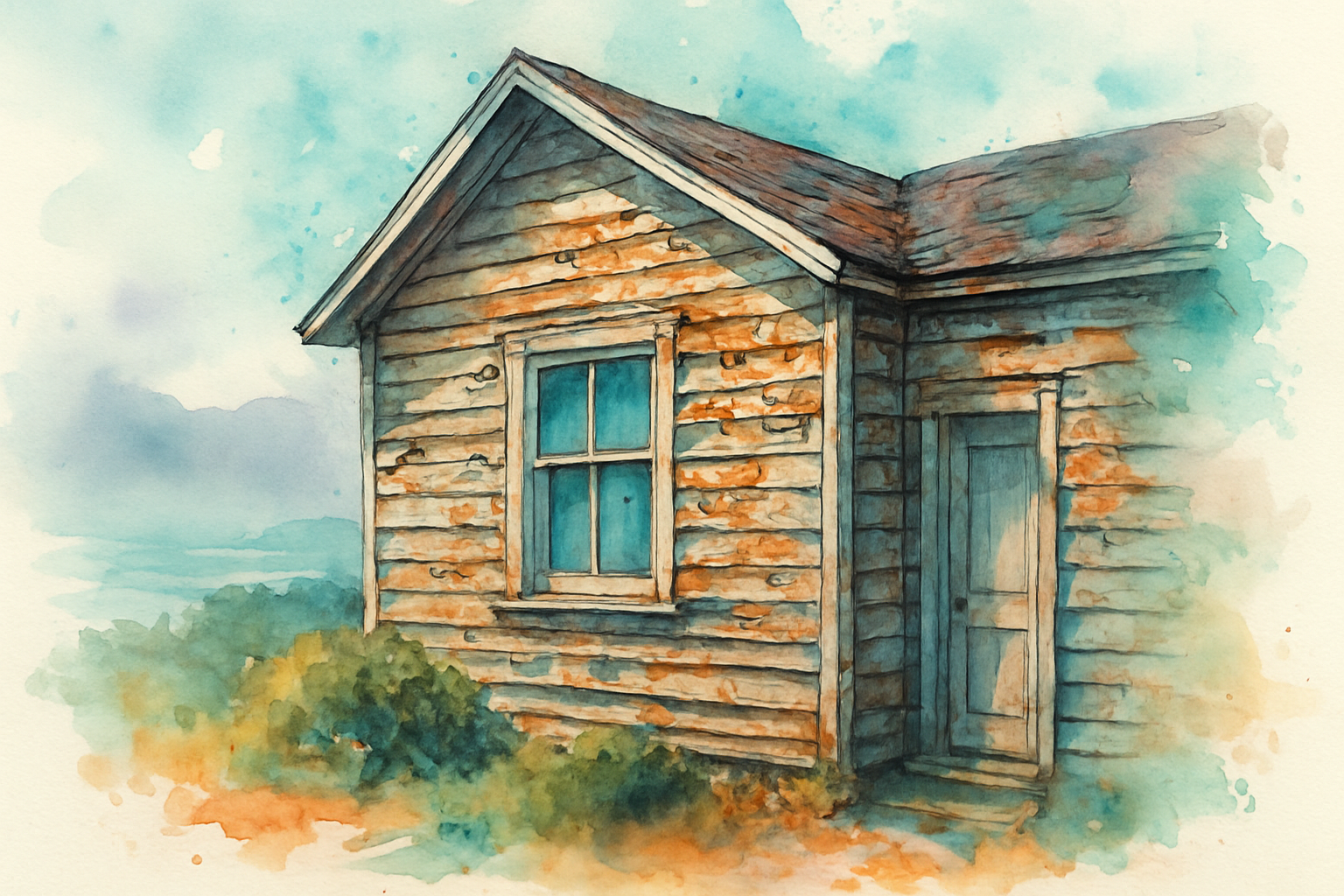
What Failure Actually Looks Like — and What It’s Telling You
Paint doesn’t just ‘look bad’ when it starts failing. Each type of failure pattern is telling you something different about the underlying cause, and reading them correctly changes what you do next.
Peeling in sheets usually points to adhesion failure. This happens when moisture got under the film before or shortly after the paint was applied — often because the surface wasn’t fully dry before painting began, or because a primer wasn’t used on bare or repaired areas. On the Monterey Peninsula, this is especially common when painters schedule exterior work during the wrong window and the marine layer hasn’t fully cleared.
Bubbling or blistering on flat wall sections typically means moisture is escaping outward through the wall. This can come from interior humidity (a house near the ocean with poor ventilation) or from water intrusion behind the siding. The bubbles are actually the paint film lifting as vapor pushes through from behind.
Chalking and fading are the most gradual failure signs. You’ll see this as a dull, powdery residue on the surface that comes off on your hand when you run a finger across it. It means the resin in the paint has broken down from UV exposure, leaving the pigment particles loose. At this stage the paint has lost most of its protective value even if it still looks intact from a distance.
Mildew staining — dark gray or black streaking, often on north-facing walls or beneath overhangs — is biological growth feeding on moisture trapped at or beneath the surface. Painting over mildew without treating it first means it will bleed through a new coat within 6–12 months.
If you’re seeing multiple failure patterns on the same home, the problem isn’t just the paint — it’s usually the prep work that came before it. Understanding what proper surface preparation actually involves is the starting point for any exterior job that needs to last.
Coastal Failure Patterns and What’s Usually Behind Them
These are the most common exterior paint failure patterns on Monterey Peninsula homes, what’s typically causing them, and what the repair path looks like.
| Failure Pattern | Most Likely Cause | What Needs to Happen Next |
|---|---|---|
| Peeling in sheets | Adhesion failure from moisture or skipped primer | Full strip of failed areas, prime bare surfaces, repaint |
| Bubbling or blistering | Moisture vapor escaping outward through wall | Identify and address moisture source, spot repair or full repaint |
| Chalking and fading | UV resin breakdown, paint past its service life | Wash surface thoroughly, apply fresh coat with UV-resistant coating |
| Mildew staining | Persistent moisture with poor airflow | Treat with mildewcide, clean thoroughly before any repainting |
| Cracking at seams and joints | Caulk failure from thermal expansion cycling | Remove old caulk, apply flexible exterior caulk, prime and repaint affected areas |
| Rust stains below fasteners | Ungalvanized nails oxidizing under surface | Set nails, apply metal primer spot treatment, repaint |
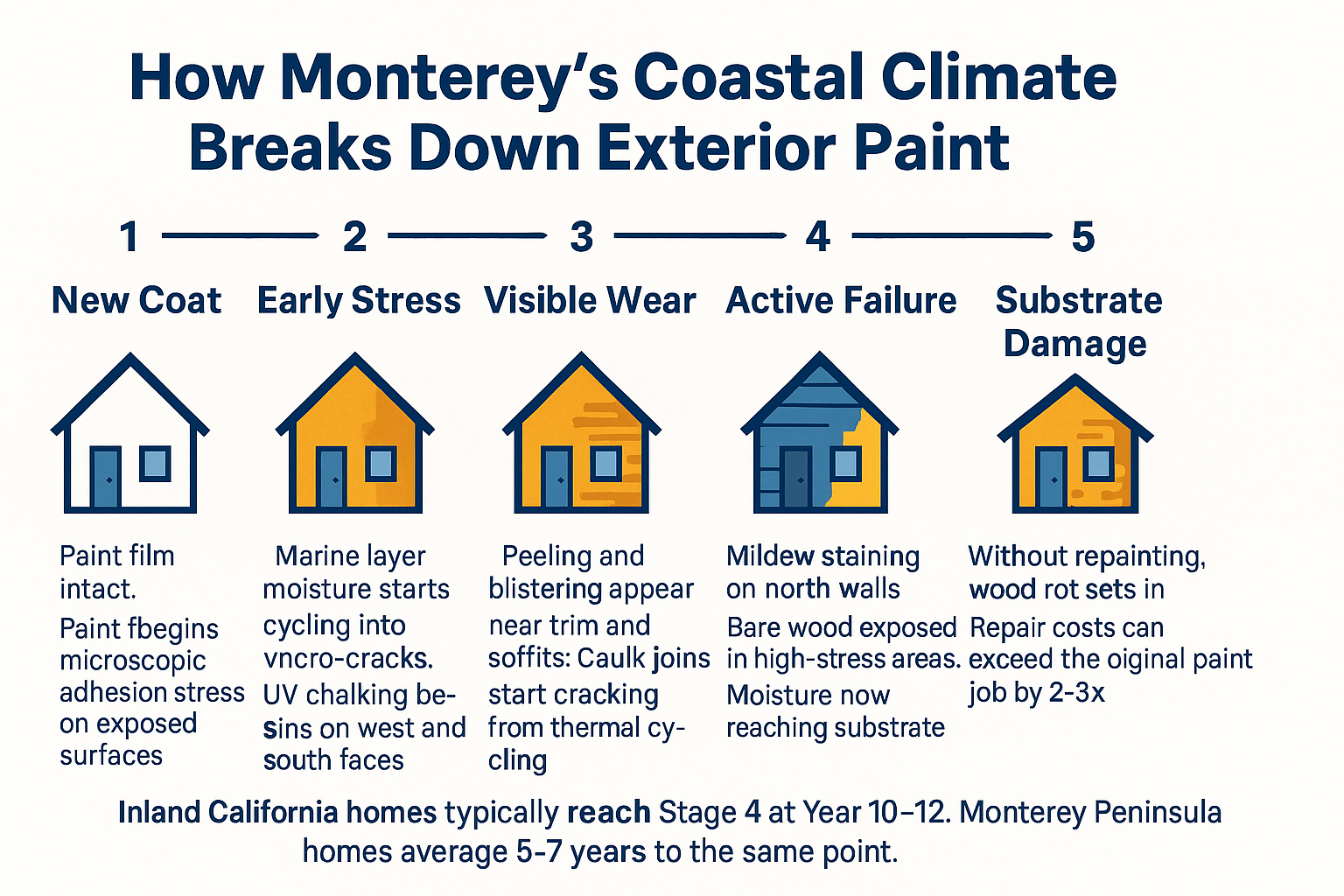
How Monterey’s Climate Breaks Down Exterior Paint Year by Year
This timeline shows what’s typically happening to an exterior paint job on a Monterey Peninsula home from application through the end of its useful life.
Why Surface Prep Is the Deciding Factor in Coastal Paint Longevity
If you’ve had a paint job fail early on a Monterey home, the paint itself is rarely the culprit. The more common reason is that the surface wasn’t in the right condition before the first brush stroke touched it.
In coastal climates, prep work carries a much higher weight than in drier inland areas. A painter working in Bakersfield can get away with a lighter prep process and still see decent results. On the Monterey Peninsula, shortcuts in prep show up within two to three seasons — and once moisture gets behind the film, the only real fix is starting over.
The prep steps that matter most on Central Coast exteriors:
- Pressure washing to remove salt residue, chalk, and loose paint — and allowing full drying time of 48–72 hours before any coating is applied
- Mildew treatment on any stained areas, followed by a clean water rinse
- Scraping and sanding all peeling areas down to a stable surface — not just feathering edges
- Caulking all seams and joints with a flexible exterior caulk rated for temperature cycling
- Spot priming every bare wood area, sanded patch, and repaired section before top coat application
- Full surface priming when the substrate is in compromised condition or when switching paint types
This kind of prep takes time, and that time costs money. A thorough prep phase on a standard two-story home in Monterey or Carmel can add $800–$1,500 to a job estimate compared to a bare-minimum approach. But that prep work is the difference between a paint job lasting 4 years and one lasting 8–10 years.
When you’re comparing bids, ask specifically what the prep process includes. A detailed answer is a good sign. Vague answers — or a price that seems too low to cover the labor — are worth paying attention to. Understanding how to tell a professional painter from someone just calling themselves one can help you ask the right questions before anyone sets foot on a ladder.
Choosing the Right Paint and Timing Your Project Right
Not every exterior paint performs the same way in a coastal environment. The formula matters, and so does when you apply it.
For most Monterey Peninsula homes, 100% acrylic latex exterior paints are the practical standard. They stay more flexible than oil-based alternatives as temperatures cycle, which means they’re better at handling the thermal stress from morning fog and afternoon sun. They also breathe slightly, which helps moisture vapor escape rather than building up behind the film.
For stucco — which is extremely common in Monterey and Pacific Grove — an elastomeric coating is worth serious consideration. These coatings are thicker and more flexible than standard paint, and they can bridge small hairline cracks that would otherwise let moisture in. The best paint for stucco exterior walls on Monterey County homes is a topic worth reading in more detail before committing to a product.
Timing matters as much as product selection. On the Central Coast, the best exterior painting windows are generally:
- Late spring (May–June) before fog season intensifies
- Early fall (September–October) after the marine layer starts thinning out
Avoid painting during peak marine layer months — July and August are consistently the worst months for exterior application in Monterey County, despite being summer. Humidity above 70% at application can prevent proper curing and cause adhesion failures that won’t be obvious until months later.
And if you’re planning other exterior work at the same time — a deck refinish, new outdoor structures, or hardscape — it makes sense to sequence the work intentionally. Painting and renovation projects that share scaffolding access or prep phases can save real money when planned together. The question of whether to tackle the exterior or interior of your home first is worth thinking through before you schedule anything.
Frequently Asked Questions About Exterior Paint and Monterey’s Coastal Climate
How long should an exterior paint job actually last on a home near the Monterey Bay waterfront?
On a well-prepped surface with a quality acrylic paint, 5–8 years is a realistic range for homes within a mile of the water. Homes in more exposed positions — say, on Ocean View Boulevard in Pacific Grove or along Scenic Road in Carmel — should expect to be closer to the 5-year end. Homes further inland in Salinas or Carmel Valley will typically see 8–12 years from the same quality of work.
Can I paint my exterior in July or August in Monterey?
Technically yes, but those are genuinely the worst months to try. The marine layer in July and August keeps relative humidity elevated for most of the morning, and by the time surfaces are dry enough to paint, the afternoon window is short. Paint applied to a surface that’s still holding absorbed moisture won’t cure properly. If you need to paint during summer, work with your contractor to schedule around verified dry days and check morning dew point forecasts.
Is there a paint that won’t peel in salt air?
No paint is immune to salt air over time, but the right product slows the process significantly. High-quality 100% acrylic latex exterior paints with added mildewcide hold up better than standard grades. The brand matters less than the formula — look for products rated for coastal or marine environments. What matters more than product selection, though, is the prep work underneath. A premium paint on a poorly prepped surface will fail faster than a mid-grade paint on a properly cleaned, primed, and caulked surface.
My paint is fading badly but not peeling. Does the whole house need to be repainted, or can I just touch it up?
If the chalking is widespread — meaning the resin has broken down across most of the surface — spot touching up won’t match and won’t restore the protective value of the coating. At that stage, a full repaint is the practical answer. But before any paint goes on, the chalky surface has to be thoroughly washed and abraded so the new coat has something to bond to. Painting over chalked paint without cleaning it first is one of the most common reasons early failures happen.
What’s the actual cost difference between a quality prep job and a minimal one?
On a typical single-story home in Monterey County, thorough prep — pressure washing, mildew treatment, full scraping, caulking, and priming — adds roughly $800–$1,500 over a bare-minimum approach. Over a 10-year period, that cost difference is almost always recovered because the paint job lasts 3–4 years longer before needing to be redone. The math tends to favor doing it right the first time, especially given what labor and materials cost on the Central Coast.
Does wood siding need different treatment than stucco in a coastal climate?
Yes, meaningfully so. Wood siding expands and contracts more than stucco, and it’s far more vulnerable to moisture absorption. It typically needs a penetrating primer before any topcoat, and all end grains and cut edges need to be sealed carefully — those are the entry points where moisture does the most damage. Stucco is more dimensionally stable but develops hairline cracks over time that can let moisture in; that’s where elastomeric coatings earn their cost premium. The two substrates need different product selections and slightly different prep sequences.
Want an Honest Assessment of What Your Exterior Actually Needs?
Legacy Painting and Renovating works with homeowners across the Monterey Peninsula — from Pacific Grove and Carmel to Salinas and Carmel Valley — and coastal exterior conditions are something our team deals with on every single job. If your paint is showing early signs of failure or you’re trying to plan ahead before the next paint cycle, we’re glad to take a look and give you a straight answer. Reach out by phone at (831) 917-0047 or through the contact form at legacypaintingrenovating.com to schedule a free estimate.