Direct Answer: High-traffic areas need a paint with a higher sheen — satin or semi-gloss — plus proper prep and a quality formula. Flat paint scuffs, stains, and can’t be cleaned without damage.
If you’ve repainted your hallway or entryway within the last two years, you’re not doing anything wrong — you’re just living with the wrong paint. High-traffic areas fail faster than the rest of your home, and most of the time, the problem isn’t the painter. It’s the product and the prep.
This is especially true in coastal Monterey County homes, where entryways and mudrooms deal with more than just foot traffic. The marine layer moisture that rolls in off Monterey Bay gets tracked inside on shoes, coats, and bags — and it clings to walls near doorways. That combination of humidity, skin oils, and daily contact accelerates paint breakdown faster than in a dry inland house.
If your paint is scuffing, staining, or going dull in spots you touch every day, this article explains what’s actually happening — and what changes it.
The Sheen Problem Most Homeowners Don’t Catch Until It’s Too Late
The single most common mistake in high-traffic rooms is using flat paint in spaces that need to be cleaned regularly. Flat finish has zero sheen and a porous surface texture — it absorbs stains instead of resisting them, and scrubbing it even gently tends to leave visible dull patches or remove the paint entirely.
Flat paint has its place. Ceilings, formal living rooms, and master bedrooms where walls rarely get touched are all good candidates. But a hallway, foyer, kids’ room, or kitchen — anywhere with daily hand contact, backpack drag, or pet activity — needs something higher on the sheen scale.
Here’s a plain-English breakdown of the sheen spectrum:
- Flat / Matte — No sheen. Hides imperfections well. Zero washability. Best for low-traffic rooms and ceilings.
- Eggshell — Slight glow. Marginally more cleanable. Works in bedrooms and dining rooms with light traffic.
- Satin — Soft, velvety sheen. The sweet spot for most living spaces, hallways, and kids’ rooms. Cleans with a damp cloth without damaging the surface.
- Semi-gloss — Noticeably shiny. Built for bathrooms, trim, and doors. Moisture-resistant and durable. Shows surface flaws more clearly.
- High-gloss — Very shiny and very durable. Rarely used on walls. Common on trim and baseboards where maximum hardness matters.
For most Monterey County homeowners repainting a hallway or entryway, satin is the right starting point. If the space is near an exterior door — like a mudroom or foyer — bumping up to semi-gloss on the lower half of the wall adds meaningful moisture resistance.
Why Coastal Entryways Are Their Own Category
A mudroom or entry hall in Pacific Grove or Seaside faces conditions that most interior paint isn’t designed for. The marine layer doesn’t stay outside. It comes in on wet shoes after a morning beach walk, on damp jackets after fog-heavy commutes, and on dogs who’ve been rolling in the dunes at Del Monte Beach.
That ambient humidity near entry points creates a wall environment that hovers between interior and exterior conditions — especially in older Peninsula homes with less insulation between the door frame and the wall surface. Walls in these zones absorb and release moisture through repeated daily cycles, and standard interior paint doesn’t always handle that expansion and contraction well over time.
For these specific areas, look for interior formulas that list moisture resistance or mildew resistance on the label — these are not just for bathrooms. Some homeowners in coastal communities have also had good results specifying the same low-VOC, CARB-compliant coatings used for rooms with poor ventilation. These formulas tend to cure to a harder film, which holds up better against repeated contact. Monterey’s coastal climate creates these same demands on exterior surfaces — but the entry zones of your home deserve the same level of product thought.
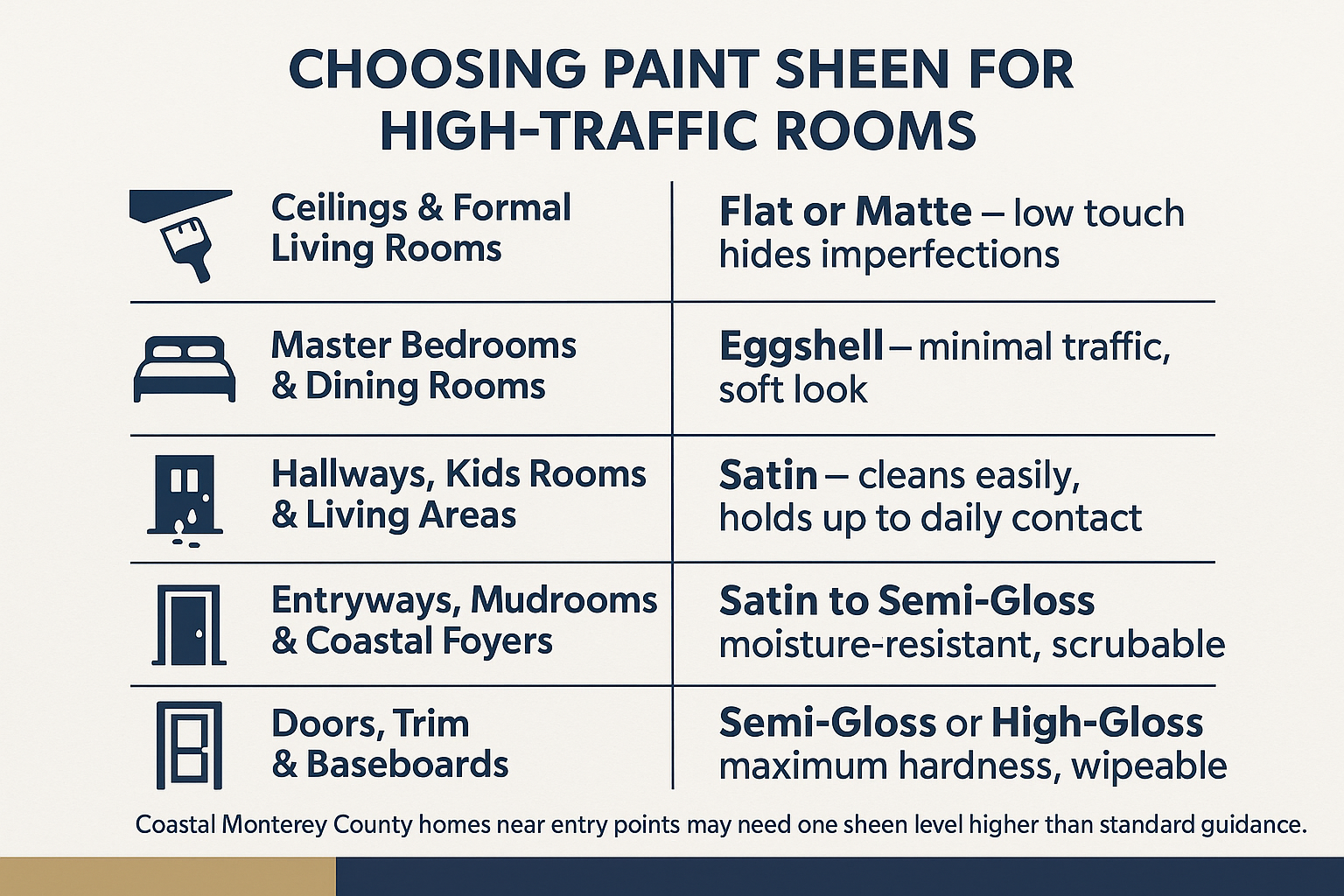
Sheen vs. Room: A Quick Reference for High-Traffic Spaces
This reference chart shows which sheen level fits which room type, and why — based on traffic level, cleaning needs, and coastal conditions.
The Prep Work That Actually Determines How Long the Paint Lasts
Most homeowners who repaint a high-traffic room every two or three years aren’t using bad paint — they’re skipping the prep that makes paint bond and hold. Walls in hallways, kitchens, and foyers accumulate grease, skin oils, airborne cooking residue, and surface contamination over time. New paint applied directly over that layer doesn’t bond to the wall — it bonds to the grime. And that layer eventually separates.
The prep sequence that actually matters in high-traffic zones:
- Cleaning — Walls should be washed with a degreasing cleaner, not just wiped down. TSP (trisodium phosphate) or a TSP substitute cuts through oil-based contamination that plain water misses.
- Light sanding — Scuffed or shiny areas need to be dulled so the new paint has something to grip. This is especially important over existing semi-gloss or gloss surfaces.
- Spot repairs — Dings, nail holes, and corner damage in high-traffic areas tend to be more numerous. Skipping repairs means paint lays unevenly and those spots fail first.
- Priming — A bonding primer is not optional when painting over a heavily soiled surface, a drastically different color, or a wall that had repairs made to it. It creates the anchor layer that holds everything above it in place.
This is exactly what separates a professional paint job from a weekend DIY job in these zones. The prep adds time upfront — but it’s the difference between a finish that looks good in six months and one that still looks good in six years.
Paint Quality Tiers: What You’re Actually Paying For
There is a real and meaningful difference between contractor-grade paint and premium interior lines — especially in high-traffic rooms where that difference shows up on the wall within a year.
| Paint Tier | Typical Characteristics | High-Traffic Performance |
|---|---|---|
| Contractor / Builder Grade | Thinner formula, lower pigment density, adequate hide on fresh surfaces | Scuffs and stains more readily; may need repainting in 2-3 years in heavy-use zones |
| Mid-Range Interior | Better scrub resistance, improved hide, available in a full sheen range | Holds up to regular cleaning; a reasonable choice for most living areas |
| Premium Interior Lines | Higher resin content, significantly better scrub resistance, better moisture tolerance, deeper color retention | Best suited for hallways, entryways, kids’ rooms, and coastal foyer walls; repaints avoided over a 5-7 year window |
| Specialty Formulas (moisture-resistant, low-VOC/CARB-compliant) | Designed for demanding environments; cure to a harder film | Worth specifying for Pacific Grove, Seaside, or Marina homes with high entry-zone humidity |
What the Price Gap Between Paint Tiers Actually Means Over Time
One of the most common hesitations homeowners have is paying more for premium paint when the cheaper option covers the same square footage. But in high-traffic areas specifically, the cost math shifts when you count repaints.
If a lower-grade product in a hallway needs repainting every two to three years, and a premium formula in the same space holds for five to seven, the premium option pays for itself before the third year — and that’s before accounting for the cost of labor. Paint is typically the smallest line item on a professional paint job. Spending more on product in the rooms that take the most abuse is almost always the better trade.
That said, not every room in your home needs the most expensive formula. A practical approach is to tier your product choices by traffic level — save the premium line for hallways, entryways, kids’ rooms, and kitchen walls, and use a solid mid-range formula in lower-traffic bedrooms and guest rooms. Choosing the right finish for your kitchen cabinets follows similar logic — the surfaces that get touched every day are worth the upgrade.
Frequently Asked Questions About Paint in High-Traffic Areas
Can I just use semi-gloss everywhere to avoid the problem?
You can, but it comes with trade-offs. Semi-gloss reflects light and shows every surface imperfection — nail pops, texture variations, uneven mud work — in a way that satin and eggshell hide. Most painters recommend saving semi-gloss for trim, doors, and bathrooms, and using satin on walls in high-traffic rooms. It gives you washability without the harshness of a very shiny finish.
My hallway paint is scuffing badly but it’s only a year old. What went wrong?
A few common causes. First, the finish may be flat or eggshell — both are too porous for high-contact zones. Second, the walls may not have been properly cleaned and primed before painting, so the new coat never bonded fully. Third, the product itself may be a lower-grade formula with limited scrub resistance. Any one of these is enough to cause early failure.
Does the Monterey coastal climate actually affect interior paint?
Yes — particularly near entry points and exterior-facing walls in older homes. The marine layer brings real moisture into entryways, mudrooms, and foyers on a daily basis, especially in communities like Pacific Grove, Seaside, and Marina. That moisture cycling stresses paint film over time. In these specific zones, specifying a moisture-resistant interior formula in a satin or semi-gloss finish makes a meaningful difference in how long the paint holds.
How do I know if my walls need primer before repainting a high-traffic room?
If any of these apply, use a bonding primer: the current color is very dark or very saturated, you’ve made drywall repairs, the surface is greasy or stained, or the existing paint has a high-gloss sheen. Primer isn’t always required, but skipping it in high-traffic rooms is one of the most common reasons repaints don’t last.
Is there a sheen difference between eggshell and satin that’s worth knowing about?
Yes — the difference between eggshell and satin is more significant than most people realize, especially in terms of washability and moisture resistance. Satin has a noticeably higher sheen and scrubs without damage. Eggshell is softer-looking but far more delicate when cleaning. For high-traffic walls, satin is the better choice in nearly every case.
What does professional prep actually involve beyond cleaning the wall?
Real prep in a high-traffic room includes degreasing the wall surface, light sanding of shiny or scuffed areas, patching all dings and holes, and applying primer where needed. It also includes protecting floors, trim, and adjacent surfaces before a single drop of paint goes on. The prep work often takes as long as the painting itself — and it’s the part that determines how long the result lasts. Rushing it is where most DIY paint jobs lose the durability battle.
Want Paint That Actually Holds Up in Your Home?
Legacy Painting and Renovating works with homeowners across Monterey County — from Pacific Grove to Salinas to Carmel Valley — who are tired of repainting the same hallway every couple of years. If you want an honest look at what’s causing early paint failure in your home and what prep and product choices would actually fix it, reach out to the team at (831) 917-0047 or through the contact form at legacypaintingrenovating.com.