Direct Answer: Before booking any exterior painter, verify their CSLB license, get a written estimate with prep details spelled out, and ask how they handle Monterey’s coastal conditions and older homes.
Most homeowners shopping for an exterior painter on the Monterey Peninsula aren’t just looking for a price. They’ve usually had a contractor let them down before — someone who disappeared mid-job, left a mess, or delivered work that started peeling inside of two years. The questions they ask me when they call or fill out our contact form say the same thing over and over: How do I know I’m hiring someone who will actually do this right?
That’s exactly the right instinct. And on the Central Coast, where salt air, marine layer humidity, and constant fog-to-sun cycles put exterior paint under real stress, the difference between a contractor who understands the local environment and one who doesn’t shows up fast — usually in the form of early peeling, chalking, or mildew.
These are the questions worth asking before you book anyone. Not to be difficult, but because a contractor who can answer them clearly is almost certainly a contractor worth hiring.
Start Here: License and Insurance Verification
I’ll be direct about this — fewer homeowners check a contractor’s license than should. California makes it genuinely easy. The CSLB license lookup at www.cslb.ca.gov takes about 30 seconds, and it tells you everything you need to know.
Here’s what to look for when you pull up a contractor’s record:
- License status should say “Active” — not expired, suspended, or in process
- Classifications should match the work you’re hiring for (a painting contractor holds a C-33 license)
- Bond and workers’ comp status shows whether their crew is covered if someone gets hurt on your property
Why does this matter so much locally? Older homes throughout Carmel, Pacific Grove, and the Monterey waterfront involve real technical complexity — dry rot, failing stucco, multi-layer paint systems going back decades. If an unlicensed contractor does shoddy work or someone gets hurt on your property, you may be held liable. That’s not a hypothetical. California law places real exposure on homeowners who knowingly hire unlicensed contractors.
Ask for the license number up front. Any legitimate contractor gives it without hesitation. We list ours — CSLB #1066829 — on every estimate and on our website. If someone gets cagey about it, that’s your answer.
Also ask specifically: Do you carry general liability and workers’ comp for your crew? Get the certificate, not just a verbal answer. This is especially worth confirming if a contractor uses subcontractors — make sure the coverage follows the actual workers on your job.
What a Real Exterior Painting Estimate Should Say
One of the most common situations I hear about is a homeowner who got three estimates, picked one, and only discovered mid-project what wasn’t included. A vague estimate is how disputes start.
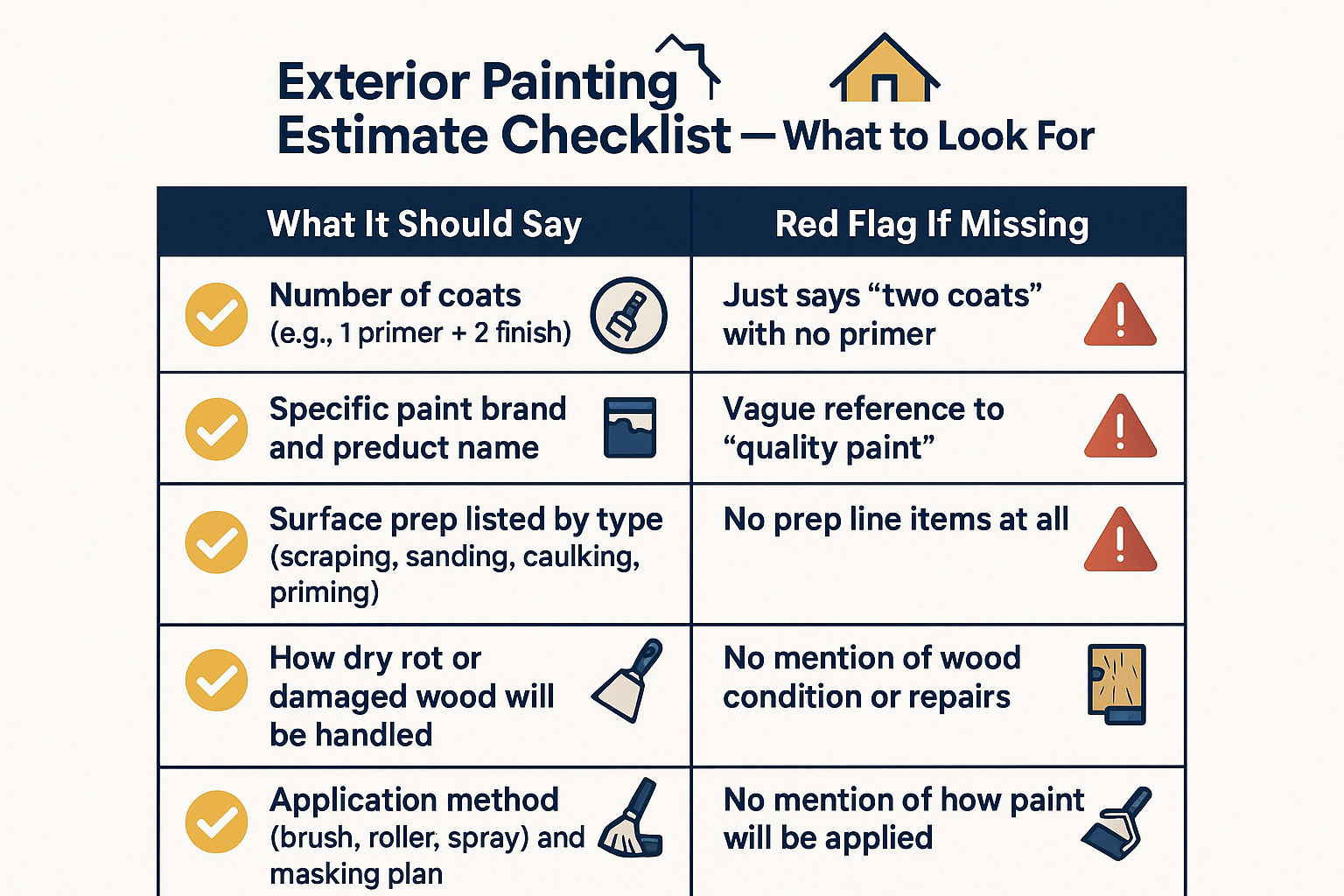
A written estimate for exterior painting should spell out all of the following:
- Number of coats — one coat and two coats are not the same job
- Specific products being used — brand and product line, not just “premium exterior paint”
- What surface prep is included — scraping, sanding, caulking, priming, and which of these are line items
- How damaged wood or dry rot will be handled — will it be repaired, replaced, or excluded?
- What “clean up” means — at the end of each day, and at the end of the project
- Application method — brush, roller, or spray, and whether adjacent areas will be masked
An estimate that reads “paint exterior of home, two coats, $X” leaves enormous room for misunderstanding. If caulking isn’t listed, it probably won’t happen. If primer isn’t called out, don’t assume it’s included.
One homeowner who reached out to us had gotten estimates that varied by several thousand dollars — and couldn’t figure out why. Often that gap comes down to prep. One contractor is pricing full prep; another is pricing paint-over-existing. Understanding what proper prep involves is worth reading before you compare numbers.
Ask every contractor the same question: Walk me through what your crew will do before a single drop of paint goes on. The answer tells you more than the price does.
What Every Exterior Painting Estimate Should Include
Use this as a checklist when reviewing estimates from any exterior painting contractor on the Monterey Peninsula.
Coastal Prep: The Question Most Homeowners Don’t Think to Ask
This is where Monterey County is genuinely different from most other markets, and it’s the part of the conversation where you learn the most about a contractor fast.
Salt air attacks bare wood, stucco, and trim faster than almost anything else. Homes near the water in Carmel, Pacific Grove, and along the Monterey waterfront regularly show chalking surfaces, mildew growth, and moisture-related paint failure that inland homes simply don’t see at the same rate. The effects of Monterey’s coastal climate on exterior paint are real and documented — this isn’t an upsell, it’s just physics.
Proper prep for a coastal exterior typically involves:
- Pressure washing to remove salt deposits, mildew, and chalking
- Mildewcide treatment on affected areas before priming
- Thorough caulking of all gaps, joints, and penetrations to block moisture infiltration
- Spot priming or full prime coats on bare or porous surfaces
- Dry rot identification and repair before any finish coat goes on
And then there’s the timing question, which almost no homeowner thinks to raise: What time of day do your crews start exterior work, and how do you check surface conditions before painting?
Monterey’s marine layer means surfaces stay damp well into the morning hours. Painting on a damp surface causes adhesion failure — it’s not about what you can see, it’s about dew point and surface temperature. A contractor who doesn’t mention this probably hasn’t thought about it. The answer I give is straightforward: we check surface conditions before the crew starts, and we don’t paint on damp substrate. If the marine layer held overnight, we wait.
For stucco homes specifically — and there are a lot of them in Salinas and Seaside — choosing the right paint for stucco matters as much as the prep work itself. Ask the contractor what product they’re recommending and why it’s right for your substrate and your proximity to the coast.
Coastal Prep vs. Standard Prep: What Changes
This shows how exterior prep requirements shift for homes on the Monterey Peninsula compared to typical inland conditions.
| Prep Step | Standard Exterior | Coastal / Monterey Peninsula |
|---|---|---|
| Pressure washing | Standard rinse | Salt deposit and mildew-focused wash |
| Mildewcide treatment | As needed | Recommended on most coastal exteriors |
| Caulking | Visible gaps only | All joints, penetrations, and transitions |
| Primer application | Spot prime bare areas | Full prime coat common on coastal wood and stucco |
| Surface moisture check | Rarely discussed | Critical — dew point and timing matter here |
| Dry rot inspection | Addressed if visible | Active inspection before any work begins |
If Your Home Was Built Before 1978, Ask This Before Anything Else
We had a homeowner reach out describing extensive paint cracking and peeling on the exterior of their older home — and they mentioned they believed it might be lead paint. That’s a situation that needs a specific conversation before any work begins.
Homes built before 1978 have a real probability of containing lead-based paint. On the Monterey Peninsula, where a significant portion of the housing stock dates to the mid-20th century or earlier, this is not a rare edge case.
When lead paint is disturbed — through scraping, sanding, or pressure washing — it creates dust and debris that carry genuine health risks, particularly for children and pregnant women. Federal law requires contractors who disturb lead paint in pre-1978 homes to follow EPA Renovation, Repair, and Painting (RRP) protocols. This includes:
- RRP certification for the contractor and crew members doing the work
- Containment of the work area to prevent lead dust from spreading
- Proper disposal of lead-contaminated debris
- Post-work cleaning and verification before the area is released
Ask any contractor you’re considering: Are you RRP-certified, and how do you handle lead paint on older homes? If they brush it off or say it’s not a big deal, take that seriously. Disturbing lead paint without proper protocols isn’t just a health issue — it carries legal consequences for the contractor and can create liability exposure for the homeowner as well.
This connects to a broader point about hiring contractors for older coastal homes. The more complex the history of a house, the more the prep conversation matters. A detailed look at what separates professional painters from everyone else is worth reading if you’re still comparing options.
Frequently Asked Questions About Hiring Exterior Painting Contractors in Monterey
How do I verify a painting contractor’s license in California?
Go to www.cslb.ca.gov and use the license lookup tool. Enter the contractor’s name or license number. You want to see Active status, a C-33 classification for painting, and current bond and workers’ comp coverage. It takes about 30 seconds and is completely free.
What should I expect to pay for exterior painting on the Monterey Peninsula?
Costs vary based on home size, substrate type (wood vs. stucco), the extent of prep work needed, and product choices. Many Monterey County homeowners see estimates ranging somewhere in the low thousands for a smaller single-story home to considerably more for a large two-story with extensive prep needs — but I’d be misleading you to name a number without knowing your specific situation. The best move is to get two or three written estimates that each spell out prep in detail, then compare them line by line rather than just comparing the bottom number.
Is one coat of exterior paint ever enough?
Rarely, and almost never on a coastal home. One finish coat over bare or previously painted surfaces that haven’t been primed properly will not hold up — especially with the UV exposure and salt air that homes in Carmel, Pacific Grove, and Monterey deal with year-round. Two finish coats over a primer is the standard I’d expect any reputable contractor to propose.
What time of year is best for exterior painting in Monterey County?
Late spring through early fall tends to work well — roughly May through September — when the marine layer typically burns off by mid-morning and afternoon temperatures are stable. That said, Monterey’s weather is mild enough that exterior painting can happen most of the year. What matters more than season is daily timing and surface conditions: painting on a damp surface from overnight fog causes adhesion failure regardless of what month it is.
Do I need a permit for exterior painting in Monterey or Salinas?
Standard exterior repaints generally don’t require a permit. But if the project involves significant wood replacement, structural repairs, or work on a historically designated property, that can change. Pacific Grove in particular has a number of homes with historic designations that come with their own review requirements. It’s worth a quick call to your local building department if you’re unsure — and any contractor working on an older home should be able to point you in the right direction.
How do I know if a contractor is actually doing proper prep or just skipping it?
Ask before the job starts: Can you walk me through exactly what happens before paint goes on? Then watch the first day or two. Proper prep takes time — scraping, sanding, caulking, and priming a coastal home correctly is not a half-day job. If a crew is rolling on finish coats by mid-morning of day one, something got skipped. A contractor confident in their prep work won’t mind you asking to see it.
Have Questions About Your Exterior Before You Get Estimates?
If you’re comparing exterior painting contractors in Monterey County and want to talk through what your home actually needs before committing to anything, Legacy Painting and Renovating is happy to take a look. You can reach us by phone at (831) 917-0047 or through the contact form at legacypaintingrenovating.com — we serve homeowners throughout Monterey, Pacific Grove, Carmel, Salinas, and the surrounding Peninsula communities.