Direct Answer: A cured garage coating is hard and inert, so a dog walks on it like sealed concrete. The fume concern belongs to the wet install window, not the finished floor.
If you have dogs and you are thinking about coating your garage floor, you have probably read something online about epoxy fumes and gotten nervous. That worry is fair. But most of what is written about it lumps together two completely different things: the wet product during application and the hard floor that exists a few days later.
A homeowner planning a new build in Carmel reached out to us asking for a garage coating that was not toxic and safe for dogs, saying they wanted to avoid off-gassing epoxies. It was the clearest version of a question we hear in softer forms all the time.
So here is the honest breakdown. I will walk through what actually comes off the product and when, why a Monterey Peninsula garage makes ventilation harder than people expect, and the three questions that will tell you in about ten seconds whether a contractor really knows their product.
The Cured Floor and the Install Window Are Two Different Questions
Once a floor coating has fully cured, the chemistry is finished. The resin and hardener have reacted into a solid, and what is left is a hard, inert surface. Your dog walks on it the same way it walks on sealed concrete or a tile entryway.
There is no slow leak of fumes from a properly cured floor sitting in your garage months later. The smell people describe is solvent and uncured resin vapor, and it exists while the product is wet and during the hours right after.
That means the real question is not “is this coating safe for my dog.” It is:
- How strong is the smell while it goes down, and how long does it last?
- When does the manufacturer say people and pets can re-enter the space?
- Where does the dog stay in the meantime?
- What gets done to vent the garage so the vapor leaves instead of sitting?
I would rather give a homeowner a clear timeline than the word “safe.” Precision is what actually settles the worry. A dog that spends two nights sleeping on the far side of the house is not having a chemistry problem, it is having a scheduling one, and scheduling is something you can plan around.
“Non-Toxic” Is a Marketing Word. VOC Numbers Are Not.
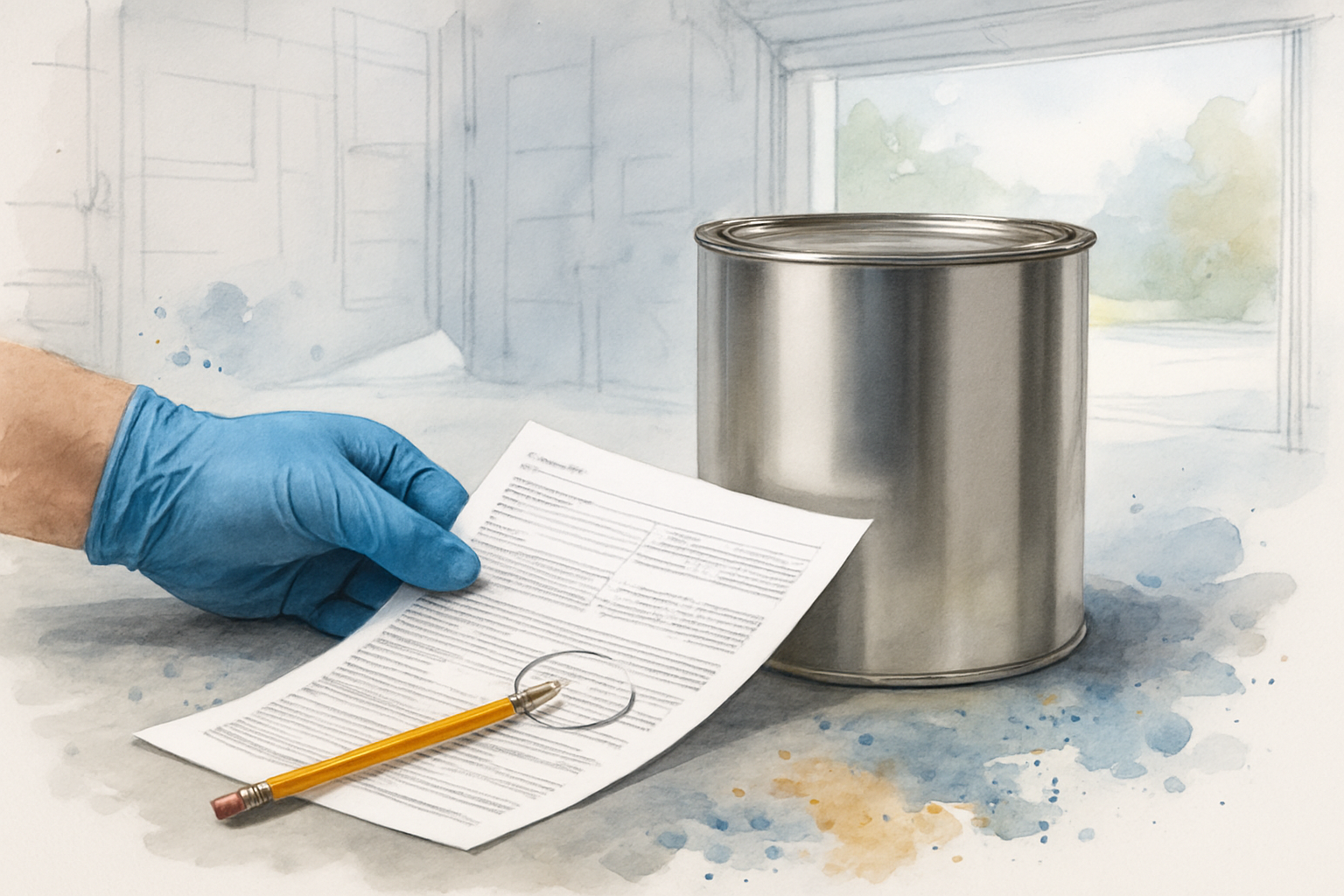
Any contractor can tell you a product is non-toxic, because the phrase has no fixed definition. Two things do have meaning, and both are printed on paper you can ask to see.
The first is VOC content, measured in grams per liter. VOCs are the volatile compounds that evaporate out of a wet coating and make up the smell you are worried about. Lower number, less vapor.
The second is the manufacturer’s re-entry time and full cure time. Those are published for a reason, and a crew that works with a product every week knows them without looking.
California already sets limits here, which is a piece of context most national “is epoxy toxic” articles skip entirely. State air quality rules cap architectural coatings by category, and floor coatings are limited to 100 grams per liter of VOC content. A product sold and applied legally in Monterey County is a different animal from the solvent-heavy industrial coatings people read about online.
So ask any contractor these three questions:
- What exact product are you using? Brand and system, not “epoxy.”
- What is the VOC content in grams per liter? It is on the data sheet.
- What does the manufacturer say about re-entry time? For people and for pets.
We select low-VOC and CARB-compliant coatings as a standing part of how we pick materials, so these questions are easy ones. A contractor who waves them off and says not to worry is telling you something.
What Is in the Air at Each Stage, and Where the Dog Should Be
Timelines shift with product, temperature, and how much prep your slab needs. This is a general picture of how a two-car garage coating tends to run.
| Stage | What is in the air | Where pets should be |
|---|---|---|
| Grinding and prep | Fine concrete dust, no coating vapor yet | Out of the garage and away from the interior door |
| Base coat application | Strongest solvent odor of the project | Inside the house with the garage door to the house shut, or off site |
| First several hours after coating | Odor fading as the film sets | Still out of the garage entirely |
| Topcoat and overnight | Mild residual odor, drops steadily | Out of the garage, house side is normally fine |
| After manufacturer re-entry time | Little to no detectable odor | Paws back on the floor once the installer confirms it |
| Full cure | Nothing. Hard, inert surface | Normal use, no restrictions |
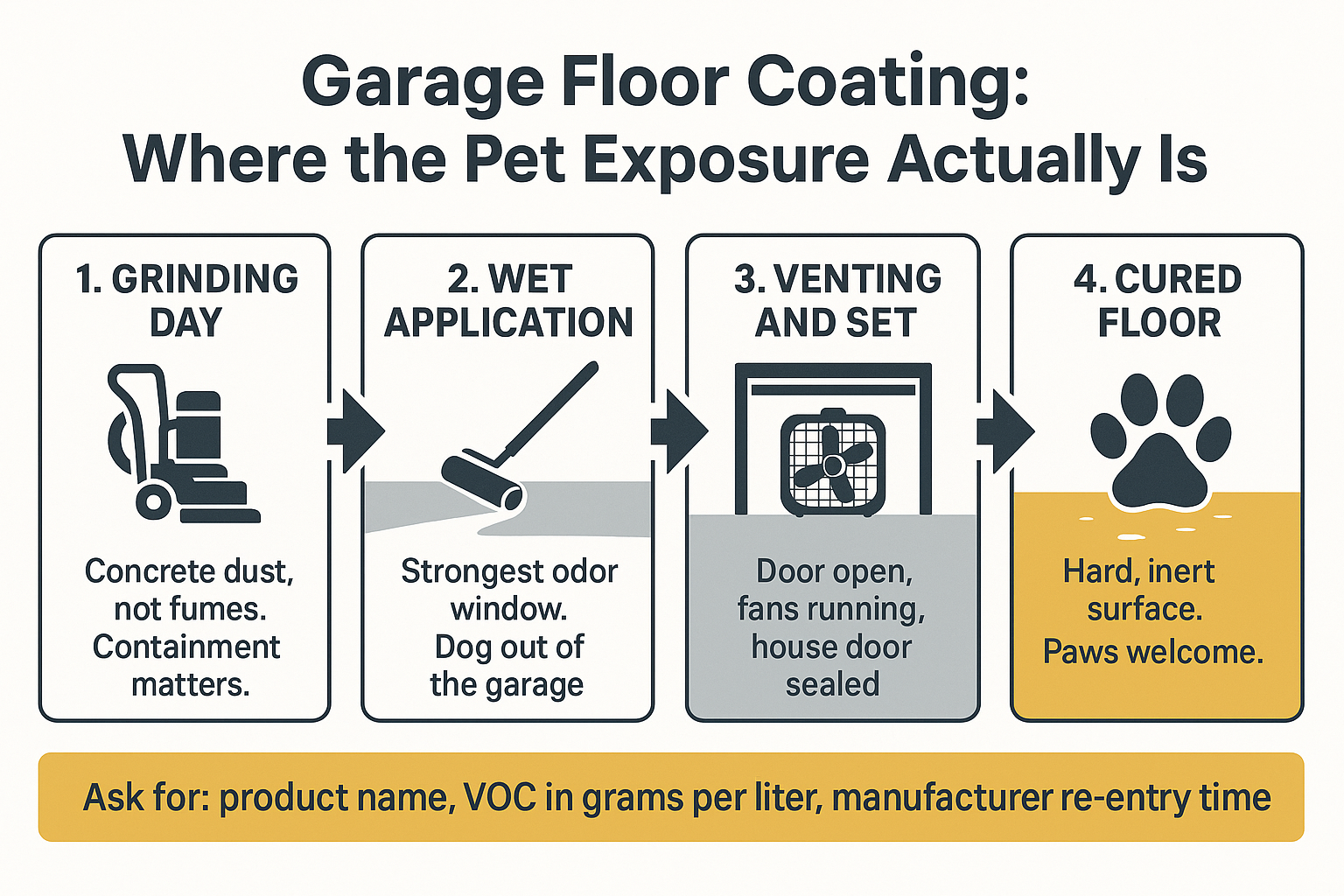
The Pet Owner’s Garage Coating Timeline
A simple view of where the exposure actually sits across a typical install week.
The Garage Is the Worst Ventilated Room in Your House
This is the part that changes the math more than product choice does. A garage usually has one big door, maybe one small window, and a sealed door into the living space. Close it up and vapor has nowhere to go.
Now add a Peninsula morning. Cool, damp marine layer air slows evaporation, and on a foggy day in Seaside or Pacific Grove the instinct is to keep that door down. That single decision traps solvent vapor longer than any difference between two product brands.
A real ventilation plan on a job like this looks like:
- Garage door open for a set number of hours, not “cracked for a bit”
- Fans positioned to push air out the opening, not just stir it around
- The interior door to the house taped or sealed so nothing migrates into the hallway
- Timing the application for the drier, warmer part of the day rather than first thing in the fog
- A clear plan for where the dog goes, whether that is the back of the house, a yard, or a day away
Several homeowners who have contacted us about garage coatings also asked about moving stored belongings in and out, which tells you exactly what these spaces are: packed, single-door rooms with one path for air. Plan for that and the week goes smoothly.
Concrete Dust Is the Half of This Nobody Mentions
Fumes get all the attention, but if you have animals in the house, the prep stage deserves just as much of it. Before any product comes out of a bucket, the slab gets diamond ground to open the concrete so the coating can bond.
That throws fine concrete dust, and fine dust travels. It lands on paws, gets tracked into the laundry room, and settles on whatever was stored along the garage walls.
One buyer in Monterey came to us with older garage concrete that clearly needed grinding before anything could go on it. Another had an eleven-year-old amateur coating that had to come off first, which is more grinding, not less. Both of those are normal, and both are dusty.
What containment should look like:
- Vacuum-attached grinding equipment, capturing dust at the head instead of after it is airborne
- Plastic sheeting taped at the interior door to the house
- Stored items moved out or sealed, not just shoved to one side
- HEPA vacuum cleanup before any coating is applied
If you want the full picture of that stage, I wrote more about what happens to your garage floor before the epoxy goes on, and there is a separate piece on redoing a garage floor that was already painted or coated if that is your situation.
One Note on Cure Speed, Then Back to the Point
Faster-curing systems shorten the window your dog is displaced. That is the honest connection between system choice and pet planning, and it is about scheduling, not toxicity.
If you want the full comparison of how long before you can walk and park on a new floor, that lives in a separate article on cure time and when you can park on a new garage floor. For this question, the only thing that matters is the number of hours between “wet” and “your dog can walk on it,” and your installer should give you that number before the job starts.
What to Get in Writing Before Anyone Starts
Before the first grinder runs, I would want these spelled out in the proposal or in an email:
- The specific product and system, by name
- VOC content from the data sheet
- Manufacturer re-entry time and full cure time
- The ventilation plan, including how long the garage door stays open
- Dust containment method for the grinding stage
- The day-by-day schedule, so you know when the dog needs to be elsewhere
None of that is an unusual request, and a crew that does this work regularly can answer it on the spot. If the numbers vary between bids, it is usually prep scope and product grade driving it, which I covered in more detail in what changes the price on garage floor coating quotes.
Frequently Asked Questions About Garage Coatings and Pets
How long after the floor is coated can my dog walk on it?
Go by the manufacturer’s stated re-entry time for the specific product, not a general rule. It commonly lands in the 24 to 72 hour range for foot traffic, but temperature and the coastal humidity we get on the Peninsula can stretch it. Ask your installer for the number before the job starts and plan the dog’s week around it.
Will my dog smell the floor for weeks after?
No. Once the coating has cured, the reaction is done and there is nothing left to evaporate. A lingering smell weeks later usually points to something that did not cure properly, which is worth a call to the installer.
Is one coating system genuinely safer for pets than another?
The practical difference is how fast it cures, which shortens how long your pet is kept out of the space. Any floor coating sold legally in California already sits under the state VOC cap for its category, so the bigger variables are ventilation and timing, not brand.
Does a low-VOC product cost more?
Product grade is one of several things that moves a garage coating price, along with slab condition, how much grinding is needed, and square footage. Costs vary quite a bit across Monterey County, so the only reliable number comes from an on-site look at your slab.
Can I just stay in the house while they work?
Usually yes, as long as the interior door to the garage stays sealed and the garage door stays open with fans running. If anyone in the house is sensitive to odors, or your dog’s crate sits against the shared garage wall, it is worth being out for the application day.
Planning a Garage Coating Around Pets in Monterey County?
If you are working out the timing for a household with animals, you should expect a contractor to name the product, give you re-entry timing before the job starts, and stay reachable while the work is happening. One garage coating client in the area put it simply in a review: “He was a good communicator and easy to deal with.” Legacy Painting and Renovating is available at (831) 917-0047 or through the contact form at legacypaintingrenovating.com for homeowners who want that conversation before they decide.