Direct Answer: As of January 1, 2026, California law requires contractors to email you a signed copy of your home improvement contract within 24 hours and disclose in writing whether subcontractors will do the work.
Most Monterey County homeowners have no idea that two new California laws took effect on January 1, 2026, and both of them directly affect what any contractor, painter, remodeler, or otherwise, is legally required to give you before a single person shows up to work on your home.
I’ve had customers ask me what a contract is supposed to look like, or whether it’s normal that a contractor asked for a large chunk of money upfront before the job even started. These aren’t unusual questions. Too many homeowners have been burned by contractors who operated on a handshake, sent nothing in writing, and disappeared when things went sideways.
The laws I’m walking through here, AB 1327 and SB 517, don’t change how good painting or renovation work gets done. What they do is spell out the paper trail a licensed contractor is required to leave, and give you real tools to protect yourself if something goes wrong. Here’s what changed, and what you should expect from any contractor you hire in 2026.
AB 1327: You’re Entitled to That Contract in Your Inbox Within 24 Hours
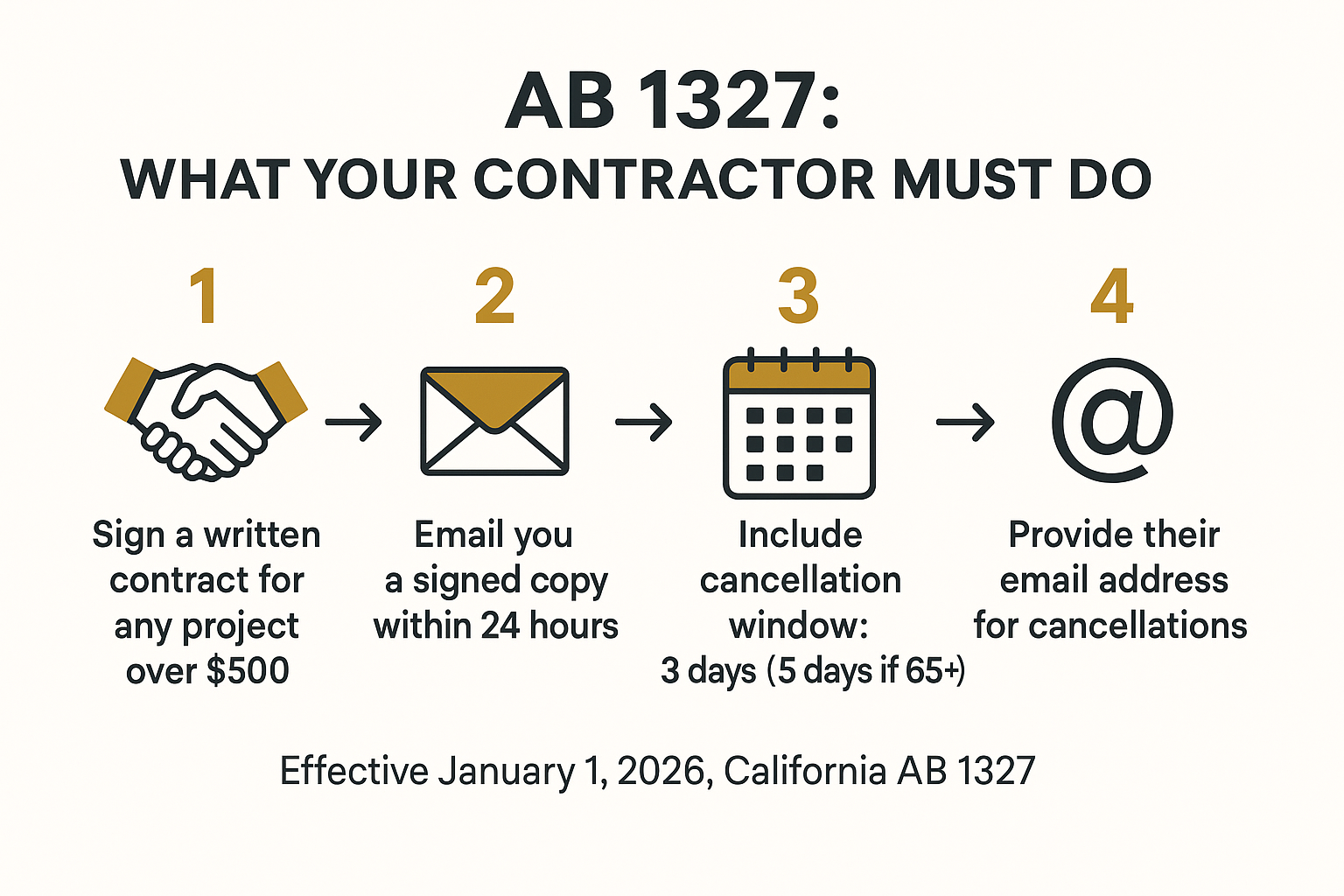
For years, the law required contractors to give homeowners a written contract for any home improvement project over $500. What was missing was any practical requirement about how quickly that contract had to reach you.
AB 1327 closed that gap. When a contractor signs a home improvement contract at your home, they are now legally required to email you a signed copy within 24 hours. This applies to any project over $500, which covers nearly every painting, staining, or renovation job a homeowner would hire out.
Why does this matter? Because a contract you never received in writing is a contract you can’t easily reference, dispute, or cancel. If a contractor hands you a copy at the door and you misplace it, or they claim they left you one and you have no record, you are at a disadvantage. Having a timestamped email in your inbox is simple, but it’s meaningful.
For any project we sign at your home, that email goes out the same day. That’s just how a professional operation should run, and now it’s also what the law requires of any licensed contractor in California.
If a contractor can’t or won’t email you a signed contract promptly, that is already a compliance issue before any work begins. You can tell a professional apart from someone just calling themselves one by how they handle the basics, and the contract is one of the first basics.
Your Right to Cancel, and How Email Changed That Too
California has given homeowners the right to cancel a home improvement contract for decades. What most people don’t know is that how you could send that cancellation was stuck in the past, until now.
Here’s how the cancellation window works:
- 3 business days to cancel if you’re under 65 years old
- 5 business days to cancel if you are 65 or older
- The clock starts the day you receive the contract
Before AB 1327, cancellation had to go by mail or hand delivery. Most homeowners never knew that. If you woke up two days after signing and had second thoughts, you couldn’t just send a quick email, you had to find an envelope and a post office, and do it fast enough to be postmarked in time. That was a real barrier.
As of 2026, email is an accepted cancellation method. This is a practical improvement that makes the right actually usable. The contract the contractor sends you must include their email address specifically so you have a valid address to send a cancellation to. If that email address is missing from the contract, the contractor is out of compliance.
If you ever need to cancel, write a clear, brief email stating that you are canceling the contract, include the project address and the date you signed, and send it before the window closes. Keep that sent email. It is your record.
For more on how to approach a contractor relationship from the start, what to ask an exterior painter before you book covers a lot of the same territory from a hiring angle.
What AB 1327 Requires From Your Contractor
This summarizes the key requirements under AB 1327 so you can check them off before any work starts.
SB 517: Who Is Actually Doing the Work on Your Home?
This one comes up more than most homeowners expect, and it’s something I hear real frustration about. A homeowner hires a contractor, signs a contract, and then an unfamiliar crew shows up at the door. No introductions, no explanation. The contractor they vetted and trusted is nowhere to be seen.
SB 517, also effective January 1, 2026, requires contractors to disclose in writing whether subcontractors will perform any work on your home improvement project. And it goes further: if a subcontractor is performing more than 50 percent of the estimated project cost, that subcontractor’s name and contact information must be included in the contract.
Knowing who is doing the work on your home is a reasonable expectation. It is not a special request. You deserve to know whether the person swinging a paintbrush or retiling your bathroom floor is a direct employee of the company you hired, or someone they subcontracted out to a crew you have no information about.
This matters for a few reasons:
- Insurance and licensing, a subcontractor who isn’t properly licensed or insured creates exposure for you as the homeowner
- Accountability, if something goes wrong, knowing who actually performed the work matters enormously
- Quality control, the company you hired may have standards their subcontractors don’t share
For context on how to think through a larger project where this kind of coordination comes up, planning a home renovation in Monterey walks through the questions worth asking before work starts.
The Down Payment Rule That Contractors Keep Ignoring
This isn’t a 2026 change, but it’s worth restating clearly because it gets violated regularly and most homeowners don’t know the number.
California law limits contractor down payments on home improvement contracts to $1,000 or 10 percent of the contract price, whichever is less. That’s the cap. There is no exception for large projects, no carve-out for materials, and no valid reason a licensed contractor should ask for more.
If you’re looking at a $12,000 exterior painting project and a contractor asks for $5,000 upfront, that request exceeds what California law allows. The legal down payment on that job would be no more than $1,000.
This matters because large upfront payments are consistently the point where homeowner problems begin. When a contractor has most of the money before most of the work is done, their incentive to stay on schedule and communicate clearly drops significantly. That’s just human nature, and it’s why the law exists.
You can read more about how Monterey’s coastal climate shapes a painting project if you’re planning exterior work, but regardless of what the job is, the down payment rules are the same.
According to the California Contractors State License Board’s 2026 New Laws bulletin, these protections apply broadly to home improvement contracts, and the CSLB enforces them.
Your 2026 California Contractor Contract Checklist
Before any work starts, your contract should include all of these. If something is missing, ask for it in writing before you sign.
| What to Look For | What the Law Requires | What to Do If It’s Missing |
|---|---|---|
| Written contract | Required for any project over $500 | Do not sign or pay anything without one |
| Signed copy emailed to you | Within 24 hours of signing (AB 1327) | Ask for it in writing before work begins |
| Cancellation notice with email address | Must be in the contract (AB 1327) | Request it, this is a legal requirement |
| Subcontractor disclosure | Required if subs are used (SB 517) | Ask who specifically will perform the work |
| Down payment amount | No more than $1,000 or 10% of contract, whichever is less | Refuse any request above the legal limit |
| Contractor license number | Should appear on the contract and all documents | Verify at cslb.ca.gov before signing |
What to Do If a Contractor Skips These Steps
A contractor who can’t produce a proper written contract, won’t email it to you, asks for an oversized down payment, or goes quiet about who’s doing the work isn’t just being sloppy, they’re already out of compliance with California law before the first brush hits the wall.
You have a clear option if that happens. File a complaint with the California Contractors State License Board at cslb.ca.gov. The CSLB licenses and regulates contractors in California, and contract violations are exactly the kind of issue they investigate. You can also verify any contractor’s license number on their site before you sign anything.
For a painting or renovation project on the Monterey Peninsula, there is no shortage of contractors claiming to be legitimate. The difference between a professionally run operation and someone cutting corners often shows up in the paperwork, not the sales pitch.
Frequently Asked Questions About California Contractor Contract Rights
Does the 24-hour email requirement apply to small painting jobs?
Yes. AB 1327 applies to any home improvement contract over $500, which covers nearly every professional painting or renovation job. There is no minimum project size that exempts a contractor from this requirement.
What if I want to cancel but the three-day window has passed?
Once the cancellation window closes, you are generally bound by the contract terms. This is why it’s worth reading the contract carefully before you sign and asking questions upfront, not after. If you have a dispute after the window closes, your options shift to negotiation or, in serious cases, a complaint with the CSLB.
Can a contractor ask for more than 10 percent if materials are expensive?
No. California law sets the down payment limit at $1,000 or 10 percent of the contract price, whichever is less, and that limit applies regardless of material costs or project complexity. If a contractor needs to purchase materials upfront, that’s a business logistics issue on their end, not a legal basis to exceed the cap.
What if my contract doesn’t mention subcontractors at all?
Ask directly before you sign. SB 517 requires disclosure in writing if subcontractors will perform any portion of the work. If the contract is silent on this and you want clarity, ask the contractor to add it in writing. A contractor who is evasive about who’s showing up to your home is worth a second look.
How do I verify a contractor’s license before I sign anything?
Go to cslb.ca.gov and use their license lookup tool. You’ll see whether the license is active, whether the contractor is bonded and insured, and whether there are any complaints on record. This takes about two minutes and is one of the most useful things a homeowner can do before committing to any contractor.
Ready to Work With a Contractor Who Gets the Paperwork Right?
If you’re planning a painting or renovation project in Monterey County and want to work with a team that’s licensed, fully insured, and runs a clean, documented process from estimate through final walkthrough, Legacy Painting and Renovating is happy to talk through your project. Reach us at (831) 917-0047 or through the contact form at legacypaintingrenovating.com to request a free estimate.