Direct Answer: Monterey’s marine layer creates repeated moisture cycles that soften and lift trim paint faster than inland climates. Proper surface prep and a water-based alkyd formula fix most of it.
If you’ve repainted your trim and watched it start chalking or peeling within a year or two, you’re not imagining things. Coastal humidity does real damage to paint film, and the standard advice you’ll find online, pick a semi-gloss and a name-brand product, skips the part that actually matters on the Monterey Peninsula.
I’ve seen this play out on homes from Pacific Grove to Carmel Valley. The marine layer rolls in most mornings, coats every surface in fine moisture, then burns off by noon. That cycle, repeated hundreds of times a year, does something that a dry inland climate never does: it softens paint film, breaks down adhesion, and accelerates chalking and peeling on trim that wasn’t properly prepared before it was painted.
This article covers the two things that determine whether your trim paint lasts five years or fifteen: product selection and surface preparation. Get one wrong, and the other won’t save you. Get both right, and you won’t be dealing with this again anytime soon.
What Coastal Humidity Actually Does to Trim Coatings
Most homeowners think of paint failure as a product problem. In my experience on the Central Coast, it’s usually a moisture-plus-prep problem that the product gets blamed for.
The fog-to-sun cycle here isn’t just an aesthetic feature of living near Cannery Row. It creates a genuine stress cycle for exterior and interior trim alike. Moisture gets into micro-cracks in the paint film overnight, then the afternoon sun drives it out. Over hundreds of cycles, that expansion and contraction weakens the bond between the paint film and the substrate beneath it.
For interior trim, the risk isn’t always obvious. But bathrooms, kitchens, and rooms on the west-facing side of homes in Pacific Grove or Carmel see higher ambient humidity than most homeowners realize. You can learn more about how this climate affects your home’s surfaces overall in our article on how Monterey’s climate actually shapes a house painting project.
The result: paint that was never bonded correctly in the first place fails even faster when coastal humidity is added to the equation. Product selection helps, but it cannot compensate for a moisture problem in the substrate or a surface that wasn’t prepped before painting.
The Sheen Question, and Why It’s More Complicated Than Semi-Gloss
Semi-gloss has been the default trim sheen for decades, and it’s not wrong, but it’s also not the whole answer.
Here’s what the sheen spectrum actually does in a humid environment:
- Flat and matte finishes absorb moisture rather than repelling it. They’re soft, mark easily, and have no place on trim in a coastal bathroom or kitchen.
- Eggshell is better for walls but still too porous for trim that takes regular contact and moisture.
- Satin is a reasonable middle ground on interior trim in drier rooms. It cleans up easier than eggshell and doesn’t amplify imperfections as much as higher sheens.
- Semi-gloss repels surface moisture well, is easy to wipe down, and holds up to repeated cleaning. It’s still a solid choice for most trim.
- High-gloss offers the best moisture resistance and the hardest film, but it makes every surface defect visible. On older trim with dings, brush marks, or filler spots, high-gloss makes problems look worse, not better.
The honest answer for most Monterey homes is that sheen and surface prep have to be chosen together. If the trim has been painted multiple times without sanding in between, going to a high-gloss finish will show every layer of buildup and every imperfection. Satin or semi-gloss over properly sanded trim will almost always look cleaner and hold longer.
A related read worth checking: what’s actually the best paint for trim and baseboards covers product selection from a different angle if you want to go deeper.
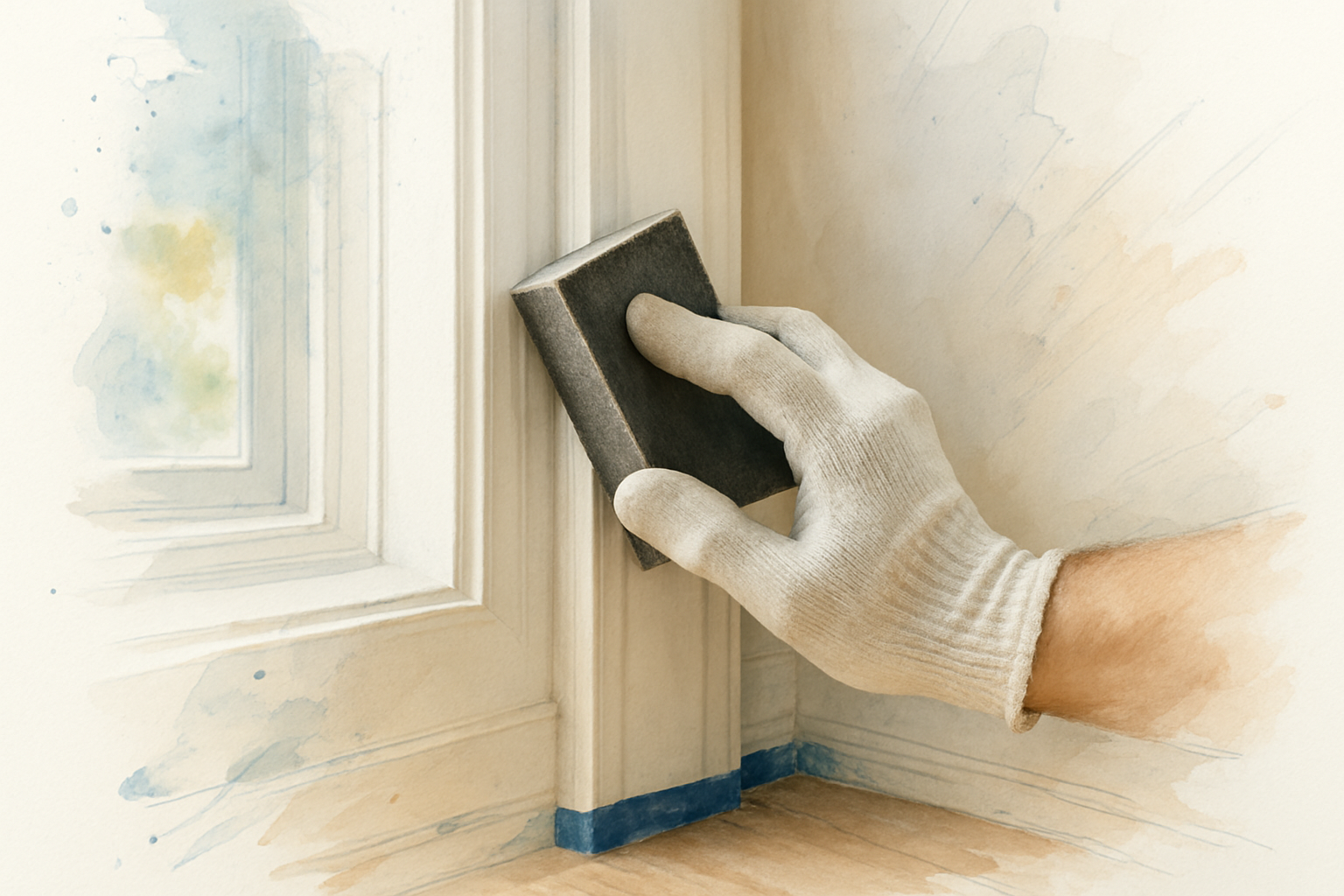
Oil-Based vs. Water-Based Alkyd, What California Contractors Actually Use
This is a real decision, not just a brand preference. And in California, it comes with a regulatory layer that most homeowners don’t know about.
Traditional oil-based trim paints were the gold standard for decades. They level beautifully, cure to a hard film, and resist moisture well. But California’s air quality rules, enforced through the California Air Resources Board (CARB), have substantially restricted the VOC content allowed in oil-based products sold and used in the state. High-VOC oil-based trim paints that were common even ten years ago are no longer legally sold here in their original formulas. You can read the current California regulations on coating requirements through CARB’s compliance resources.
Water-based alkyd formulas have largely filled that gap. They’re not the same as standard latex paint. They cure to a harder, scrubbable film similar to oil-based paint, clean up with water, and meet California’s low-VOC limits. For trim work in coastal climates where moisture resistance matters, water-based alkyd is what I’d reach for on most jobs.
When you’re reading a label, look for these indicators:
- “Alkyd” in the product name or description, not just acrylic latex
- CARB-compliant or California-compliant VOC labeling
- Hard, enamel-like finish noted in the product description
- Recommended for trim, doors, and cabinetry (not just general interior use)
For more on what low-VOC labeling actually means in California, this breakdown explains it in plain language.
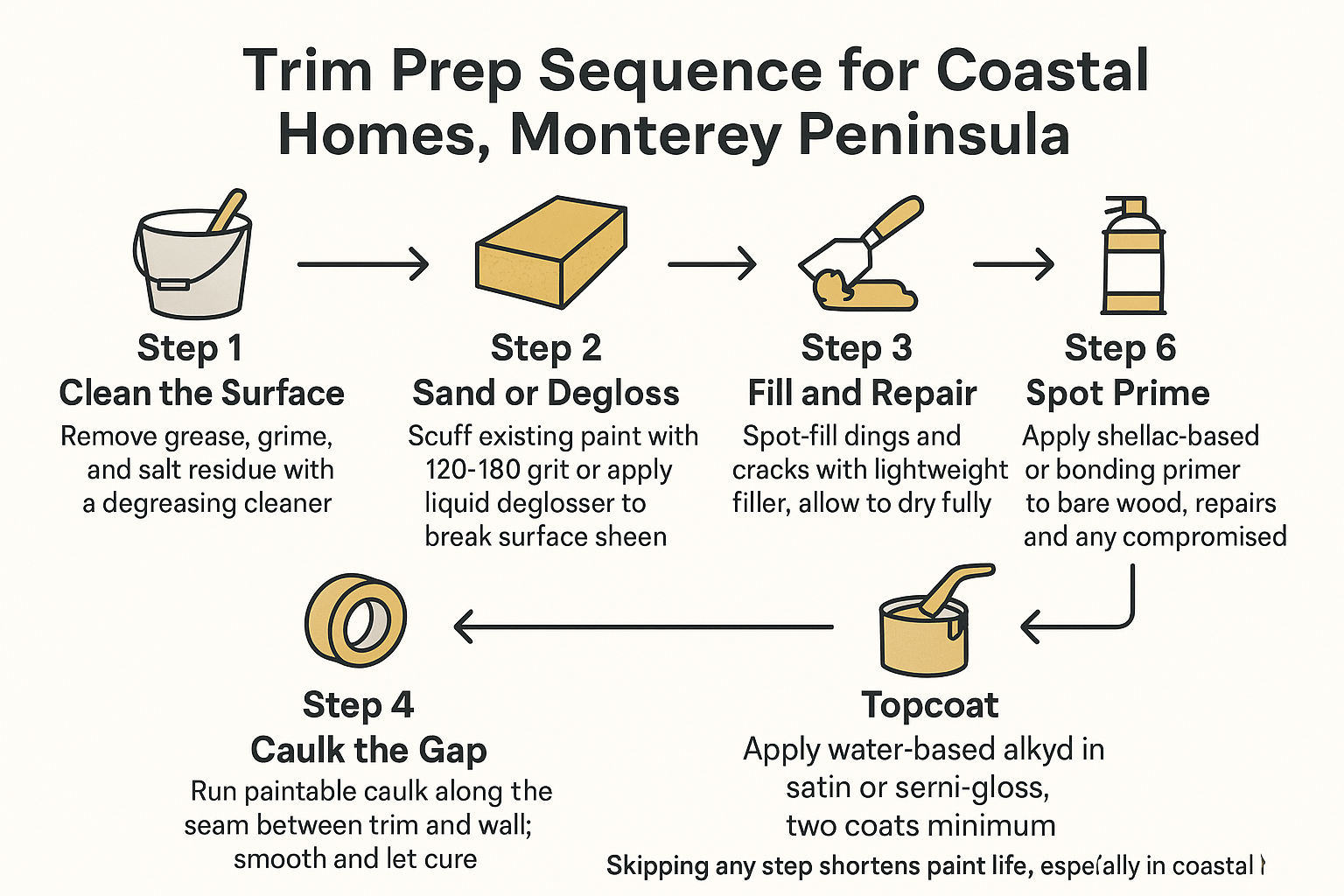
How to Prep Trim Correctly, The Sequence That Makes Paint Last
This is the step-by-step prep sequence that separates trim paint that holds for ten years from trim that starts peeling within eighteen months.
The Bathroom Baseboard Problem, and How to Actually Fix It
Bathroom baseboards fail first. Every time. And it’s not a mystery, they sit at floor level, where moisture from showers, mopping, and condensation settles before it has anywhere to go.
I’ve taken calls from homeowners describing exactly this: paint coming off in sections from bathroom trim, sometimes in large pieces, with no prep done under the prior paint layer. When that’s what you’re dealing with, you’re not looking at a repaint, you’re looking at a repair sequence.
Here’s how to approach it correctly:
- Strip or sand down to bare wood wherever the paint is lifting, bubbling, or peeling. Don’t paint over compromised film, it will fail again in months.
- If the existing paint is heavily compromised, a shellac-based primer like Zinsser BIN or a high-adhesion bonding primer is the right call before any topcoat. Shellac-based products seal stains, block tannin bleed from wood, and grip surfaces that standard primer won’t.
- Caulk the joint between the baseboard and the floor or tile surround, this is where most moisture infiltration starts in bathrooms.
- Topcoat with a semi-gloss or high-gloss water-based alkyd and plan on two coats. In a wet room, film thickness matters.
If the damage is extensive or the baseboard has started to absorb moisture at the wood level, replacement may make more sense than repainting. That’s a judgment call worth making with someone who can look at it in person.
For homeowners dealing with broader bathroom updates alongside this kind of trim repair, this overview of the bathroom renovation process gives a realistic picture of what these projects involve.
Trim Paint Sheen Comparison for Coastal Interiors
Here’s a quick reference for how each sheen level performs in the humid interior conditions common to Monterey Peninsula homes.
| Sheen Level | Moisture Resistance | Best Use Case | Coastal Caveat |
|---|---|---|---|
| Flat / Matte | Poor | Ceilings only | Absorbs moisture, avoid on trim |
| Eggshell | Low | Low-traffic walls | Too soft for coastal trim or bathrooms |
| Satin | Moderate | Trim in dry rooms | Good if prep is thorough; shows some imperfections |
| Semi-Gloss | Good | Most interior trim | Standard choice; repels surface moisture well |
| High-Gloss | Best | Doors, cabinets, wet rooms | Amplifies surface flaws, prep must be flawless |
Frequently Asked Questions About Trim Paint and Coastal Humidity
How long should trim paint last in a coastal home like Monterey or Pacific Grove?
With proper surface prep and a quality water-based alkyd product, interior trim paint in a coastal home should hold 8 to 12 years before it needs more than a touch-up. Bathroom trim that sees daily moisture exposure may need attention sooner, closer to 5 to 8 years, even with a good application. The biggest factor isn’t the product; it’s whether the surface was properly cleaned, sanded, and primed before painting.
Can I paint over peeling trim paint, or do I have to strip it first?
If the paint is actively peeling or lifting in sections, you need to remove the compromised material first. Painting over loose film just traps the failure underneath and you’ll be right back to the same problem within months. Sand or scrape back to a stable surface, prime bare spots with a shellac-based or bonding primer, then topcoat.
Is water-based alkyd really as durable as oil-based paint for trim?
For most residential trim applications in California, yes. Modern water-based alkyd formulas cure to a hard, scrubbable film that performs comparably to older oil-based products. They also meet California’s CARB air quality standards, which is a practical requirement here, not just a preference. The tradeoff is that they take longer to cure fully than standard latex, often 24 to 48 hours before the surface can take contact without marking.
What primer should I use on bathroom baseboards that had no prep under the old paint?
A shellac-based primer (like Zinsser BIN) is the most reliable choice when you’re painting over a surface with adhesion problems or unknown prior coatings. It grips where other primers won’t, seals stains, and gives your topcoat a stable base. If the prior paint is intact but just glossy, a water-based bonding primer is usually enough.
Does sheen level actually matter for trim durability, or is it mostly cosmetic?
It matters for moisture resistance, which means it matters for durability in coastal conditions. Higher sheens repel surface moisture better and are easier to wipe clean. But sheen alone won’t compensate for poor prep, a high-gloss finish over an unsanded, compromised surface will just make the failures more visible.
Ready to Stop Dealing With Peeling Trim?
If your trim is already showing signs of failure, chalking, peeling, or paint lifting off in sections, the team at Legacy Painting and Renovating can assess what’s actually happening and walk you through what a proper repair and repaint would involve. We work with homeowners throughout Monterey County, from Salinas and Seaside to Pacific Grove and Carmel, and we’re familiar with what this coastal climate does to paint over time. Reach us at (831) 917-0047 or through the contact form at legacypaintingrenovating.com to set up a free estimate.