
Direct Answer: Check for a valid CSLB license, proof of insurance, and a written scope of work. A real professional can produce all three without hesitation.
Homeowners in Monterey County get burned by this more than almost any other contractor decision. Someone shows up with a van, a few brushes, and a low bid — and six weeks later you’re dealing with peeling paint, missed prep work, and a phone number that goes straight to voicemail.
The problem isn’t that bad painters are hard to spot after the fact. The problem is they’re hard to spot before you sign anything. Most of them can talk a good game, show up looking professional, and still cut every corner that matters once the job starts.
This article covers what actually separates a licensed, qualified painting contractor from someone who bought a roller at Home Depot and started taking jobs. A few specific things to check before you commit will save you a significant amount of money — and a genuine headache — down the road.
The CSLB License: The First Thing to Verify, Not the Last
In California, anyone performing painting work valued at $500 or more — including labor and materials — is required by law to hold a valid contractor’s license through the California State License Board (CSLB). That includes painters. There is no gray area here.
A licensed contractor has passed trade exams, carries workers’ compensation insurance, and is legally accountable for their work in ways that unlicensed operators simply are not. If an unlicensed worker gets hurt on your property, that liability can fall back on you as the homeowner.
Verifying a license takes about 60 seconds. Go to check.cslb.ca.gov and enter the contractor’s license number. You’ll see whether the license is active, what classification it covers, and whether any complaints or disciplinary actions are on record. Any contractor worth hiring will give you their license number without being asked.
For reference, a C-33 classification is the specific painting contractor license in California. A general contractor holding a B classification can also perform painting as part of broader project work. If someone can’t tell you their license number off the top of their head, that’s already a problem.
On the Monterey Peninsula, where homes range from Craftsman bungalows in Pacific Grove to estate properties in Pebble Beach, the stakes of hiring an unlicensed painter are especially high. These homes have real value. Protecting that value starts with verifying who you’re actually dealing with.
What a Real Scope of Work Looks Like — and Why Vague Bids Cost More
A professional painter doesn’t just quote you a number. They give you a written scope of work that spells out exactly what’s being done, to what surfaces, with what materials, and how the prep work will be handled.
That last part — prep work — is where most of the difference lives. Painting over a dirty, chalky, or failing surface without proper preparation is how paint fails in two years instead of ten. On the Central Coast, where salt air, moisture, and UV exposure put real stress on exterior surfaces year-round, skipping prep isn’t a minor shortcut. It’s a guarantee of early failure.
Here’s what a thorough exterior scope of work should include:
- Surface cleaning — pressure washing or hand washing before any coating goes on
- Scraping and sanding — removing loose or flaking paint down to a stable surface
- Caulking — sealing gaps around windows, trim, and penetrations to block moisture
- Spot priming — bare wood or repaired areas need primer before topcoat
- Product specification — the actual brand and product being used, not just “exterior paint”
- Number of coats — two coats of finish is standard; one coat should raise a flag
If a bid doesn’t mention any of this, it’s not because the work is implied. It’s because the work isn’t being done.
You can read more about what proper exterior painting prep actually involves before comparing bids — knowing the baseline makes it much easier to spot what a cheap quote is leaving out.
Insurance: The Part Most Homeowners Forget to Ask About
A license and insurance are not the same thing. A painter can hold an active CSLB license and still be carrying zero insurance coverage at the time they’re working on your home.
There are two types of coverage you want to verify:
- General liability insurance — covers damage to your property during the job (spilled paint on hardwood floors, a broken window, a ladder going through a screen)
- Workers’ compensation insurance — covers the painter and any crew members if they’re injured on your property
Ask for a certificate of insurance, not just a verbal confirmation. A professional contractor can email you one same day. If there’s any delay or pushback, that’s a sign the coverage isn’t current.
In Monterey County, where homeowners’ insurance policies on coastal properties already carry elevated premiums, the last thing you need is a liability gap opened up by an uninsured crew working on your roof line or a second-floor exterior.
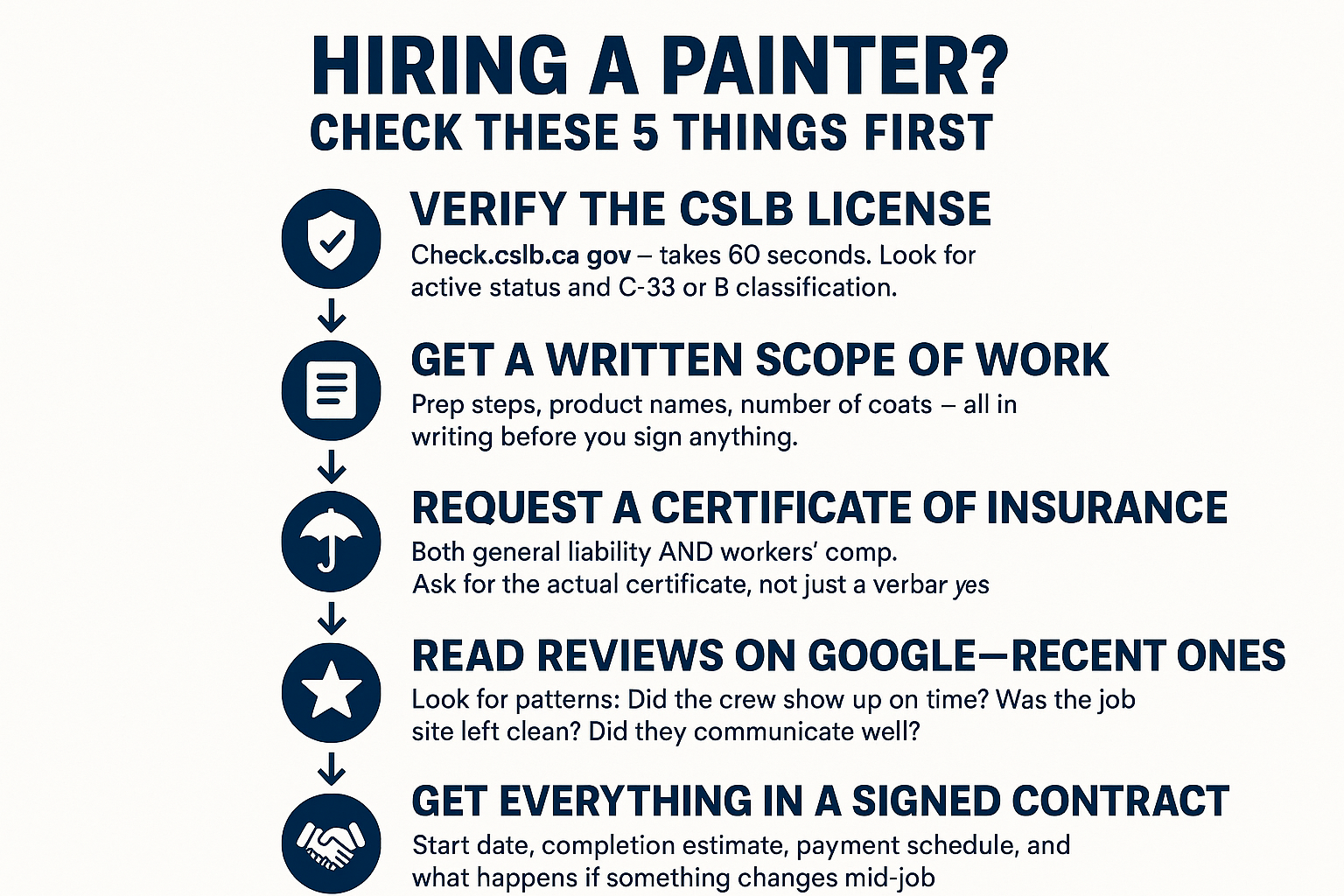
The 5-Point Check Before Hiring Any Painter
Before you commit to any painting contractor, run through these five verification points. They take less than 15 minutes and can save you thousands.
Professional Painter vs. Unlicensed Handyman: Side-by-Side
The differences between a licensed painting contractor and an unlicensed operator often aren’t visible on the surface — until the job is done and the problems start showing up.
| What to Check | Licensed Professional | Unlicensed Operator |
|---|---|---|
| CSLB License | Active license, verifiable online | None, or can’t provide a number |
| Proof of Insurance | Certificate emailed same day | “Yeah I’m covered” with no documentation |
| Written Scope of Work | Detailed, includes prep steps and product specs | One-line quote or verbal agreement only |
| Surface Preparation | Explicit steps listed and performed | Minimal or skipped entirely |
| Product Transparency | Names the brand and product being used | “Good quality paint” — nothing more specific |
| Job Site Standards | Drop cloths, clean edges, daily cleanup | Variable — depends on the day |
| Warranty or Follow-Up | Willing to put something in writing | Disappears after final payment |
What Reviews Actually Tell You — If You Know How to Read Them
Google reviews matter, but not the way most people think. A 4.8 rating with 200 reviews means more than a 5.0 with 4 reviews — and the content of the reviews matters as much as the number.
When you’re evaluating a painter, look for these specific patterns in the reviews:
- Did reviewers mention the job site being left clean at the end of each day?
- Did the crew communicate proactively when something came up mid-project?
- Were the start and finish dates close to what was promised?
- Did the painter follow up after the job to make sure the client was satisfied?
These details tell you far more than a generic five-star review that says “great job, highly recommend.”
Also look at how the contractor responds to negative reviews. A professional who handles criticism calmly and professionally is showing you exactly how they’ll handle issues on your project. Someone who gets defensive or dismissive is showing you that too.
For homeowners thinking through a larger painting project as part of a broader renovation, it’s also worth reading about how to avoid a full home remodel turning into a nightmare — many of the vetting principles are the same whether you’re painting or renovating.
The Coastal Climate Factor: Why Prep Matters Even More Here
This isn’t just a general painting topic. On the Monterey Peninsula, the environment makes the difference between a professional and an amateur more obvious — and more expensive when you guess wrong.
The combination of marine layer humidity, salt air, and fog-to-sun temperature swings accelerates paint failure on surfaces that weren’t properly prepared. A coat of paint applied over a surface that wasn’t cleaned, primed, or caulked correctly may look fine for the first season. But by the second winter, you’re looking at blistering, peeling, and moisture getting into the substrate.
Homes in Carmel, Pacific Grove, and along the coastline in Seaside face this more aggressively than inland properties in Salinas or Gonzales. Exterior coatings on these properties should be 100% acrylic latex rated for high-moisture environments, and the prep work underneath them needs to be thorough enough to outlast that environment.
Choosing the right paint for stucco exterior walls in Monterey County is a good place to go deeper on product selection for the coast — but the short version is that a qualified painter should already know this without you having to ask.
If a contractor isn’t asking about your home’s sun and wind exposure, the age of the existing paint, or whether there’s any active moisture infiltration, they’re not doing the job right. A professional painter asks those questions before they ever pick up a brush.
Frequently Asked Questions About Hiring a Painter in Monterey County
How do I actually verify a California painting contractor’s license?
Go to check.cslb.ca.gov and enter the license number the contractor gives you. You’ll see the license classification, whether it’s active, and any disciplinary history. A C-33 is the painting contractor classification. A B (General Building) license also permits painting work. The whole check takes about a minute.
Is it really a big deal if a painter is unlicensed, as long as the price is good?
It’s a bigger deal than most people realize before something goes wrong. If an unlicensed worker is injured on your property, your homeowner’s insurance may not cover it — and in some cases, the liability falls to you. Beyond the legal risk, unlicensed operators typically skip the prep work that makes paint last. A cheap job that fails in two years and needs to be redone costs far more than doing it right the first time. You can read more about why the cheapest bid usually isn’t the deal it looks like.
What should a painting contract actually include?
At minimum: the scope of work with specific prep steps listed, the paint brand and product being used, the number of coats, a start date and estimated completion window, the total price and payment schedule, and a process for handling changes. If any of those are missing, ask for them before you sign.
How do Monterey’s coastal conditions affect how exterior paint holds up?
Salt air, marine layer humidity, and the rapid daily shifts between fog and direct sun all put extra stress on exterior coatings. Paint applied to a surface that wasn’t properly cleaned, primed, and caulked will fail faster here than it would in a drier inland climate. Homes in Pacific Grove, Carmel, and oceanside Seaside are especially exposed. A qualified painter accounts for this in both their product selection and their prep process.
How many estimates should I get before choosing a painter?
Three is a reasonable number. It gives you enough to spot an outlier — either a suspiciously low bid or a padded one. But don’t just compare the bottom line. Compare what each scope of work actually includes. Two estimates can be $500 apart because one contractor skipped caulking and priming, not because one is a better deal.
Want to Know You’re Talking to a Real Professional Before You Commit?
Legacy Painting and Renovating, Inc. holds CSLB license #1066829, carries full general liability and workers’ compensation insurance, and provides a detailed written scope of work on every estimate — no exceptions. If you’re in Monterey County and want a straight answer about what your project actually involves, call (831) 917-0047 or reach out through the contact form at legacypaintingrenovating.com.