Direct Answer: Epoxy bonds well and costs less, but yellows under UV and cures slowly. Polyaspartic cures faster, holds color better, and off-gasses less — making it worth the higher price for many Monterey homeowners.
Garage floor coating is one of those projects where homeowners do a lot of research, get a few quotes, and still aren’t totally sure what they’re being sold. I hear this constantly — someone receives a quote, doesn’t know if it’s fair, and isn’t clear on whether the product is actually right for their situation. One homeowner who reached out to us had received a quote of $3,200 for a two-car garage and genuinely didn’t know if that number was reasonable or not.
The confusion usually starts with the products themselves. Epoxy and polyaspartic get used interchangeably in marketing, but they’re meaningfully different in how they cure, how they hold up over time, and how they perform in a coastal environment like the Monterey Peninsula. Getting that distinction right matters before you book anyone.
In this article, I want to cut through the noise on three things: what these two coating systems actually are, why the prep work underneath determines whether either one lasts, and what drives cost variation so you can evaluate a quote with some confidence.
Epoxy and Polyaspartic Are Not the Same Product
Epoxy has been the standard garage floor coating for decades, and for good reason. It bonds well to properly prepared concrete, holds up under car traffic and chemical spills, and produces a clean, hard finish. Most of what you see marketed as a garage floor coating — including the DIY kits at home improvement stores — is some form of epoxy.
But traditional epoxy has real limitations that matter specifically in Monterey County. UV exposure causes epoxy to yellow and chalk over time, which is a problem when your garage door faces west and gets afternoon sun. Epoxy is also rigid — it doesn’t flex as concrete expands and contracts with temperature changes, which means it can develop hairline cracks over time, especially in older slabs.
Polyaspartic is a type of polyurea that was developed partly to address those weaknesses. The key practical differences:
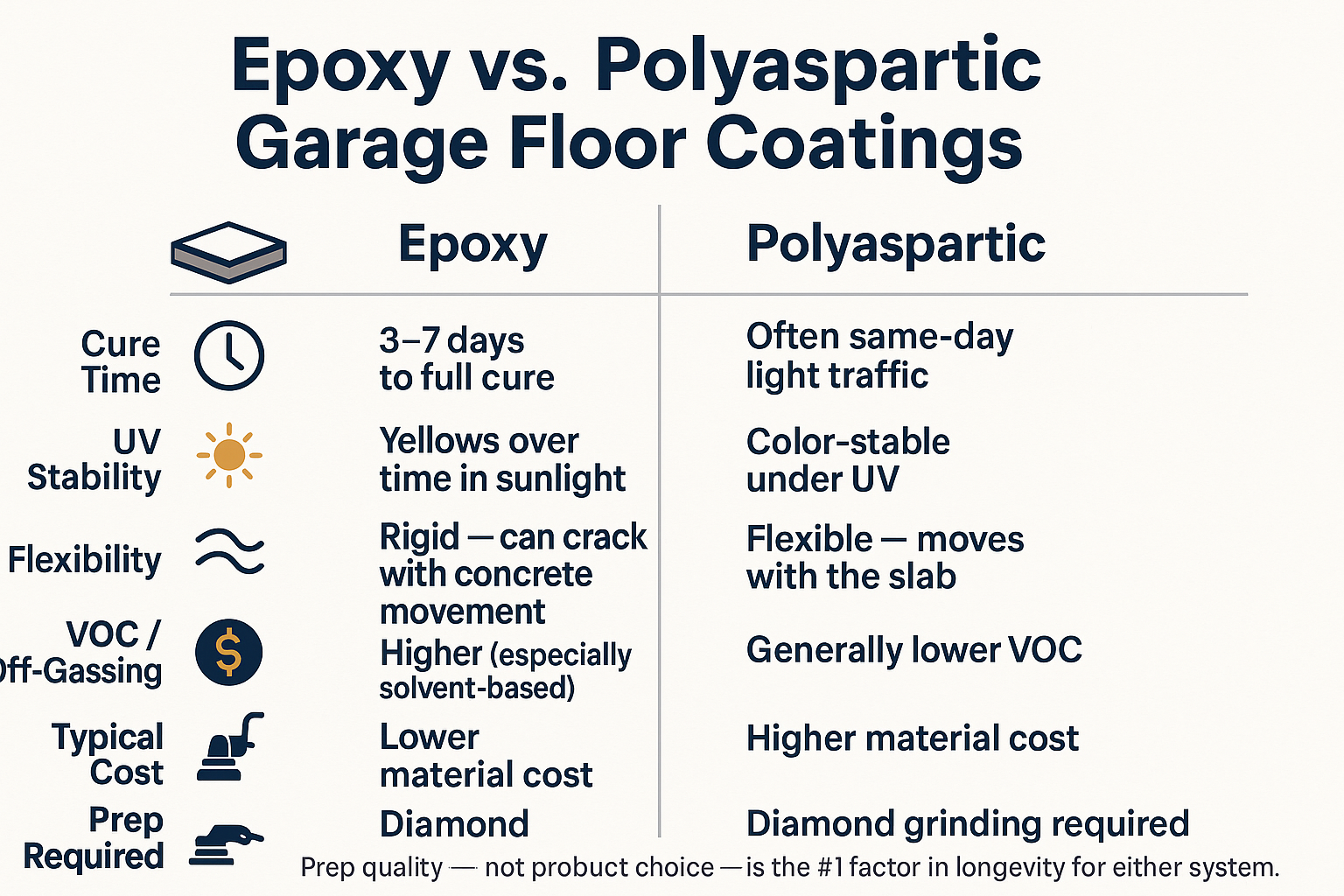
- Cures significantly faster — many polyaspartic installs allow same-day or next-day return to use, versus the three to seven days full cure time typical for epoxy
- More flexible than epoxy, which helps it move with the concrete rather than crack against it
- Color-stable under UV — it won’t yellow the way solvent-based epoxy does in sun-exposed garages
- Generally lower VOC emissions, which matters if you’re concerned about air quality or chemical sensitivity
That last point came up directly in an inquiry we received from a homeowner in a new Carmel construction who specifically wanted to avoid off-gassing coatings because of dogs in the home. Polyaspartic formulas are typically the better answer in that situation, and I’ll explain why in the next section.
What ‘Low-VOC’ Actually Means for Garage Floor Coatings
VOC stands for volatile organic compound — the chemicals that evaporate from a coating as it cures and make up most of what you smell after application. High-VOC products off-gas more aggressively and require better ventilation, longer wait times before re-entry, and more caution around children and pets.
California already sets stricter VOC limits than most states through the California Air Resources Board (CARB). Products sold here have to meet those standards, but there’s still a meaningful range between a low-VOC water-based product and a solvent-heavy one that technically passes.
For garage floors specifically:
- Solvent-based epoxies tend to have higher VOC content and require the space to be well-ventilated for an extended period after application
- Water-based epoxies are lower-VOC but often sacrifice some durability, which is a real trade-off on a surface that sees tire traffic
- Polyaspartic formulas generally off-gas less than solvent-based epoxy and cure faster, which shortens the total exposure window considerably
Safe re-entry timing after a polyaspartic application is typically measured in hours rather than days for light foot traffic — though driving on it usually requires waiting until full cure, which your contractor should confirm based on the specific product used.
If you have pets, young children, or sensitivity to chemical odors, asking your contractor specifically about the product’s VOC content and re-entry guidance isn’t an unusual request. Any professional doing this work should be able to tell you exactly what they’re using and what the ventilation requirements are.
Why the Prep Work Is What Actually Determines How Long the Coating Lasts
I’ll say this plainly: the product matters less than what happens before the product goes down.
For any floor coating — epoxy or polyaspartic — to bond and stay bonded, the concrete has to be profiled. That means the surface needs to be mechanically opened so the coating has something to grip. The industry-standard method for doing this is diamond grinding, which removes the top layer of concrete and creates a texture similar to fine sandpaper. Acid etching is sometimes used on newer, smoother slabs, but grinding is generally more reliable.
This is the step that separates a professional install from a box-store DIY kit. Those kits skip profiling because the homeowner typically doesn’t have access to a grinder. Without profiling, the coating sits on top of the concrete’s sealed surface rather than bonding into it — and it peels, sometimes within a year.
One situation I see regularly is a floor with a failed previous coating — someone used a DIY product years ago, it’s now peeling or delaminating, and they want to put something new over it. That old coating has to come off completely before anything new goes on. Grinding over a partially bonded existing layer just traps the problem underneath.
A homeowner who contacted us about a floor that had been painted with a non-professional epoxy-like product eleven years ago is a perfect example of this. That’s not a prep-and-coat situation — it’s a strip-and-start-over situation. Acknowledging that upfront, and pricing accordingly, is what honest contractors do. If a quote doesn’t mention surface prep or existing coating removal for a floor with a history, that’s worth asking about directly. You can read more about what separates thorough prep work from a rushed job in our article on how to tell a professional painter from someone just calling themselves one.
Epoxy vs. Polyaspartic: Side-by-Side at a Glance
Here’s a quick comparison of how the two systems differ on the factors that matter most to Monterey homeowners.
How to Read a Garage Epoxy Flooring Quote Without Getting Lost
Several homeowners who’ve reached out to us were trying to figure out the same thing: is the quote I received actually fair? That’s a reasonable question, and the answer depends on factors that aren’t always spelled out in the estimate.
Here’s what drives cost variation for a garage floor coating project:
- Square footage — a standard two-car garage in Monterey County runs roughly 400 to 500 square feet, but three-car garages and attached workshops can push that significantly higher
- Concrete condition — a clean, flat slab on a newer home is faster to prep than a cracked, stained, or uneven floor on a 30-year-old home
- Existing coating removal — if there’s an old coating that has to be stripped, that’s additional labor and time; it should be called out explicitly in any honest quote
- Product grade — there’s a wide range of quality between entry-level and professional-grade coatings; cheaper material usually shows up in the price but also in the longevity
- Number of coats — most professional systems include a base coat plus a topcoat; some include a broadcast layer of color flake or quartz between coats for texture and slip resistance
A quote of $3,200 for a standard two-car garage isn’t automatically out of line — but whether it’s fair depends entirely on what’s included. A lower quote that skips diamond grinding or uses a single coat of entry-level product isn’t a bargain. A higher quote that includes full prep, a quality polyaspartic system, and color flake broadcast may be the better value over five to ten years.
If you’re comparing multiple quotes, ask each contractor to confirm what prep method they’re using, what product they’re applying, and how many coats. Those three questions will tell you more than the bottom-line number. Projects that seem straightforward can also reveal surprises once prep begins — our article on when a small project turns into something bigger covers how to plan for that honestly.
What Affects the Final Cost of a Garage Floor Coating
Cost varies a lot based on the specifics of your floor and what the job actually requires. This table breaks down the main variables and how they tend to push price up or down.
| Cost Factor | Lower Cost Scenario | Higher Cost Scenario |
|---|---|---|
| Square footage | Single 2-car garage (~400 sq ft) | 3-car or oversized garage (600+ sq ft) |
| Concrete condition | New slab, clean and flat | Old slab with cracks, stains, or moisture |
| Existing coating | Bare concrete, no prior coating | Old DIY or failed coating must be stripped |
| Product type | Water-based epoxy, single coat | Professional polyaspartic, base + topcoat |
| Broadcast/texture layer | No color flake or quartz | Full broadcast with flake or quartz aggregate |
| Prep method | Light acid etch on new slab | Full diamond grinding, crack repair, patching |
Frequently Asked Questions About Garage Epoxy Flooring
Can I just put a new coating over my old garage floor paint?
Only if the existing coating is fully bonded and in good condition — and even then, the surface still needs to be profiled before anything new goes on. If the old coating is peeling, flaking, or was a DIY product applied without proper prep, it needs to come off entirely first. Coating over a compromised surface is the main reason garage floor jobs fail prematurely.
Is polyaspartic worth the extra cost over standard epoxy?
For most Monterey Peninsula garages, yes — especially if your garage gets direct sun or you want faster return to use. The UV stability alone is meaningful here. Epoxy that yellows and chalks after two or three summers of Pacific Grove or Carmel-side sun exposure isn’t a long-term solution. Polyaspartic costs more upfront, but it tends to hold up better over a five-to-ten-year horizon.
How long do I need to stay out of the garage after the coating is applied?
For polyaspartic coatings, light foot traffic is often possible within a few hours, though you should confirm this with your contractor based on the specific product. Parking a car on it typically requires waiting until full cure, which varies by product and ambient temperature. Solvent-based epoxy usually requires longer ventilation and more wait time before any use.
Is a garage floor coating safe for dogs and pets?
Once fully cured, most professional-grade coatings are safe for pets. The concern is the curing period, when VOCs are actively off-gassing. Polyaspartic formulas generally off-gas less than solvent-based epoxies and cure faster, which shortens the window during which you’d want to keep pets out. Ask your contractor specifically about the product’s VOC content and when re-entry is safe for animals.
Does a garage floor coating require a permit in Monterey County?
In most cases, no. Applying a surface coating to an existing garage floor is typically considered maintenance work and doesn’t require a permit from the City of Monterey, Salinas, or other local jurisdictions. That said, if the project involves structural repairs to the slab itself, that’s a different conversation. When in doubt, your contractor should be able to clarify what’s required for your specific situation.
What’s the difference between the flake finish and a solid color?
A broadcast flake finish involves scattering colored vinyl chips into the wet base coat before the topcoat goes on. It adds texture for slip resistance, hides minor floor imperfections, and gives the floor a more finished look. Solid color is simpler and sometimes slightly less expensive, but it shows surface variation more easily. Most professional installs today include at least a partial flake broadcast for both function and appearance.
Ready to Get a Straight Answer on Your Garage Floor?
If you’ve been trying to figure out whether a quote makes sense, what product is right for your floor, or whether your old coating needs to come off first, we’re happy to take a look and talk through it honestly. Legacy Painting and Renovating serves homeowners across Monterey County — from Marina and Seaside to Carmel and Pebble Beach — and garage epoxy flooring is one of our most active project categories. Call us at (831) 917-0047 or reach out through the contact form at legacypaintingrenovating.com to set up a free estimate.