Direct Answer: As of July 1, 2026, California’s SB 779 raised the minimum civil penalty for unlicensed contracting to $1,500. Any job over $500 in labor and materials requires a CSLB license.
Almost every homeowner I talk to on the Monterey Peninsula has a contractor story. Somebody who took a deposit and stopped answering the phone. Somebody whose paint job started peeling off the salt-air side of the house within a year.
What most people do not know is that California quietly changed the rules on unlicensed work in 2026. The penalties for working without a license went way up, and that shift matters to you as the person writing the check.
Below I will walk through what actually changed on July 1, 2026, why the risk of hiring unlicensed lands on the homeowner more than people expect, and how to check any contractor’s license yourself in about a minute.
What changed with unlicensed contractor penalties in California in 2026
The licensing rule itself is not new. In California, anyone doing construction work where labor and materials together exceed $500 needs a license from the Contractors State License Board. That includes painting, drywall repair, deck refinishing, cabinet refinishing, and remodeling work.
What changed is the consequence. Senate Bill 779 took effect July 1, 2026, and it raised the minimum civil penalty for unlicensed contracting.
- Old minimum civil penalty: $200
- New minimum civil penalty: $1,500
- Trigger: any contracting work over the $500 labor-and-materials threshold
- Enforcement body: the Contractors State License Board
That $200 figure is why the old rules did not scare anyone. A guy could get cited, pay less than the cost of a good sprayer, and keep going the following Monday.
A $1,500 floor changes the math. The idea behind the law is to make operating without a license expensive enough that more work moves toward licensed contractors. Whether that plays out on the ground across Monterey County is another question, and it does nothing to undo damage on a job that already went sideways.
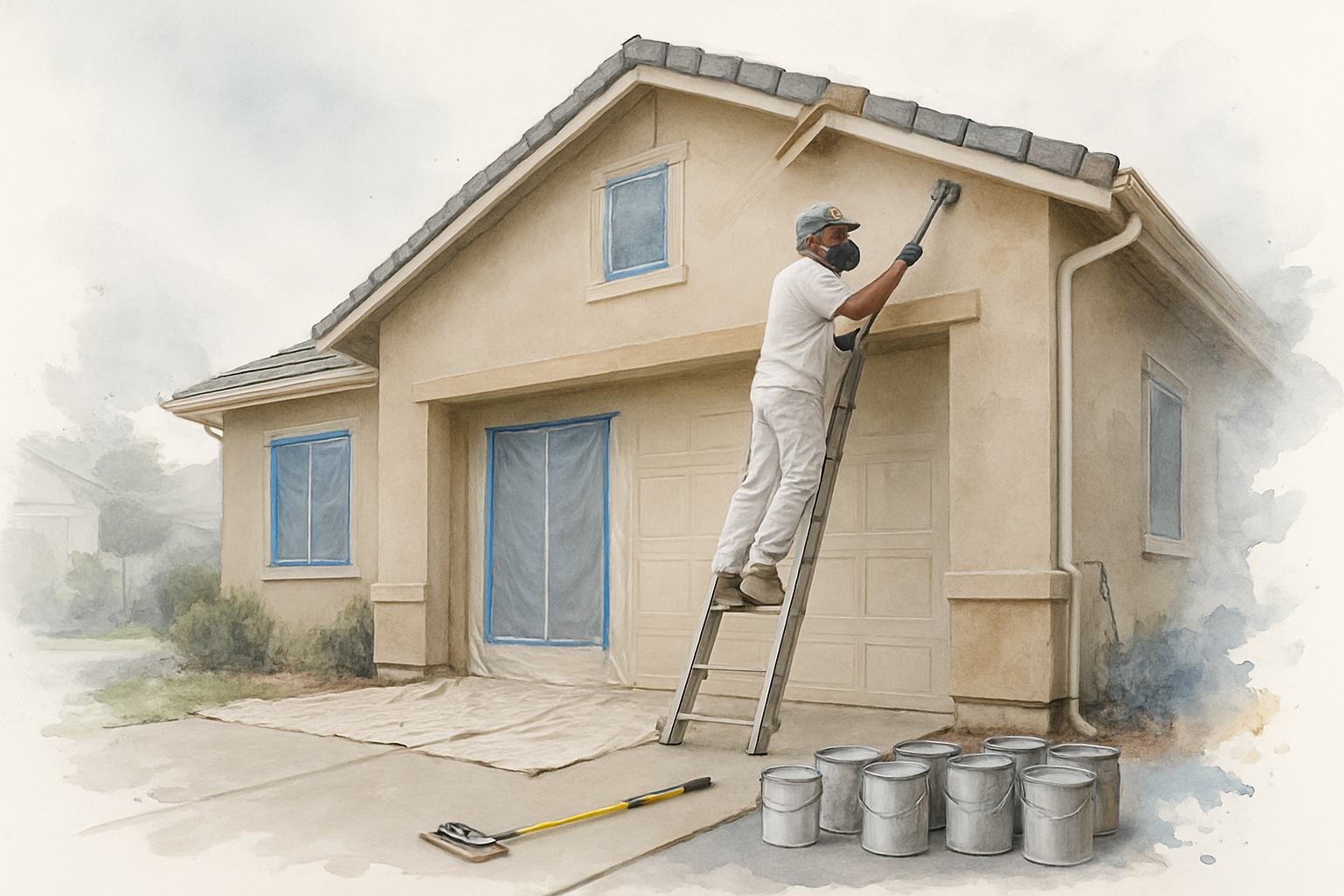
The part homeowners underestimate: the risk sits with you
People assume the penalty is the contractor’s problem. In practice, the homeowner carries real exposure when the person on the ladder is unlicensed.
Here is what you lose the moment you hire outside the license system:
- Worker injury liability. If someone gets hurt on your property working for an unlicensed contractor, California law can treat you as the employer. That is a homeowner insurance conversation nobody wants to have.
- No license bond to claim against. Licensed contractors carry a bond. If the work fails or gets abandoned, there is something to file against. Unlicensed, there is nothing.
- No CSLB complaint path. The board only has jurisdiction over licensees. If your guy is not licensed, there is no agency to bring a complaint to.
- Small claims or nothing. Your recovery option becomes a lawsuit against someone who may have no assets and no fixed business address.
I have walked into homes in Seaside and Salinas where the previous job had to be completely stripped and redone. One homeowner reached out about a garage floor that a non-professional had coated with an epoxy-style paint years earlier, and it all had to come off before anything new could go down.
The cheaper bid is only cheaper if the work holds. On the Monterey Peninsula, with marine layer moisture and salt air working on your siding every single day, weak prep shows up fast.
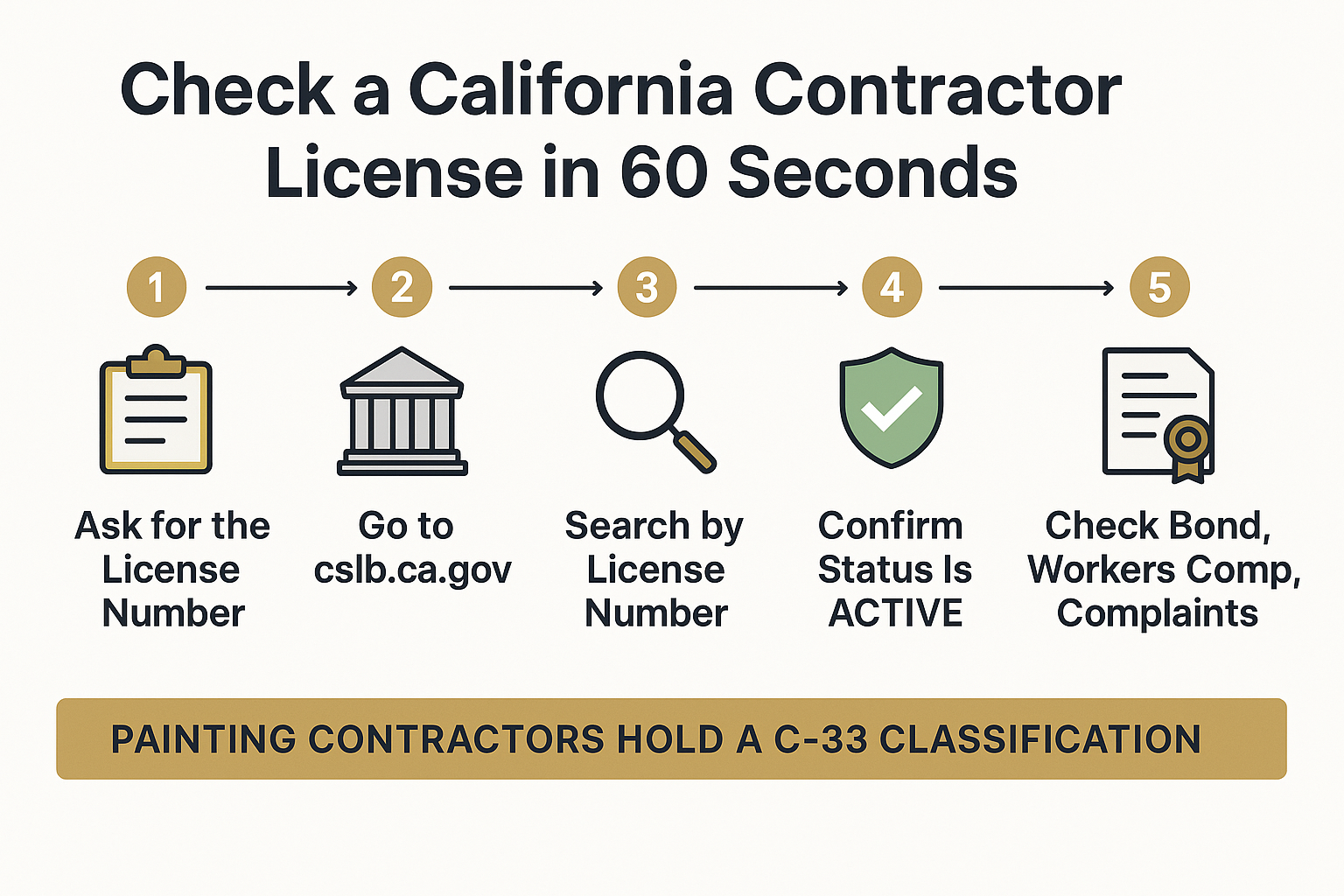
How to check a contractor license in about 60 seconds
This is the single highest-value minute you will spend during the hiring process. Here is the sequence.
What a real, verifiable license actually looks like
A license number is not a marketing badge. It is a public record you can pull up yourself.
Go to cslb.ca.gov, enter the number, and the state tells you:
- Whether the license is active or expired
- Which classification the contractor holds
- Whether the bond is currently in place
- Whether workers’ compensation coverage is on file
- Any disciplinary actions or citations on record
For painting work in California, the classification you want to see is C-33. General renovation work falls under a B classification. If a contractor bidding your kitchen remodel only holds a painting classification, that is worth asking about.
Also pay attention to the name on the license. The number should match the business name on your estimate. I have seen homeowners handed a license number that belonged to somebody else entirely, and they never checked.
Our own number is CSLB #1066829, and I tell people to look it up rather than take my word for it. Any contractor who gets defensive about that request has told you something useful.
If you want more on separating real professionals from people who bought a sprayer last spring, this walkthrough on how to tell a professional painter from an amateur covers the field-level signs.
Licensed vs. unlicensed: what you actually have when something goes wrong
The difference does not show up on day one. It shows up six months later when a problem surfaces.
| If This Happens | Licensed Contractor | Unlicensed Contractor |
|---|---|---|
| Worker is injured on your property | Their workers’ comp coverage responds | You may be treated as the employer |
| Job is abandoned halfway through | Bond claim and CSLB complaint available | No bond, no agency oversight |
| Paint fails within a year | Formal complaint process exists | Your only path is civil court |
| Permit is required for the work | Can pull permits legally | Cannot pull permits under their own name |
| You sell the home later | Documented, permitted work | Unpermitted work can stall escrow |
Why the words ‘licensed and insured’ keep showing up in searches
A lot of homeowners who reach out to us found the site by searching for a painter with the words licensed and insured typed right into Google. That is not an accident.
Those two words are shorthand for a specific worry. People are not asking about paint quality at that moment. They are asking whether the person showing up at their house is going to disappear.
One customer, a retired general contractor who had hired plenty of specialty trades over his career, wrote that our crew “kept everything protected and clean” and “finished on time.” Another homeowner with 18 years in the building industry said her project was a complete redo of a handyman’s earlier work.
That second story is the common one across Monterey County. Somebody took the low bid, and the real cost showed up later.
Licensing does not guarantee good craftsmanship on its own. But it puts a floor under the relationship, and it gives you somewhere to go if things break down. Pair that check with a written contract that spells out scope, materials, and payment schedule, which California law now requires in more detail than it used to.
Frequently Asked Questions About Unlicensed Contractor Penalties in California
Can I get in trouble for hiring an unlicensed contractor?
You are not the one facing the $1,500 minimum civil penalty, that falls on the contractor. But you can end up carrying liability if a worker is injured on your property, because California may treat you as the employer in that situation.
Is a small painting job exempt from the license requirement?
Only if the total is $500 or less including both labor and materials. That threshold gets crossed on almost any real painting or repair job in Monterey County, so in practice most work needs a licensed contractor.
What license classification should a painting contractor have?
C-33 is the painting and decorating classification in California. Remodeling work generally falls under a B general building classification. You can see exactly which classifications a contractor holds on the CSLB lookup page.
How do I know the license number on an estimate is really theirs?
Look it up at cslb.ca.gov and compare the business name on the record to the name on your estimate. If they do not match, ask. Borrowed or copied license numbers do happen.
Does the 2026 penalty increase mean unlicensed work will go away?
I doubt it disappears. Raising the floor from $200 to $1,500 makes it more expensive to operate unlicensed, which should push some work toward legitimate contractors. Your protection still comes from verifying the license yourself before signing anything.
Thinking through a painting or renovation project on the Peninsula?
If you are comparing bids in Salinas, Monterey, Pacific Grove, or Carmel, run every license number you receive through cslb.ca.gov before you decide. It costs you nothing and rules out a whole category of problems. Legacy Painting and Renovating is licensed under CSLB #1066829 and available for free estimates at (831) 917-0047 or through the contact form at legacypaintingrenovating.com if you would like to talk it through.