Direct Answer: A damp slab will push a coating off from below. Test moisture first with a taped plastic sheet at home, or an ASTM F2170 probe test, before any product goes down.
You pull into the garage after a storm, and the slab is dark and damp in the middle of the floor. Or the old coating near the door is lifting in sheets, and you can peel it up with your fingernail.
The question that matters is not which brand of product went down. It is whether the slab underneath is dry enough to hold anything at all.
I have walked a lot of garages in Monterey, Seaside, Salinas, and Pacific Grove, and most coating failures I see trace back to moisture moving up through the concrete. This article covers how to tell the difference, how moisture gets measured, and why a wet January is actually the best time to find out.
Is the coating failing, or is the slab pushing it off?
A coating sits on top of concrete. It does not stop water that is already traveling up from the soil below.
When moisture vapor moves through a slab and hits the back of a sealed coating, it builds pressure. Over time that pressure breaks the bond, and the coating releases in sheets, bubbles, or whole patches rather than wearing thin in traffic lanes.
That is the tell. Here is what I look for first:
- Coating that lifts in large flakes with clean concrete underneath, not worn-down color
- Bubbles or blisters in the middle of the floor, away from tires
- A slab that darkens all over after rain and takes days to lighten back up
- Chalky white residue at cracks or along the base of a wall
One Monterey homeowner reached out about a two-car garage that had been painted more than a decade earlier by someone who was not a professional, using an epoxy-like paint from a store. Another had just bought a home and assumed the older concrete would need grinding before anything new went down. Both were asking the right question in different ways.
If you are in that spot, redoing a garage floor that was already painted or coated starts with figuring out why the first one let go.
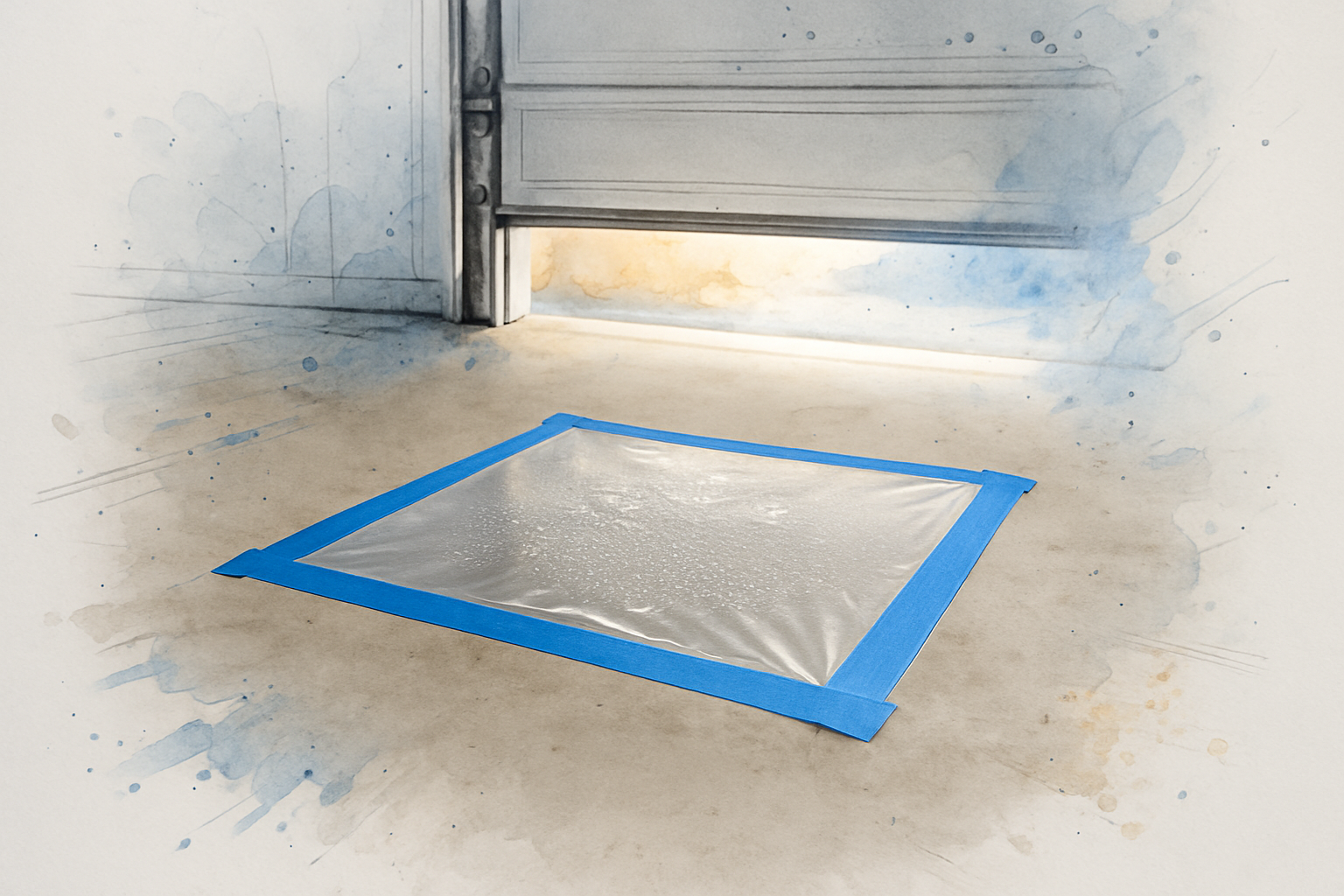
How concrete moisture testing before a garage floor coating actually works
You can run a rough version of this yourself this weekend. It costs almost nothing.
The plastic sheet test:
- Cut an 18 by 18 inch square of clear plastic sheeting
- Tape all four edges down tight to the bare slab with painter’s tape
- Pick a spot in the middle of the floor, not right by the door
- Leave it 24 to 72 hours, then lift it
If you see condensation on the underside of the plastic, or the concrete under it has darkened into a visible square, moisture is moving up. That is not a pass or fail number, but it tells you the slab deserves a real test.
The two tests a contractor should know by name:
- Calcium chloride test (ASTM F1869). A small dish of salt sits under a sealed dome on the slab for about 72 hours and gets weighed. It measures how much vapor comes off the surface.
- In-situ relative humidity probe (ASTM F2170). A hole is drilled into the slab, a probe goes in, and it reads the humidity inside the concrete after it equalizes.
The probe test reads deeper and is the more telling of the two. A surface test can look fine on a dry week and miss what the slab is holding three inches down.
Three ways to check a garage slab for moisture
Here is how the home version stacks up against the two standard professional tests.
| Test | What it tells you | Time and who runs it |
|---|---|---|
| Plastic sheet test | Yes or no signal that vapor is moving up through the slab | 24 to 72 hours, any homeowner with tape and plastic |
| Calcium chloride (ASTM F1869) | How much moisture vapor comes off the surface over three days | About 72 hours, run by a contractor or flooring pro |
| In-situ RH probe (ASTM F2170) | Humidity inside the slab itself, the deeper and more telling read | Drilled and read after equalizing, run by a contractor |
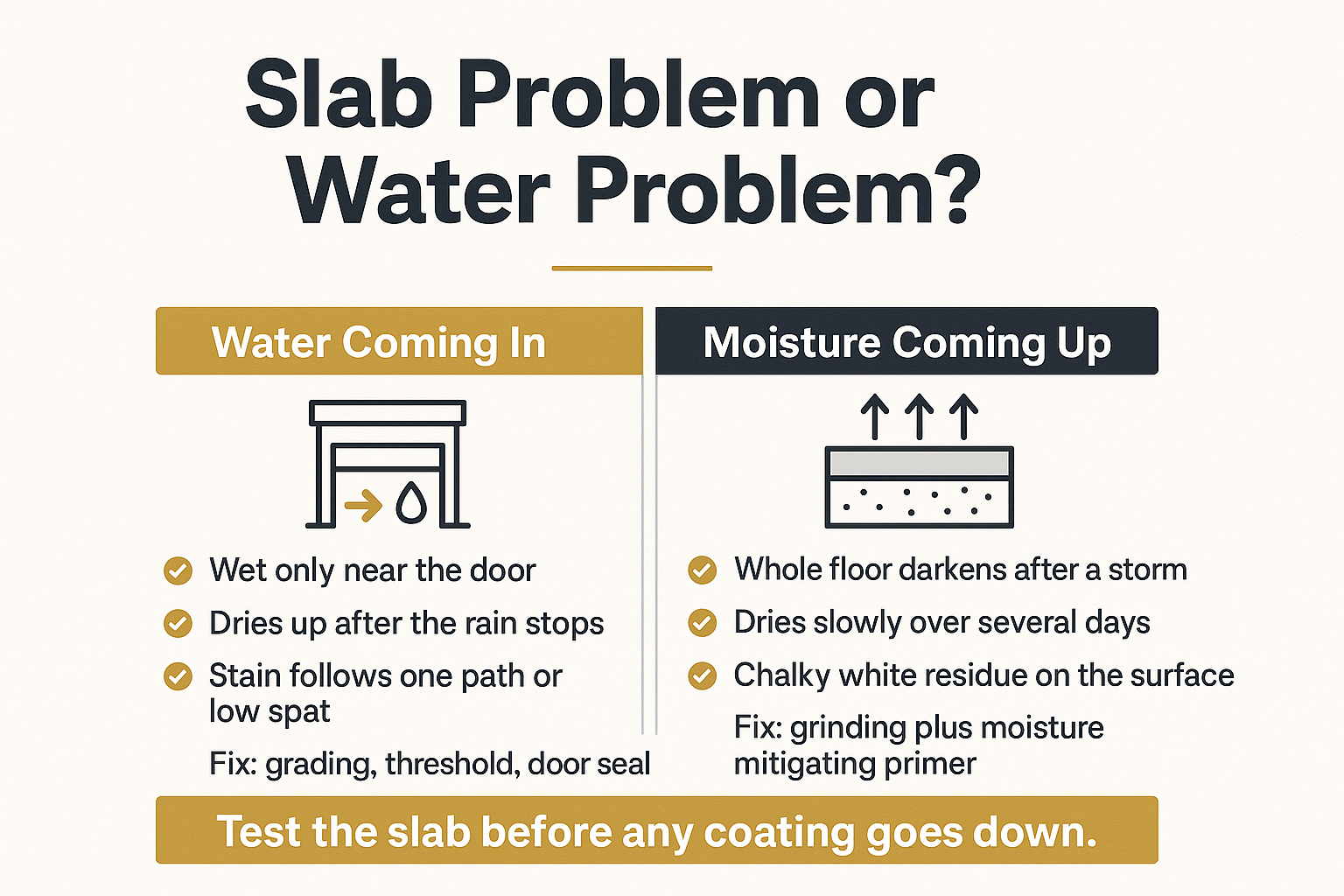
Slab problem or water problem?
Before you look at products, figure out which of these two things you are dealing with. They have completely different fixes.
Why a wet Monterey winter is the best time to test
A slab test run in September tells you less than the same test run in late January. The ground has been dry for months by the end of summer, and the concrete reads that way.
After a few weeks of steady rain, the soil under your garage is saturated, and the slab shows you what it is really going to do. The wet season is free diagnostic information.
That matters more than usual right now. NOAA has confirmed that El Niño has formed and is expected to strengthen through winter, which raises the odds of above normal rain along the California coast from December through February.
None of that is a guarantee for any single address. But it shifts the odds, and the state has already moved to prepare for flooding and debris flow risk.
For local scale: Monterey normally sees somewhere in the range of 15 to 18 inches of rain a year, with December and January carrying the heaviest share. Strong El Niño winters on the Central Coast have historically run well above that.
So if you are planning a garage project as a New Year item, here is my honest advice. Run the plastic test during the wettest stretch you get. A floor that stays dry through a heavy January is a floor you can coat with real confidence in spring.
What changes when the moisture numbers come back high
High readings do not mean you can never coat the floor. They mean the job changes.
What gets added:
- Mechanical grinding instead of acid etching. Grinding opens the concrete so the primer bites into clean, porous surface. Etching does not go deep enough for a slab under vapor pressure.
- A moisture mitigating primer or vapor barrier system underneath the color coat, designed to hold back pressure from below.
- Crack and pit repair, which usually gets more involved on a slab that has been cycling wet and dry for years.
This is also why a square foot price quoted over the phone cannot be honest. I have had a homeowner ask for a per foot number on roughly 400 square feet of garage, and another ask how my price compared to a bid he already had in hand. Neither question can be answered without someone standing on the slab.
The factors that move a garage floor number are the slab age and condition, grinding versus etching, whether moisture mitigation is needed, how much crack and pit repair is involved, and how much of the garage has to be emptied before anyone can work. If you want the full breakdown, I wrote about what actually changes the price on a garage floor coating quote.
When a bid comes in far below the others, prep is usually what got left out. What happens to a garage floor before the coating goes on is most of the work and most of the cost.
What a coating cannot fix
Some garage water problems have nothing to do with the slab, and no product solves them.
If water runs under the garage door during a storm and the wet spot is always in the same place near the threshold, that is drainage. Look at the slope of the driveway, the door bottom seal, and where the downspouts dump. A coating applied over that will still get walked on by standing water every winter.
If the whole floor darkens after a storm and takes days to lighten, look underneath the slab instead.
Then there is efflorescence, the chalky white powder that shows up on concrete. It is mineral left behind after water moved through the slab and evaporated at the surface. Treat it as a signal, not a cosmetic nuisance.
Monterey County housing stock skews older, with a lot of homes built in the mid 1970s and earlier. Garage slabs from that era were often poured straight onto dirt or gravel with no vapor barrier underneath. That is the single most common reason I find a floor that will not stay dry.
Product choice still matters once the slab checks out, and epoxy and polyaspartic coatings behave differently in coastal conditions. But it is a second question, not the first one.
Frequently Asked Questions About Garage Slab Moisture
Can you coat a garage floor during the winter in Monterey County?
Sometimes, yes. Garages are enclosed, so temperature and humidity can often be controlled well enough to work. But if the slab itself is holding moisture from weeks of rain, I would rather test it, show you the numbers, and schedule the work for a drier stretch than put a coating down that fails in a year.
How long does the plastic sheet test take?
Leave it taped down 24 to 72 hours. Longer is better. Check it after a wet week, not after a dry one, or you are testing the weather instead of the slab.
Does a moisture mitigating primer add to the cost?
It adds a material and a labor step, so yes, it affects the number. How much depends on the square footage and how aggressive the grinding has to be. Anyone who quotes it sight unseen is guessing.
Is white chalky residue on my concrete a dealbreaker?
No, but it is information. Efflorescence means water has been moving through the slab and leaving minerals behind. It needs to be removed mechanically and the source understood before a coating goes on, otherwise it keeps coming back underneath the new finish.
My old epoxy peeled off in big sheets. Was it a bad product?
Usually not. Product that was worn thin by tires looks worn thin. Product that lets go in sheets with clean concrete underneath almost always lost its bond, either from moisture pressure below or from a slab that was etched instead of ground. Checking cure time and hot tire pickup is worth doing too, since parking on a coating too early can cause similar looking damage.
Thinking about a garage floor this winter?
If your slab has been acting up through the rain, a walkthrough that includes a look at slab condition and moisture is available at no cost to homeowners around Monterey County, CA. One Monterey customer put it this way after his garage was done: “Ernesto and his team did a great job transforming my garage. He was a good communicator and easy to deal with.” Legacy Painting and Renovating is licensed and insured under CSLB #1066829, and you can reach us at (831) 917-0047 or through the contact form at legacypaintingrenovating.com whenever you are ready to talk it through.