Direct Answer: Starting January 1, 2027, SB 1117 requires local impact fees on an ADU larger than 750 square feet to be charged only on the square footage above 750, for up to two ADUs per lot.
If you have been pricing out a backyard unit in Salinas or a larger addition in Seaside, you already know the fees are the part nobody warns you about. The construction number is one thing. Then the city hands you a sheet of impact fees and the budget moves.
That sheet changes on January 1, 2027. Governor Newsom signed SB 1117 on September 29, 2026, and for accessory dwelling units larger than 750 square feet, local impact fees will be charged only on the square footage above 750 instead of on the whole unit.
I work on the finish end of these projects, not the permit counter, but I sit in a lot of kitchens while homeowners run their numbers. So here is the plain version of what changed, who it helps, and who it does not help at all.
What SB 1117 Actually Changes on January 1, 2027
SB 1117 was authored by Senator Sabrina Cervantes and sponsored by California YIMBY. It was signed on September 29, 2026 as Chapter 809, Statutes of 2026, and it takes effect January 1, 2027.
Here is what it does, stated the way the law states it:
- For an ADU larger than 750 square feet, impact fees must be charged only on the portion of the unit exceeding 750 square feet
- Those fees must also be charged proportionately to the square footage of the primary dwelling unit
- The new marginal fee formula applies to up to two ADUs on a lot
- ADUs of 750 square feet or less already pay no impact fees, and that does not change
- Junior ADUs of 500 square feet or less already pay no impact fees, and that does not change
One more thing worth getting straight, because I hear it mixed up constantly. Impact fees are not the same as building permit and plan check fees. Impact fees are the charges a city or special district collects for things like water and sewer capacity, parks, and traffic. Your plan check, permit, and inspection fees are separate and SB 1117 does not touch them.

The Math on a 1,000 Square Foot Backyard Unit
Say you are planning a 1,000 square foot detached unit on your lot. Under the current rule, your city charges impact fees based on the full 1,000 square feet, proportionate to your main house.
After January 1, 2027, the same unit is charged on 250 square feet. That is the portion above 750. Same unit, same lot, same plans, and the fee basis drops by 75 percent.
I am not going to put a dollar figure on that, because I would be guessing. Impact fee schedules are set jurisdiction by jurisdiction, and what Salinas charges is not what Monterey, Pacific Grove, or an unincorporated parcel in Carmel Valley charges. Water and sewer connection charges alone vary widely across the Peninsula.
What I can tell you is the direction and the scale:
- The bigger the unit above 750 square feet, the less the percentage savings, because more of it sits in the chargeable range
- A unit at 800 square feet is charged on 50 square feet, which is close to free on the impact fee line
- A unit at 1,200 square feet is charged on 450 square feet, still well under half the old basis
For the exact numbers, call the planning counter in your city and ask for the current impact fee schedule for an accessory dwelling unit. They will give you a real figure. Nobody online can.
How the Fee Basis Changes by Unit Size
This compares the square footage impact fees are charged on, before and after the January 1, 2027 effective date. Actual dollar amounts depend entirely on your local fee schedule.
| Unit size | Fee basis before Jan 1, 2027 | Fee basis after Jan 1, 2027 |
|---|---|---|
| Junior ADU, 500 sq ft or less | No impact fees | No impact fees, no change |
| ADU, 750 sq ft or less | No impact fees | No impact fees, no change |
| ADU, 800 sq ft | Full unit, proportionate to the main house | 50 sq ft |
| ADU, 1,000 sq ft | Full unit, proportionate to the main house | 250 sq ft |
| ADU, 1,200 sq ft | Full unit, proportionate to the main house | 450 sq ft |
| Two ADUs on one lot | Varies by jurisdiction | New formula applies to up to two ADUs on a lot |
Why This Probably Does Nothing for Your Garage Conversion
This is the part I want people to hear before they stall a project for six months.
A standard two car garage on the Peninsula runs somewhere around 400 to 500 square feet. A one car garage is smaller still. That means the vast majority of garage conversions already come in under 750 square feet, and under existing law they already pay no impact fees at all.
So if your plan is to convert the garage and nothing else, SB 1117 changes nothing for you. Waiting until January buys you a wetter work season and not much else.
Where it does matter:
- A new detached unit in the backyard sized above 750 square feet
- A garage conversion plus an addition that pushes total conditioned space past 750 square feet
- A second unit on a lot that already has one, since the formula covers up to two ADUs
If you are converting a garage, the thing I would actually be thinking about is the slab. Older Monterey County garage slabs were often poured without a vapor barrier, and moisture coming up through concrete wrecks flooring and coatings. That is worth testing before you pick finishes, and I wrote about what a damp garage slab does to a floor coating if you want the detail.
The Decision in Four Steps
A quick walk through whether the new fee rule changes your timeline or not.
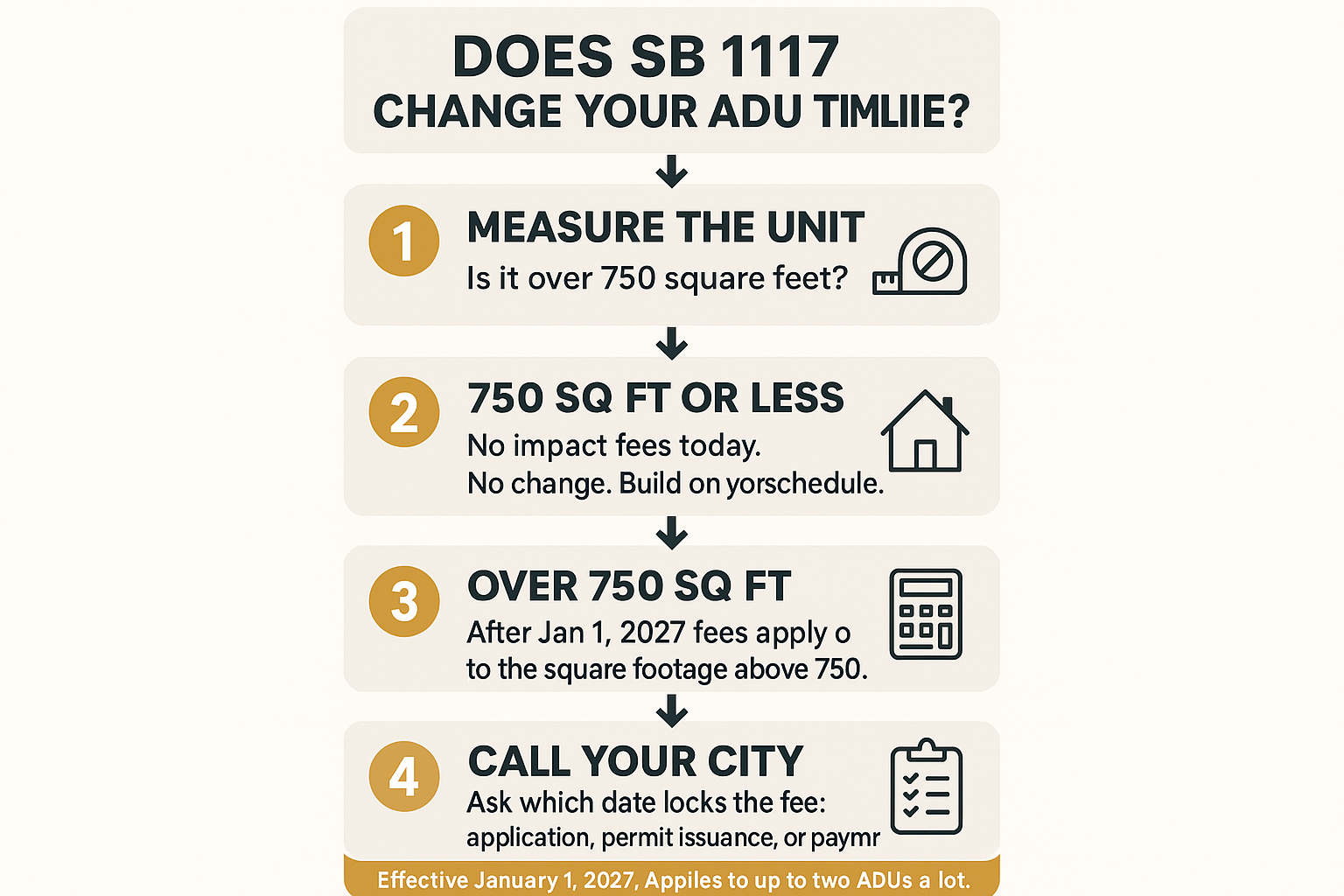
Should You Wait Until January to Apply?
If your unit is meaningfully over 750 square feet, waiting could save real money. But the savings depend on one question I cannot answer for you, and neither can a blog post.
Ask your city which date locks in your fee. Jurisdictions handle this differently. The fee that applies might be tied to the date your application is deemed complete, the date the permit is issued, or the date fees are actually paid. Get that answer in writing before you build a timeline around it.
Then weigh what waiting actually costs:
- Plan review on the Peninsula is not quick, so a January application is not a January permit
- Pushing the start into winter means framing and exterior work during the wet months
- Material and labor costs do not sit still while you wait
The honest version: for a unit at 800 or 900 square feet, the savings may be modest enough that a three month delay is a wash. For a larger unit in a city with steep water and sewer connection charges, it can be worth every week. Run the real numbers from your real fee schedule, not an estimate. The legal summary from Brownstein Hyatt Farber Schreck on California’s 2026 housing bills covers the statutory language if you want to bring something to the counter with you.
What Still Applies on the Monterey Peninsula
A fee change is not a permit exemption. A few local realities do not move:
- Coastal zone rules still apply. State ADU law does not override the California Coastal Act. If your lot sits in the coastal zone in Pacific Grove, Carmel, Monterey, Marina, or Seaside, a coastal development permit may still be part of the path.
- School district fees follow their own rules. Those are set under separate state law and are not the same thing as local impact fees. Ask the district directly.
- Utility capacity on the Peninsula is its own conversation. Water in particular. Talk to your water purveyor early, not late.
SB 1117 also carried a second piece worth knowing about. The bill package tightened the prohibition on deed restrictions and common interest development governing documents that prohibit or unreasonably restrict ADUs and junior ADUs, and that prohibition now applies to any lot zoned to allow single family residential use. If an HOA document has been the thing stopping you, it may be worth a second look.
And one practical note from my side of the job. Inspections no longer have to mean a full day blocked off at home, since California is moving toward remote video building inspections for qualifying work. For a long ADU build with many inspection stops, that adds up.
Where the Money Goes Once the Fees Drop
Here is what I see happen when a fee line shrinks. The money does not disappear from the project. It moves to finishes.
That is usually the right call, because finishes are what you live with. On an ADU built for a parent, a tenant, or a long term rental in Monterey County, the things that hold up are not the showy ones:
- Real surface preparation before paint, especially on anything facing the marine layer
- Trim and door finishes that can take repeated cleaning
- Flooring and coatings matched to a slab that was actually tested for moisture
- Exterior coatings chosen for salt air and UV, not just color
If you are collecting bids for the finish work, read them side by side with a hard eye on the prep line. I put together a breakdown of what a painting estimate should actually tell you because the cheapest number on the stack is almost always the one skipping preparation. And if you are weighing an ADU against simply selling and moving, the stay and renovate math for Peninsula homeowners has shifted quite a bit in the last two years.
Frequently Asked Questions About SB 1117 and ADU Impact Fees
When exactly does the new ADU impact fee rule start?
January 1, 2027. SB 1117 was signed on September 29, 2026 as Chapter 809, Statutes of 2026.
My ADU is 700 square feet. Do I save anything?
No, because you already pay nothing. ADUs of 750 square feet or less and junior ADUs of 500 square feet or less are already exempt from impact fees, and SB 1117 does not change that.
Does this cover more than one unit on my lot?
The new formula applies to up to two ADUs on a lot. Beyond that, ask your city how they handle it.
Does this mean my ADU permit gets cheaper too?
No. SB 1117 addresses impact fees, which are capacity and service charges from the city or a district. Your building permit, plan check, and inspection fees are separate and unaffected. Those are two different lines on two different invoices, and people conflate them all the time.
If I apply in December but get my permit in February, which fee applies?
That depends on your jurisdiction’s rules about when a fee is set. Some tie it to a complete application, some to permit issuance, some to payment. Call the planning counter and ask specifically, and get the answer in writing before you plan around it.
Do I still need a coastal development permit?
Possibly, yes. State ADU law does not override the California Coastal Act, so a lot in the coastal zone on the Peninsula can still trigger coastal review regardless of how the impact fees are calculated.
Planning the Finish Work on a Monterey County ADU?
Fee schedules and permit timing are questions for your city. The painting, drywall, cabinets, and coatings that come after are the part we handle, across Salinas, Monterey, Pacific Grove, Carmel, and the rest of the Peninsula. If you want a walkthrough and a written estimate once your plans are settled, Legacy Painting and Renovating can be reached at (831) 917-0047 or through the contact form at legacypaintingrenovating.com.