Direct Answer: A good painting estimate lists the exact surfaces, the prep steps included, the number of coats, the product line, and how your home will be protected. A single price with no detail tells you nothing.
Most homeowners I meet in Monterey County are not trying to find the cheapest painter. They are trying to figure out which of the three numbers in front of them is honest.
And that is hard to do when one estimate is four pages long and another is a single line that says “paint exterior” with a price under it. Several people who reach out to us say the same thing: they are still planning and comparing pricing before they book anything.
That comparing stage is exactly where a vague estimate does the most damage. Below is what a painting estimate should spell out, why prep is usually where the price gap lives, and what California law already requires your contractor to put in writing.
Why a Thin Estimate Costs You More Later
A low bid is not always a bad bid. But a low bid with no detail is a guess, and you are the one carrying the risk of that guess.
Here is how it usually plays out. The number looks great, work starts, and then the conversation turns to dry rot, peeling paint that needs sanding, or the trim that was never included in the first place. Now you are approving change orders on a schedule you did not plan.
I had a homeowner write in describing a two-story stucco home of about 1,200 square feet, with one wall attached to a neighbor and a request to skip the sprayer on that side. That is a real scope detail. If it is not written into the estimate, it is not a plan, it is a hope.
The estimate is the only document you have before the first drop cloth goes down. It should answer these questions without you having to ask:
- Which surfaces are being painted, and which are not
- What prep is included, step by step
- How many coats of finish paint
- What product line and sheen
- How floors, furniture, and landscaping get protected
- What happens if carpentry repairs are needed

How to Read a Painting Estimate: What to Look For Line by Line
When I walk a home in Pacific Grove or Carmel, the walkthrough usually takes about thirty minutes. What comes out of it should read like a plan, not a receipt.
Surfaces. “Exterior” is not a scope. Body, trim, fascia, eaves, doors, garage door, and shutters should each be named or clearly excluded.
Prep. This is the part that separates a five-year paint job from a twelve-year one. Look for pressure washing, scraping, sanding, caulking, spot priming or full priming, and drywall or stucco patching.
Coats. Two coats over a primed surface is a different product than one coat over whatever is there now. Deep color changes often need more, and that should be stated.
Products. The estimate should name the paint line and sheen. If you are in a coastal pocket near Pebble Beach or the Monterey shoreline, the exterior product matters more than most people realize, because salt air and marine layer moisture wear coatings differently than inland weather does.
Site expectations. Where crews park, how furniture gets moved and replaced, what gets covered, and who cleans up at the end of each day.
Exclusions. Good estimates say what is not included. Dry rot and carpentry are often quoted separately after the wood is opened up, and that is a fair way to handle it as long as it is disclosed up front.
Vague Line Items vs. Clear Ones
Here is the same job written two ways. The difference is not wording, it is accountability.
| What you might see | What you actually want to see | Why it matters |
|---|---|---|
| Paint exterior | Wash, scrape, sand, caulk, spot prime, then two coats on body, trim, fascia, and garage door | Names the surfaces and the prep so nothing gets quietly dropped |
| Prep as needed | Pressure wash all elevations, sand failing areas to sound edge, caulk all trim joints, prime bare wood and stucco | “As needed” is decided later, usually not in your favor |
| Premium paint | Specific manufacturer, product line, and sheen for body and trim | Product tier drives both cost and how long it holds up in fog and sun |
| Interior painting, whole house | Walls, ceilings, trim, and baseboards listed room by room with wall condition noted | Ceilings and trim are the most common surprise add-ons |
| Deposit due at signing | A deposit within the state limit, with a written payment schedule tied to progress | California caps what a contractor can ask for before work begins |
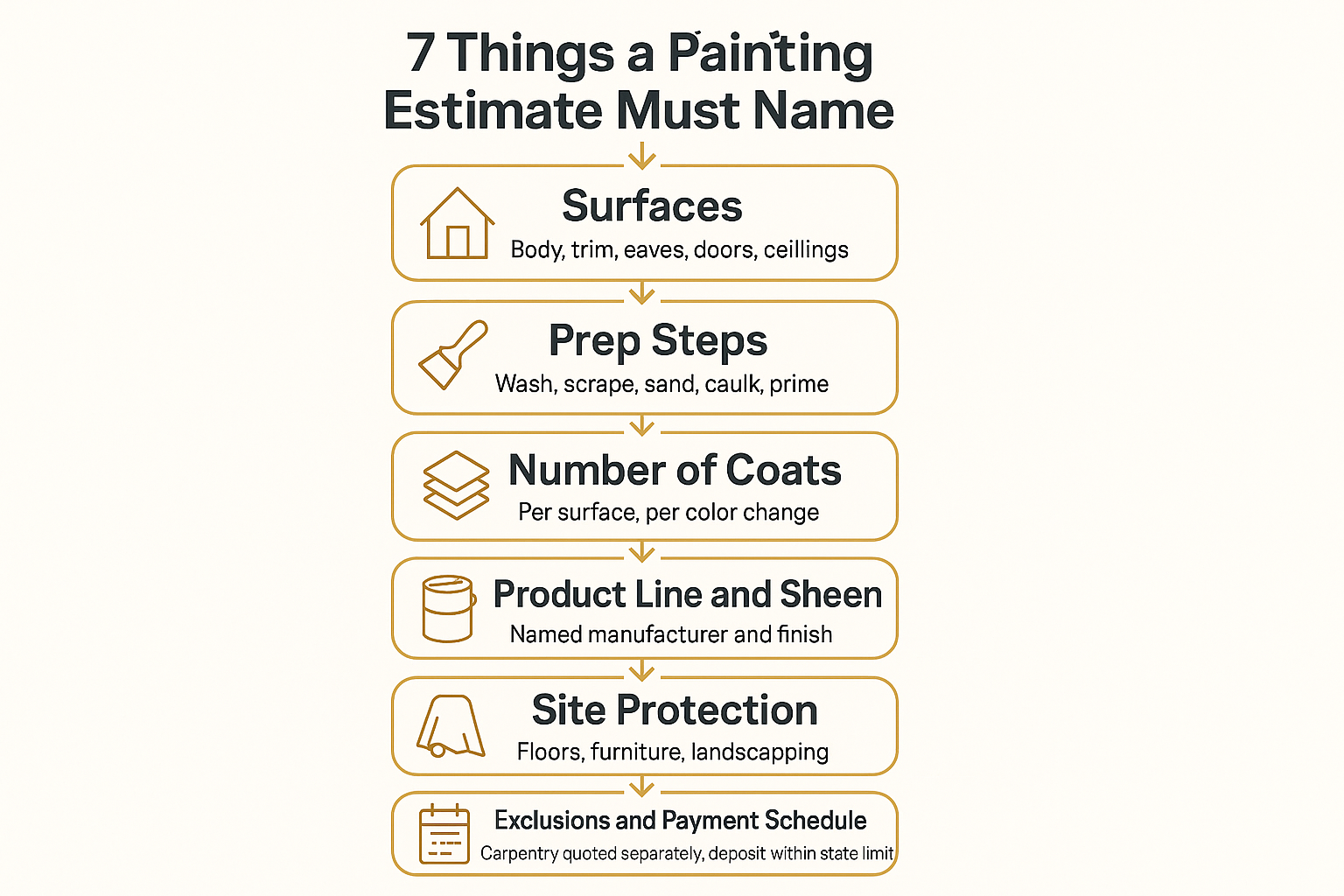
The Seven Things Your Estimate Should Name
Use this as a checklist when you sit down with two or three bids for the same project.
Prep Is Where the Price Difference Usually Lives
If you take one thing from this article, take this: when you compare two estimates for the same house, ask each contractor exactly what prep is included.
On a typical repaint, surface preparation and labor make up roughly three quarters of the cost. Paint is the smaller share. So when one bid comes in far below the others, the savings almost never come from cheaper paint. They come from skipped steps.
Common things a low bid quietly leaves out:
- Washing salt film and mildew off the siding before painting
- Caulking trim joints and window perimeters
- Priming bare wood, patched stucco, and chalky surfaces
- Sanding failed edges back to something sound
- Lead-safe containment on homes built before 1978
That last one is not optional. A large share of homes in Pacific Grove, Carmel, and older Monterey neighborhoods predate 1978, and the lead-safe rules change how the work has to be done, which shows up in the price.
Paint applied over a dirty, uncaulked, unprimed surface will look fine in March and start telling on itself by the second winter. Then you pay twice. If you want the full picture of what real prep involves, here is what it actually includes.
What California Law Already Requires in Writing
A lot of homeowners do not know this one, and it is a useful filter.
For home improvement contracts, the Contractors State License Board caps the down payment a contractor can require at 10% of the contract price or $1,000, whichever is less. If someone hands you an estimate and asks for half up front before any work starts, that is worth pausing over.
The CSLB also requires licensed contractors to put specific terms in a written agreement, including the scope of work, the payment schedule, and an approximate start and completion date. Ours carries license #1066829, and any bid you take seriously should show a license number you can look up in about a minute.
California also updated what contractors owe homeowners in writing, and it is worth knowing how those contract rules changed before you sign anything.
One review that stuck with me came from a retired general contractor who wrote that our crew “kept everything protected and clean, made carpentry repairs as expected and needed, and finished on time.” Every one of those things is something an estimate can promise in advance. The document is where you confirm it, not the job site.
Frequently Asked Questions About Painting Estimates
Should a painting estimate include a start and finish date?
Yes. California requires an approximate start date and completion date in a written home improvement contract. On the Peninsula I also like to build in a little room for weather, because a heavy marine layer morning can push exterior work later in the day.
Why did two contractors quote such different prices for the same house?
Almost always prep and scope. One may be including washing, caulking, priming, and two full coats while the other is quoting a single coat over whatever is there. Ask both to walk you through their prep list side by side and the gap usually explains itself.
Is an online cost calculator good enough to budget with?
It is a decent planning figure, not a bid. Square footage alone cannot see peeling stucco, dry rot behind trim, or two-story access. We cover what a calculator can and cannot tell you in more detail, but an on-site walkthrough is what produces a real number.
Do estimates usually cover carpentry or dry rot repair?
Often not, and that is normal. Nobody can price hidden wood damage from the driveway. What matters is that the estimate says so clearly and explains how repairs will be priced once the surface is opened up.
How long should a painting estimate take?
For most homes in Monterey County, a walkthrough runs about thirty minutes. If someone quotes your exterior from the curb without measuring or looking at the condition of the siding, the number they give you is a placeholder.
Comparing estimates for a project in Monterey County?
If you are in the planning stage and want a written scope you can actually compare against other bids, our team walks homes across Salinas, Monterey, Pacific Grove, and Carmel and puts the prep, coats, products, and site expectations in writing. Estimates are free and there is no obligation to book. You can reach us at (831) 917-0047 or through the contact form at legacypaintingrenovating.com.