Direct Answer: High Peninsula prices, thin inventory, and hesitant buyers have pushed many Monterey County owners to improve the home they already have instead of moving up in 2026.
Most of the homeowners I talk to in Monterey County started the same way. They ran the numbers on selling, looked at what they could actually buy on the Peninsula with today’s rates, and decided the smarter move was to stay put and fix what they already own.
That decision changes everything about how you should think about your house. A home you plan to sell in two years gets cosmetic work. A home you plan to live in for another ten years needs protection, especially here where salt air and marine layer humidity chew through exterior finishes faster than they do inland.
I want to walk through the math behind this shift, what our coastal climate actually does to a house you plan to keep, and how I’d sequence the work if I were standing in your driveway.
The math behind the stay and renovate trend for Monterey homeowners in 2026
Peninsula prices have not softened the way people expected. Inventory in Monterey, Pacific Grove, and Carmel stays thin, and the trade-up buyer who wants more space keeps running into the same wall: the next house costs more and carries a much higher monthly payment than the loan they already have.
So the money goes back into the current house instead. Nationally, Harvard’s Joint Center for Housing Studies projects homeowner improvement spending will reach roughly $522 billion by the end of 2026. On the ground here, I see the same pattern in the calls we get.
What that looks like locally:
- Long-term owners in Monterey and Seaside finally addressing exterior paint they have put off for 8 to 12 years
- Buyers who just closed and want paint and flooring done before the furniture arrives
- Owners converting a tub and shower combo to a walk-in shower so the house works for the next decade
- Kitchens and cabinets getting refinished instead of ripped out
None of that is glamorous. But it is where the return actually lives when you are not selling.

What another decade in a coastal home actually costs you
The Peninsula is harder on a house than almost anywhere else in California. It is not the rain totals. It is the combination.
- Salt air carries in off the bay and settles into every horizontal surface, siding, railing, and deck board
- Marine layer humidity keeps wood damp into midmorning, which slows drying and feeds mildew on north-facing walls
- Fog to sun cycling expands and contracts siding and trim almost daily, which is what opens the hairline cracks you see at joints and nail heads
- UV exposure on south and west elevations burns through a coating years before the shaded sides show any wear
That is why a house here rarely fails evenly. I have looked at homes in Pacific Grove where the north side still looks fine and the south side is chalky and cracking. Same paint, same crew, same day.
When you commit to staying, the job shifts from making it look good to keeping water out of the wall. That means caulking, priming bare wood, sanding failed edges, and repairing drywall or trim damage before a single gallon of finish coat goes on. Skipping that is how people end up repainting in four years instead of ten.
Which projects fit a stay and invest decision
Here is how I sort projects when a homeowner tells me they are staying for the long haul. The timing column reflects how our fog and sun seasons actually run.
| Project | Why it fits a long stay | Best window on the Peninsula |
|---|---|---|
| Exterior repaint with full prep | Protects the building envelope before another wet season | Late spring through early fall, once morning fog burns off reliably |
| Deck refinishing and wood staining | Slows UV graying and salt damage on boards and railings | Before peak summer sun, after decking has dried out |
| Cabinet painting and refinishing | Changes the kitchen daily without a full demo | Any time of year, interior work |
| Interior repaint and drywall repair | No permit needed, immediate change in how the house feels | Winter months when exterior work stalls |
| Bathroom or kitchen remodel | Fixes layout problems you live with every day | Plan ahead, these carry design and permit lead time |
How I’d sequence the work
If you have a fixed budget and a long timeline, order matters more than scope. This is the sequence I recommend most often.
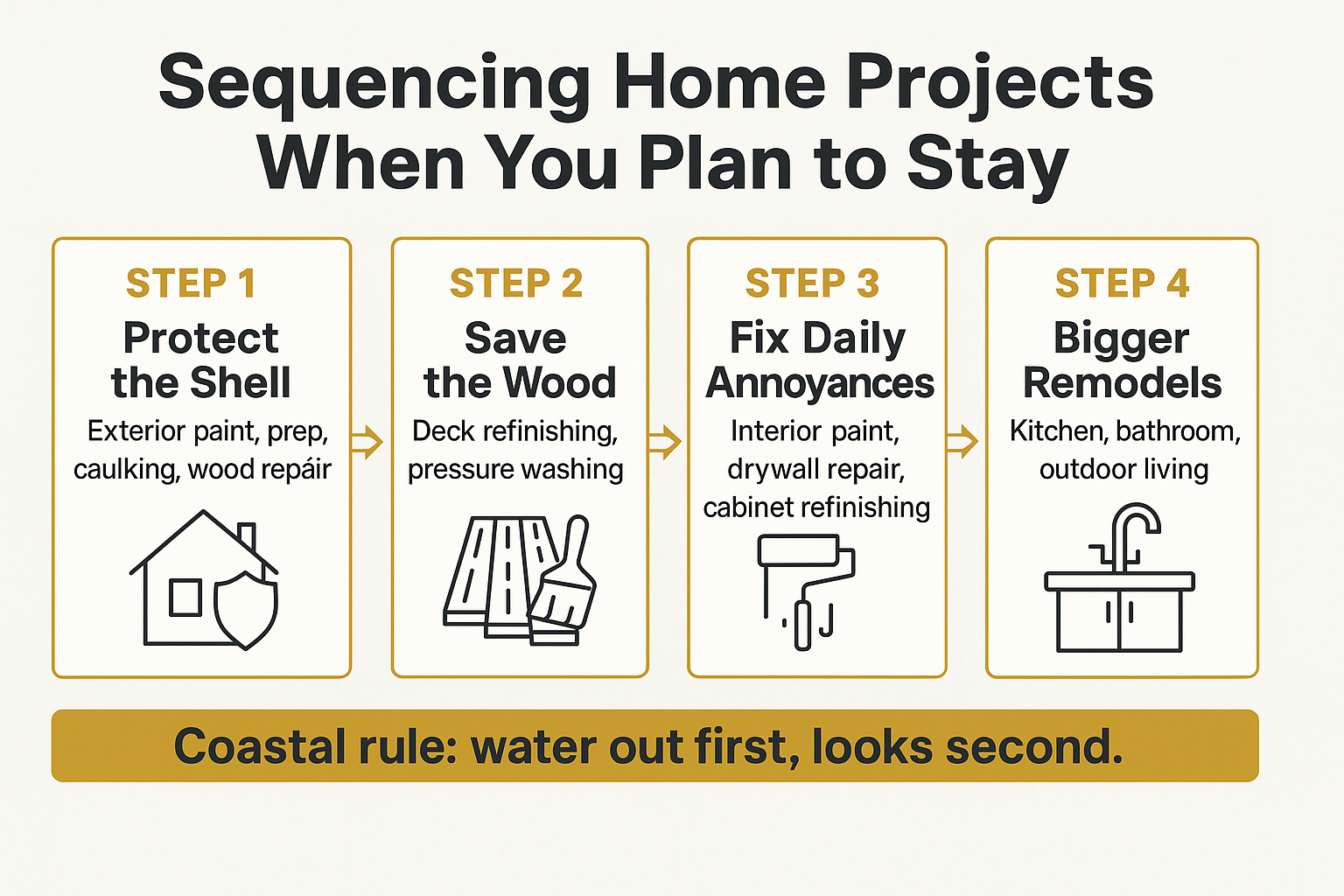
Long-term owners and new buyers need different first moves
These two groups call me with the same question and need opposite answers.
If you have owned the home for years, your first move is almost always outside. You know where the drafts are and which trim looks tired. Walk the south and west walls, look for chalking you can rub off with your thumb, and check the bottom edge of siding and door casings for soft wood.
If you just bought, do the interior work before you move in. Empty rooms paint faster, cost less to prep, and you never have to live around drop cloths. Floors and paint together, in that window, is the cheapest that work will ever be for you.
New buyers also tend to inherit decisions someone else made. A kitchen with solid boxes and dated doors is a refinishing candidate, not a demo candidate, and it is worth understanding when a cabinet repaint beats full replacement before you price out new cabinetry. If a full remodel really is the right call, there are kitchen remodel decisions that catch Monterey homeowners off guard and are worth reading before you start.
You are allowed to be in the planning stage
A lot of the messages we get open with some version of “we are still planning and comparing pricing.” One homeowner told us exactly that about a two story stucco exterior. Another simply asked whether we cover Salinas before mentioning any project at all.
That is a normal place to be, and a good estimator should be fine with it. What makes those conversations useful is having a few details ready:
- Rough square footage and number of stories
- Siding type, stucco, wood, or a mix
- Anything unusual, like a shared wall with a neighbor or paint you suspect contains lead
- Whether you want color help or already have a palette
On cost, I will not give you a number in an article, and you should be skeptical of anyone who does. Price on the Peninsula moves with prep hours, access and height, how much bare wood or repair work is involved, and coating quality. Two houses with identical square footage can land far apart once prep is scoped honestly.
What you can control is how you compare bids. Read what the prep section actually says. Confirm the license through the CSLB and confirm insurance. And know that as of 2026, California law changed what a contractor owes you in writing, which gives you more to compare than a bottom line number.
Frequently Asked Questions About Renovating Instead of Moving
Does exterior paint really wear out faster near the coast?
Yes. Between salt air, morning fog, and daily temperature swings, exterior finishes on the Peninsula typically need attention sooner than the same paint would inland. The south and west facing walls almost always fail first.
Do I need a permit for the work I’m considering?
Painting, staining, deck refinishing, and cabinet refinishing generally do not require permits. Structural changes, moving plumbing, or reworking a bathroom layout are a different conversation, and your city or county building department is the right place to confirm. Monterey, Pacific Grove, and Carmel each handle it a little differently.
Is it worth painting if I might sell in a few years anyway?
Different goal, different scope. If you are selling soon, you are buying curb appeal. If you are staying ten years, you are buying protection, and that means paying for the prep work that keeps water out of the wall.
What should I do first if I just bought the house?
Interior paint and flooring before you move furniture in, if the timing allows. It is faster, cleaner, and cheaper in an empty house than it will ever be again.
How far do most Monterey Peninsula contractors travel?
Service areas vary. Ours covers Salinas, Monterey, Pacific Grove, Carmel, Carmel Valley, Pebble Beach, Marina, Seaside, and out toward Gonzales and Soledad. It is always worth asking upfront so nobody wastes a trip.
Thinking through your next project?
If you are staying in your Monterey County home and trying to figure out what to tackle first, a walkthrough and a written estimate cost you nothing. Legacy Painting and Renovating works across Salinas, Monterey, Pacific Grove, Carmel, and the surrounding Peninsula communities, and we are happy to talk through options even if you are months out from starting. You can reach us at (831) 917-0047 or through the contact form at legacypaintingrenovating.com.