Direct Answer: Outdoor wood on the Monterey coast needs a penetrating stain, thorough cleaning and drying before application, and a refresh every two to three years on sun and fog exposed surfaces.
You walk past your front porch pillars every day and one morning you notice they have gone gray. Maybe the stain has gone blotchy, or the bottom of a post feels soft when you press a thumbnail into it. On the Monterey Peninsula, that shift happens faster than most homeowners expect.
A property owner in the Monterey area recently reached out asking about staining and maintaining outdoor wooden pillars. That request comes up more than you would think, because structural wood outdoors here takes a beating from salt air, marine layer moisture, and afternoon UV all in the same week.
I want to walk you through the three things that actually decide how your outdoor wood holds up: the finish you choose, the prep underneath it, and how often you plan to come back. Everything else is detail.
Stain or Paint? What Works Best on Exterior Structural Wood
This is the first fork in the road, and it matters more on the coast than inland.
Stain penetrates the wood fiber. It soaks in, colors the grain, and leaves no real film on the surface. Because there is no film, the wood can move and breathe as humidity swings between a foggy Pacific Grove morning and a dry afternoon.
Paint forms a film on top. That film can look sharp for years, and on some trim and siding it is the right call. But a film is only as good as what is underneath it.
Two ways a film-forming finish gets you in trouble on exterior structural wood:
- It goes on over wood that was not dry enough, and the trapped moisture has nowhere to go
- The film cracks or opens at a joint, water gets behind it, and decay starts where you cannot see it
With stain, failure shows up as fading and graying on the surface. It looks bad before it becomes a real problem, which gives you time to act. With a cracked paint film on a post, the wood can be rotting behind a finish that still looks fine from ten feet away.
The right choice depends on the wood species, the current condition of the surface, and how much direct sun and moisture that piece takes. A pergola beam in full Carmel Valley sun is a different conversation than a shaded pillar under a deep porch overhang.
Prep Is Where Coastal Stain Jobs Are Won or Lost
This is the part homeowners underestimate, and it is the reason two identical stain products can perform completely differently on the same street.
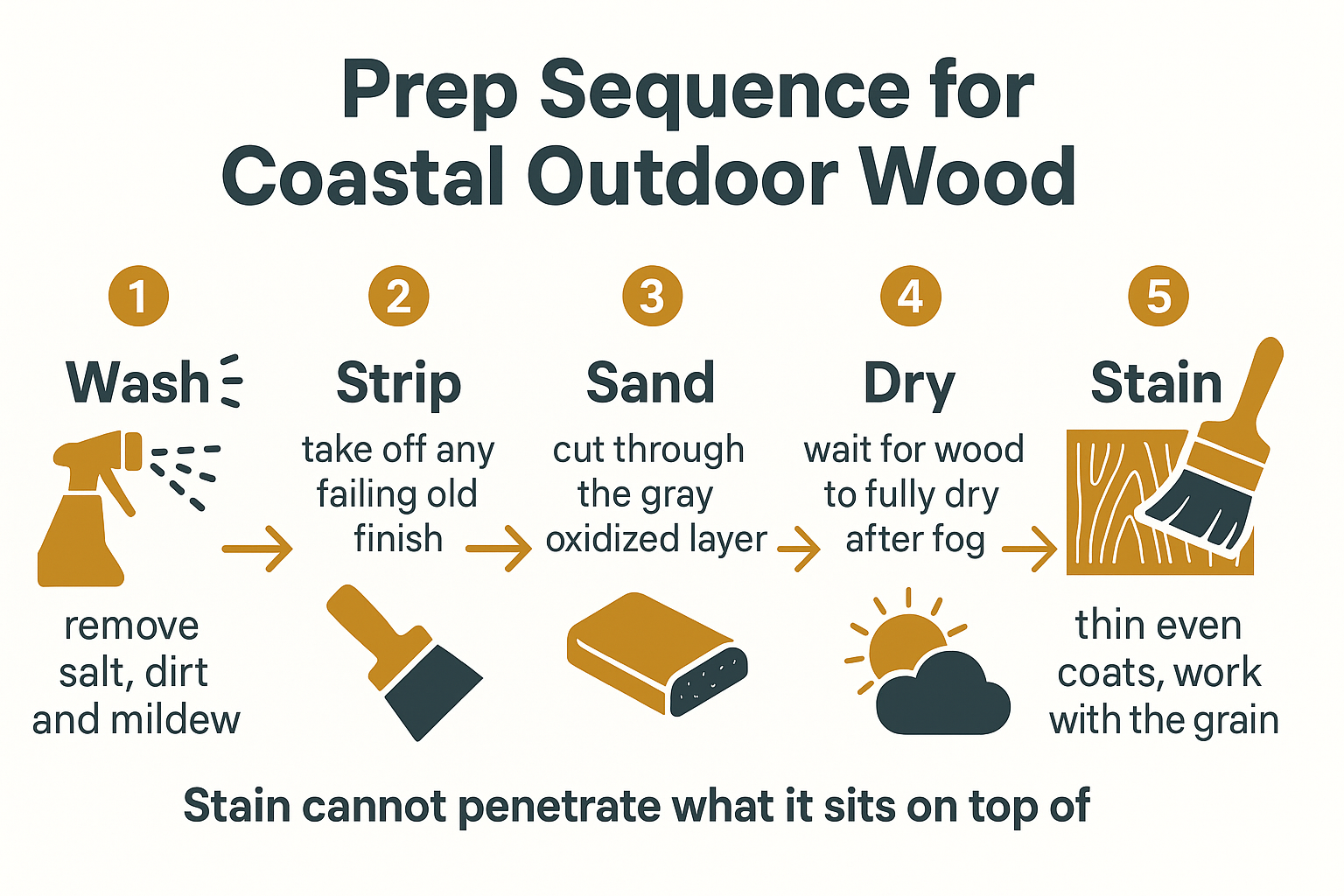
Stain has to soak in to work. It cannot soak into salt residue, an old finish, or that soft gray oxidized layer that forms on weathered wood. Put stain on top of any of those and it sits there, then peels or blotches within a season.
Good prep on outdoor structural wood looks like this:
- Wash the surface. Pressure washing works on sound wood at the right pressure and distance. On older or softer wood, hand washing with a brush and cleaner is safer.
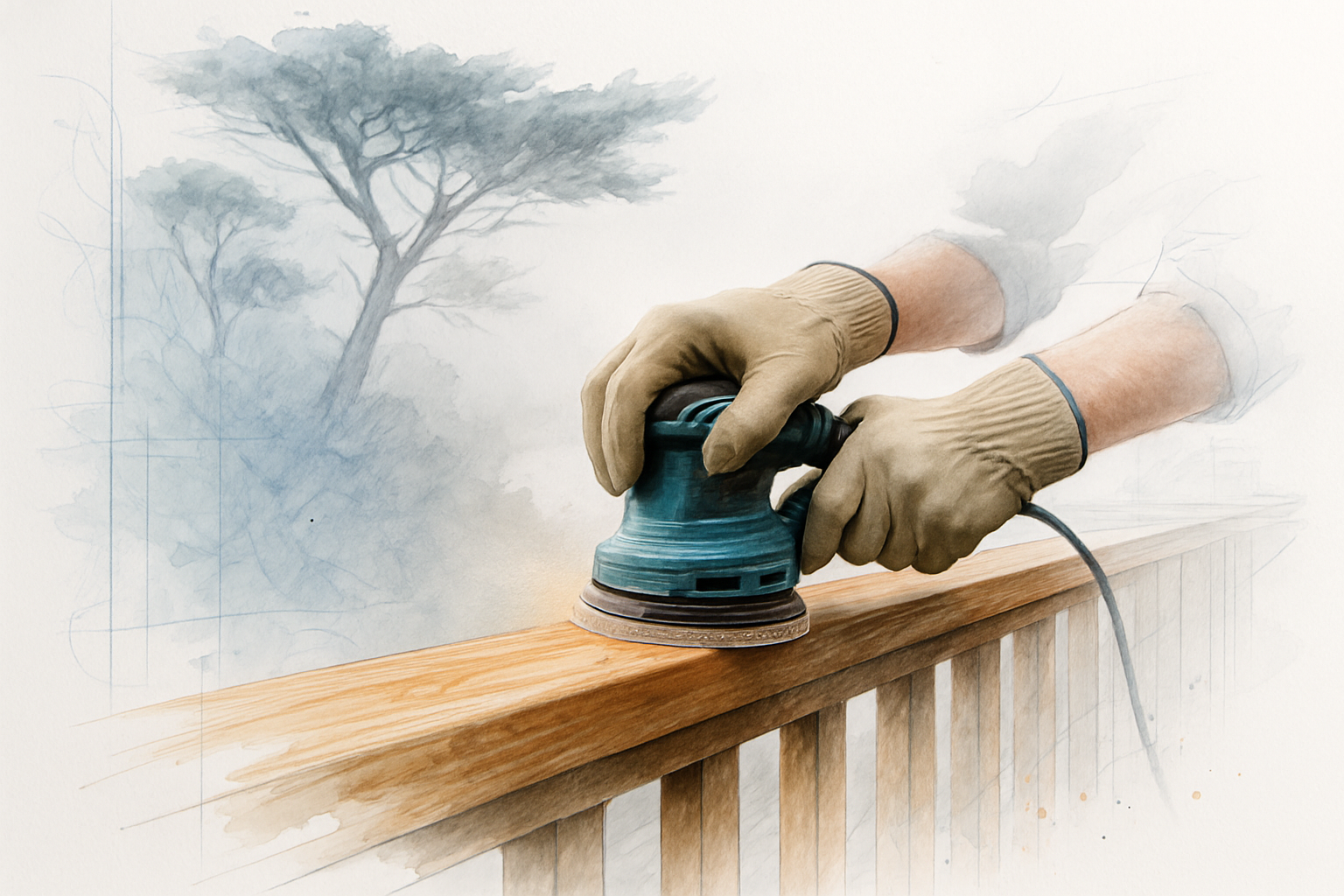
- Remove the gray layer. Weathered wood needs light sanding to cut through oxidation and open the grain back up so stain can penetrate.
- Deal with old finish. If there is a failing film on the wood, it comes off. Stain will not bond over a partial film.
- Let it dry all the way. This is the step people skip.
That last one is the big one here. Inland, wood dries in a day or two. On the Peninsula, a washed railing sitting under a June marine layer can hold moisture for the better part of a week. We check before we coat rather than guessing off the calendar.
The USDA Forest Products Laboratory has published for decades on how wood moisture content drives finish performance, and the short version matches what we see in the field: coat wet wood and you have already lost.
Realistic Refresh Windows for Outdoor Wood on the Peninsula
A stain label rated for three to five years is written for average national conditions. Here is closer to what I see on Monterey County homes, based on exposure rather than the can.
| Surface | Exposure Level | Typical Refresh Window Here |
|---|---|---|
| South or west facing deck railing | Full afternoon sun plus fog cycles | Roughly every 2 to 3 years |
| Porch pillars and posts | Partial sun, splash and ground moisture | Roughly every 3 to 4 years |
| Pergola or arbor beams | Direct overhead UV all day | Roughly every 2 to 3 years |
| Fascia under a deep overhang | Shaded and largely sheltered | Often 5 years or more |
| Fence sections facing coastal wind | Salt-laden wind, driving moisture | Roughly every 2 to 4 years |
The Prep Sequence That Makes Stain Last
Every step below happens before any stain touches the wood. Skipping one shortens the life of the whole job.
Why the Railing and the Fascia Need Different Plans
One of our reviews mentions our crew having “Painted large railings on a large deck!” That job sticks with me as a good example of why you cannot treat a whole house exterior as one surface.
A deck railing is the hardest working wood on most homes. It gets hands on it, drinks set on it, direct sun on the top rail, and moisture pooling in the joints where balusters meet. A fascia board on the same house, tucked under an eave, might go twice as long between refreshes.
So when I walk a property, I am sorting the wood into groups:
- High touch and high sun surfaces like top rails, stair treads, and gate tops that need the most frequent attention
- Structural elements like posts and beams where hidden moisture is the real risk, not appearance
- Sheltered trim and fascia where a longer cycle is honest
Budgeting this way is easier on the wallet, too. You maintain the punishing surfaces on a tighter cycle and leave the protected ones alone until they actually need it. If your deck itself is part of the picture, when to refinish a deck on the Monterey coast covers the timing side in more detail.
What Drives the Cost of Staining Outdoor Wood Here
I get asked for a number before anyone has looked at the wood, and I understand why. Costs vary a lot on this kind of work, so instead of a figure, here is what actually moves it.
Things that push the price up:
- Condition of the existing finish. Sound wood needing a wash and light sand is straightforward. Widespread peeling or a full strip is a different level of labor.
- Access and height. Second story pergola beams or a hillside deck in Pebble Beach mean staging time before any work starts.
- Dry rot and carpentry. Soft or damaged wood gets addressed before finishing, and that is quoted separately after an on-site look.
- Number of individual pieces. Fifty balusters take far longer than the same square footage of flat siding.
- Product choice. Low-VOC and CARB-compliant coatings and marine-grade products carry different material costs.
Across most repaint and refinish work here, prep and labor make up the large majority of the cost while the product itself is the smaller share. That is worth remembering when one bid comes in far under the others. Usually the gap is prep that is not happening.
For a planning range on a whole exterior, the interactive cost estimator on our site gives Peninsula-specific numbers rather than national averages. An exact price still takes a walkthrough.
Frequently Asked Questions About Staining Outdoor Wood on the Coast
Can I just stain over the old stain without stripping it?
Sometimes, and it depends on what is there. A penetrating stain that has simply faded can often be recoated after a good wash and light sand. But if the old product left a film that is peeling or flaking, it needs to come off first, because new stain will not penetrate through it.
How long should I wait after pressure washing before staining?
Longer than you want to. Inland you might get away with a day or two, but on the Peninsula with the marine layer rolling in most mornings, wood can hold moisture for several days. We check the wood rather than the calendar, and in fog-heavy stretches that can mean waiting most of a week.
What time of year is best for staining outdoor wood in Monterey County?
Late summer into early fall tends to give the most usable dry windows here. Deep winter brings rain and long drying times, and peak marine layer months can keep surfaces damp well past mid-morning. The daily timing matters too, which is covered in our piece on the right time of day to paint an exterior.
My posts look fine but feel soft near the bottom. Is stain enough?
No. Soft wood means moisture has already gotten in and decay has started. Finishing over it hides the problem instead of solving it. Those sections need to be evaluated and repaired first, then finished.
Is stain always better than paint for outdoor wood?
Not always. Paint gives more UV protection and a wider color range, and on some trim and siding it is the better long-term choice. For exposed structural wood that moves with humidity, a penetrating stain usually gives me fewer moisture headaches over time.
Thinking Through Your Outdoor Wood Maintenance Plan?
If you want a second set of eyes on your pillars, railings, or pergola before deciding what they need, our team works throughout Monterey County, from Pacific Grove and Carmel to Salinas and Seaside. A walkthrough takes about thirty minutes and there is no obligation attached to it. You can reach Legacy Painting and Renovating at (831) 917-0047 or through the contact form at legacypaintingrenovating.com whenever you are ready to talk it over.