Direct Answer: Pressure washing removes salt film, mildew, dirt, and loose chalk so paint can bond. It does not fix failed caulk, soft wood, or peeling paint. A clean wall and a sound wall are different things.
You walk the north side of the house and the siding looks green and dingy. The sunny side just looks faded and chalky. And the first thought is almost always the same: maybe it only needs a good wash.
Sometimes that is true. On the Monterey Peninsula, a wash can take years off the look of a house without touching a brush. But I have also walked homes that came out of a wash looking great and were still a bad candidate for paint that same week.
This article covers what pressure washing before exterior painting on the Monterey coast actually accomplishes, what it never fixes, how much pressure each siding type can take, and how long a wet wall really needs to dry around here.
A Clean Wall and a Sound Wall Are Two Different Things
Washing is the first step of surface preparation. It is not a repair.
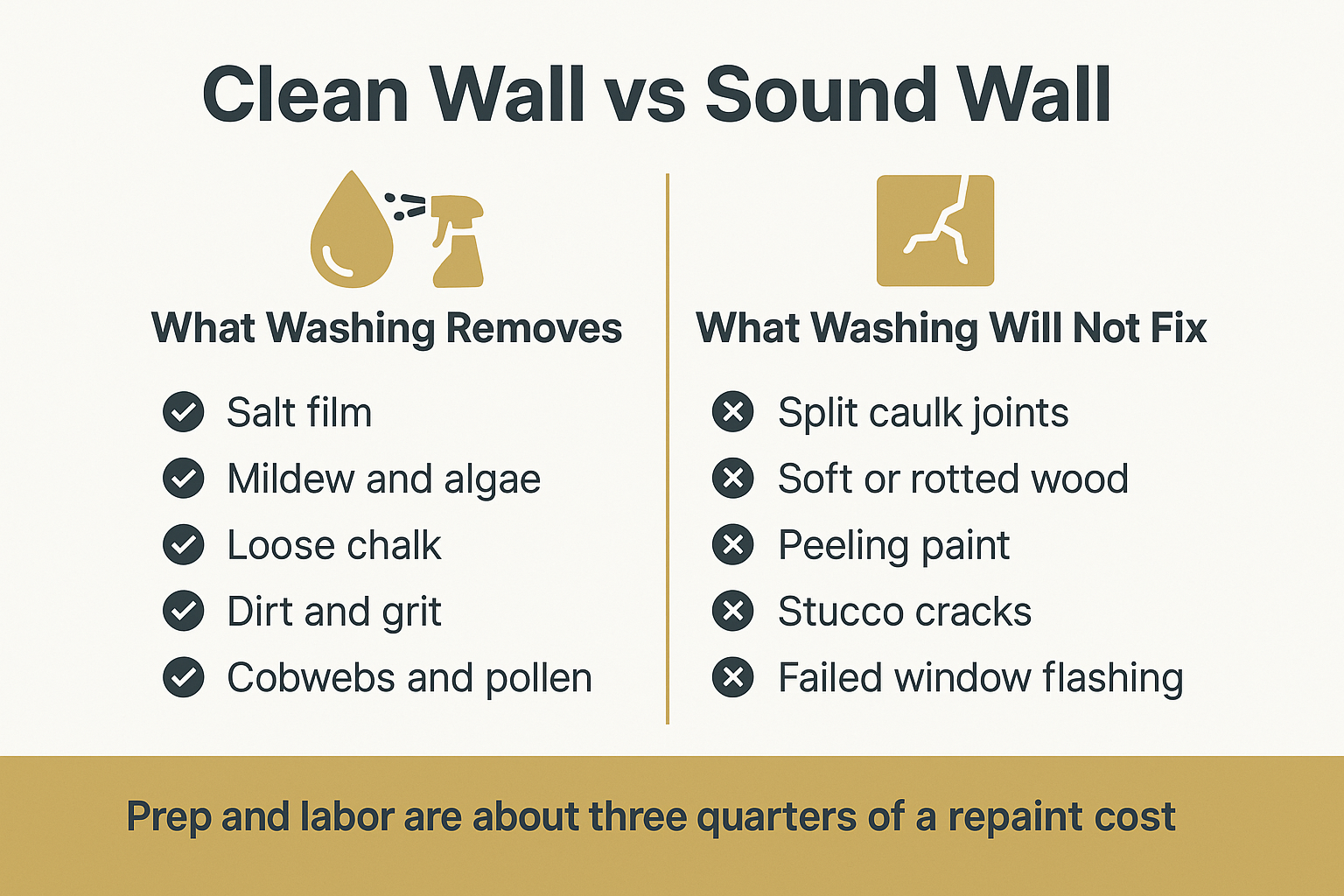
Here is what a wash genuinely removes:
- Salt film left behind by coastal air, which blocks paint from bonding even when the wall looks fine
- Mildew and algae on shaded elevations
- Loose chalk from oxidized old paint, the powder that comes off on your hand
- Dirt, cobwebs, pollen, and fine grit sitting in stucco texture
Here is what a wash does not touch:
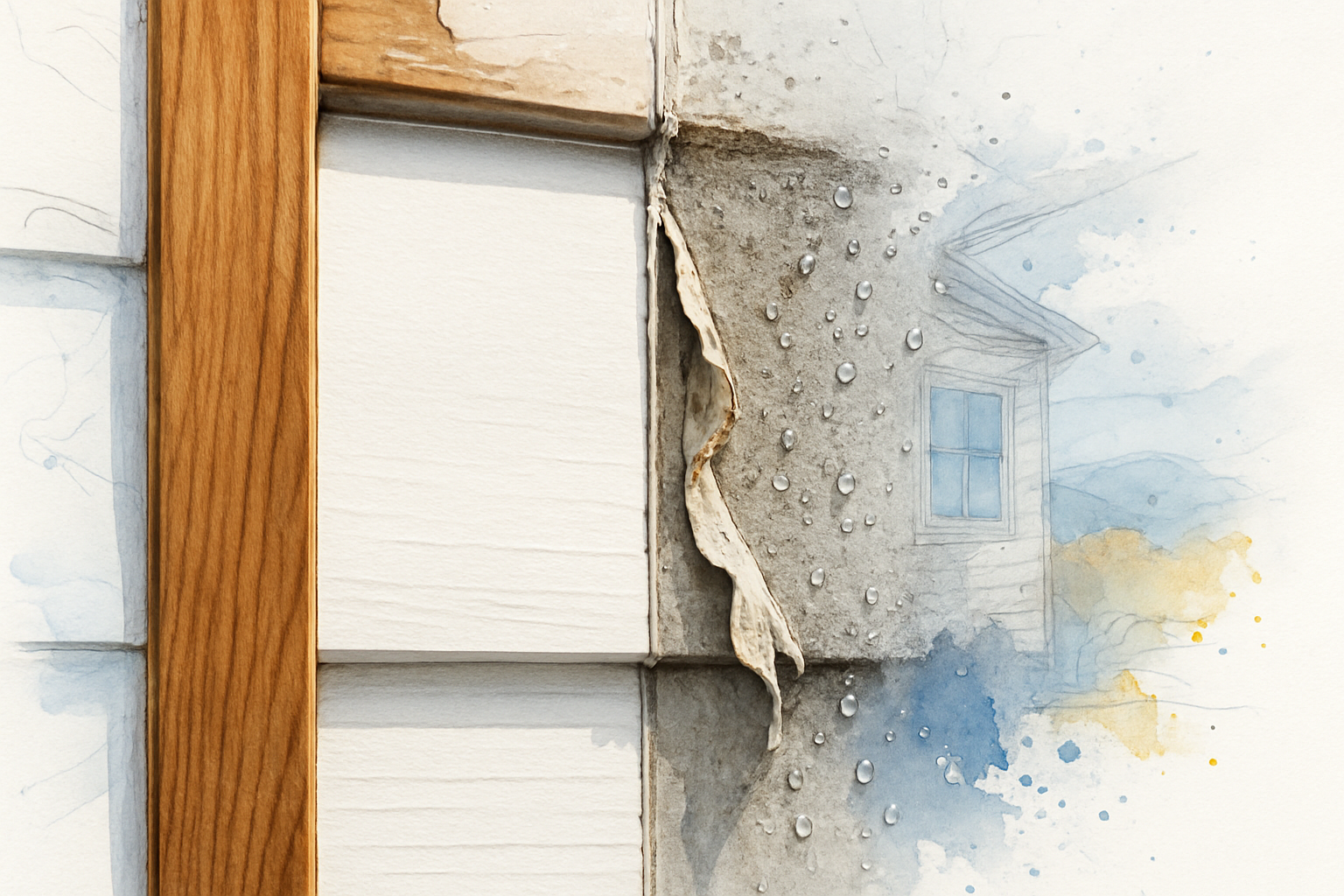
- Caulk joints that have split open at trim, windows, and siding seams
- Soft or spongy wood at fascia boards, railings, and door bottoms
- Paint that lost its grip years ago and is peeling in sheets
- Hairline stucco cracks that are letting water into the wall
One homeowner wrote to us about a bathroom where the previous owner painted without prepping, and the paint had started peeling off in sections. That is the exact same failure, just at a much smaller scale than an exterior wall.
Our cost estimator tells homeowners something most people find surprising: surface prep and labor make up roughly three quarters of a typical repaint, and the paint itself is the smaller share. Washing is a real part of that work. It just is not the whole job.
Why Peninsula Houses Get Dirty in a Way Inland Houses Do Not
Drive over the hill to Salinas on a July morning and the air is dry by nine. On the Peninsula, the marine layer can sit on a house until noon.
That cycle is what drives the grime:
- Fog rolls in overnight and walls stay damp for hours, often every morning for weeks at a stretch
- Shaded north and west elevations never fully dry, so mildew gets a foothold and spreads
- Airborne salt settles on everything within a few miles of the water and leaves a film you cannot see
- Afternoon UV on the south and west sides chalks the finish while the shady sides go green
That is why one house can have two completely different problems on two different walls. Pacific Grove, Carmel, Pebble Beach, and the Seaside hills all show it clearly.
I get two very different calls about washing. In January, people want the winter grime off. In August, people are getting ready to paint before fall. Both are valid reasons, and they are not the same job.
If you want the longer version of how this coast chews up a finish, we covered it in how Monterey’s climate actually shapes a house painting project.
Pressure, Nozzles, and What Your Siding Can Actually Take
This is where homeowners with a rented machine and crews chasing a low bid both cause damage. Most exterior prep does not need aggressive pressure. It needs the right pressure, the right nozzle distance, and usually a cleaning solution doing the actual work while the water rinses it away.
Too much pressure on the wrong surface does real harm:
- Furs up wood grain on shingles and siding, so the next coat looks rough and soaks unevenly
- Blasts sand out of stucco, leaving a visible wand track that never blends back in
- Drives water past window flashing and siding laps, which on a coastal wall is a worse outcome than leaving it dirty
- Strips loose paint violently and scatters chips across the lawn, the neighbor’s yard, and the storm drain
Stucco is the most common surface I work on across Monterey and Salinas, and it is also the one people damage most. We wrote more about that in what makes painting a stucco exterior different on the coast.
One homeowner with a two story stucco home asked us not to use a sprayer on the wall attached to her neighbor. That instinct is right. On shared walls, tight lot lines, and anything near a neighbor’s windows, controlled low pressure and hand work beat raw power every time.
How Different Siding Types Handle Pressure
Same street, same fog, very different tolerances. This is the general thinking I use on a walkthrough, not a substitute for looking at your actual wall.
| Surface | What too much pressure does | Better approach |
|---|---|---|
| Stucco | Erodes sand out of the texture and leaves wand tracks; forces water into hairline cracks | Lower pressure, wide fan, wand held well back, cleaner solution doing the work |
| Wood siding or shingle | Raises and fuzzes the grain, gouges soft spring wood, drives water behind laps | Soft wash with a mildewcide, rinse at low pressure, always with the grain and downward |
| Fiber cement | Chips factory finish at edges and blows water into unsealed butt joints | Moderate pressure at distance, extra care at seams and cut ends |
| Older painted wood (pre-1978) | Scatters paint chips across the yard and creates uncontrolled debris | Test first, contain the area, hand scrape instead of blasting |
| Brick or mixed masonry | Erodes soft mortar joints on older homes | Low pressure, chemical cleaner, spot test an out-of-sight area first |
Clean Versus Sound: What a Wash Can and Cannot Fix
A quick visual on where washing ends and actual repair begins.
If Your Home Predates 1978, Washing Changes Completely
This is not a footnote on the Peninsula. Roughly 12 percent of Monterey County’s housing stock was built before 1950, and that share climbs sharply in Pacific Grove and Carmel. The county’s median construction year sits right around 1976.
One homeowner contacted us about extensive cracking and peeling on the outside of the house and added a line I hear often: she believed it might be lead paint.
Washing a home with lead paint is not banned outright. But it becomes a containment job with rules attached, and you should know that before anyone shows up with a wand. HUD’s lead-based paint guidance strongly discourages uncontained hydroblasting on older housing, while allowing pressure washing performed inside a protective enclosure.
The real problem is chips and wastewater leaving the work area. Once that debris is in the soil, the flower beds, and the neighbor’s yard, you cannot wash it back.
The practical version: if the home predates 1978 and the paint is already failing, test first and use a contained approach. That is not a Saturday with a rented machine. We go deeper on this in older homes on the Peninsula and the lead paint question.
How Long to Wait Between Washing and Painting
Water soaks into stucco and wood. A foggy Peninsula morning does not pull it back out.
Paint applied over a wall that is still damp underneath can blister, lose adhesion, or trap moisture in the substrate. On this coast, that gap between washing and coating matters more than it does almost anywhere else in California.
A few things shape how long you wait:
- Substrate: stucco holds water far longer than a smooth primed wood surface
- Elevation: the shaded north wall may still be damp when the south wall is bone dry
- Weather window: you want consecutive dry days with real afternoon sun, not one clear morning
- Time of year: September and October deliver those days on the Peninsula far more reliably than January
There is a timing wrinkle this year. NOAA’s Climate Prediction Center moved to an El Nino Advisory in June 2026, and its August outlook puts the heaviest rain signal over coastal California, peaking January through March 2027. That is raised odds, not a certainty, since the strong 2015-16 event underdelivered rain here on the Central Coast.
So here is a decision you can actually act on. If you are washing as prep for paint, give yourself enough dry days behind it before any coating goes on. If you are washing purely to knock down mildew and grime during a wet stretch, that is fine on its own terms, just do not stack a paint job on top of a wall that has not dried out. Paint now or wait for spring walks through that call in more detail.
Frequently Asked Questions About Pressure Washing a Coastal Home
Can I just rent a pressure washer and do this myself?
On a single-story home with sound paint and no lead concern, careful low-pressure washing is a reasonable homeowner project. The trouble starts with two-story work off a ladder, older stucco, pre-1978 paint, and the common instinct to crank the pressure up when a stain will not budge. Most damage I see came from someone holding the wand too close for too long.
How often should a Monterey Peninsula home be washed?
Many homes near the water benefit from a wash every one to two years, mostly to keep mildew off the shaded walls and salt film from building up. Homes further inland in Salinas or up Carmel Valley can usually go longer.
Will washing make my peeling paint worse?
It will remove paint that was already failing, which can look alarming. That is information, not damage. Paint that comes off under a controlled wash was never going to hold the next coat, and the bigger issue is handling those chips properly if the home is older.
Does washing remove the chalky powder on my siding?
It removes most of it. Heavy chalking sometimes needs a dedicated cleaner and a bonding primer afterward, because a lightly chalked surface still fights adhesion. A simple hand test tells you a lot: if your palm comes away white, mention it when you get estimates.
Should washing be a separate line item on my painting estimate?
It should at least be spelled out. A bid that is dramatically lower than the others is usually skipping prep somewhere, and washing is an easy place to skip. What a painting estimate should actually tell you covers what to look for line by line.
Thinking Through a Wash Before Your Next Exterior Project?
Preparation and cleanup are what our customers tend to remember most. As one Monterey County homeowner put it after an exterior job, “The two painters were thorough in the preparation, painting and clean-up.” We handle pressure washing as part of exterior prep across Monterey, Pacific Grove, Carmel, and Salinas, and a free estimate is available at (831) 917-0047 or through the contact form at legacypaintingrenovating.com.