Direct Answer: Stucco is porous, so coastal fog and salt air soak in. Painting it well means washing off salt, letting it dry fully, sealing hairline cracks, and using a masonry primer.
Drive through Monterey, Seaside, or Salinas and count the houses. Most of what you see is stucco, and most of it is holding up against fog, salt air, and afternoon sun with nothing but a coat of paint between the wall and the weather.
I get calls every spring from homeowners whose stucco was painted four or five years ago and is already chalking, blistering, or showing white crusty patches near the base of the walls. Nine times out of ten, the paint was fine. The prep underneath it was not.
Recently a homeowner in Monterey reached out about a two-story stucco house, and part of it shared a wall with the neighbor. They asked whether we could skip the sprayer on that side. That is a smart question, and it gets at the heart of why stucco on the coast is its own animal. Here is what actually changes.
Why Stucco Behaves Differently Than Siding in Coastal Air
Stucco is cement based, and cement is porous. It drinks water. Wood siding sheds water off a surface; stucco pulls it in and lets it out slowly.
On the Peninsula, that matters more than it would in Sacramento. Our summer mornings bring marine layer fog that sits on a wall for hours, and salt is in the air year round within a few miles of the water.
Here is what that combination does over time:
- Salt deposits build up in the texture and block paint from bonding
- Efflorescence, the chalky white powder, pushes out through the surface as moisture moves through the wall
- Mold and mildew grow on north-facing walls that never get direct sun, especially in Pacific Grove and Carmel
- Hairline cracking opens up as the stucco expands and contracts through fog-to-sun swings
A lot of exterior paint failure I see on stucco is not really paint failure. It is moisture pushing from behind the coating, and the coating loses. I wrote more about this pattern in what Monterey’s coastal climate does to exterior paint over time, because it shows up on nearly every substrate here.
The fix is not a better paint. The fix is getting the wall clean, dry, and sealed before anything goes on it.
Stucco Exterior Painting Prep on a Coastal Home, Step by Step
On a stucco repaint here, prep is the majority of the work. Paint is the smaller share of both the labor and the cost. That surprises people, but it is why two bids on the same house can be thousands apart.
The order matters as much as the steps:
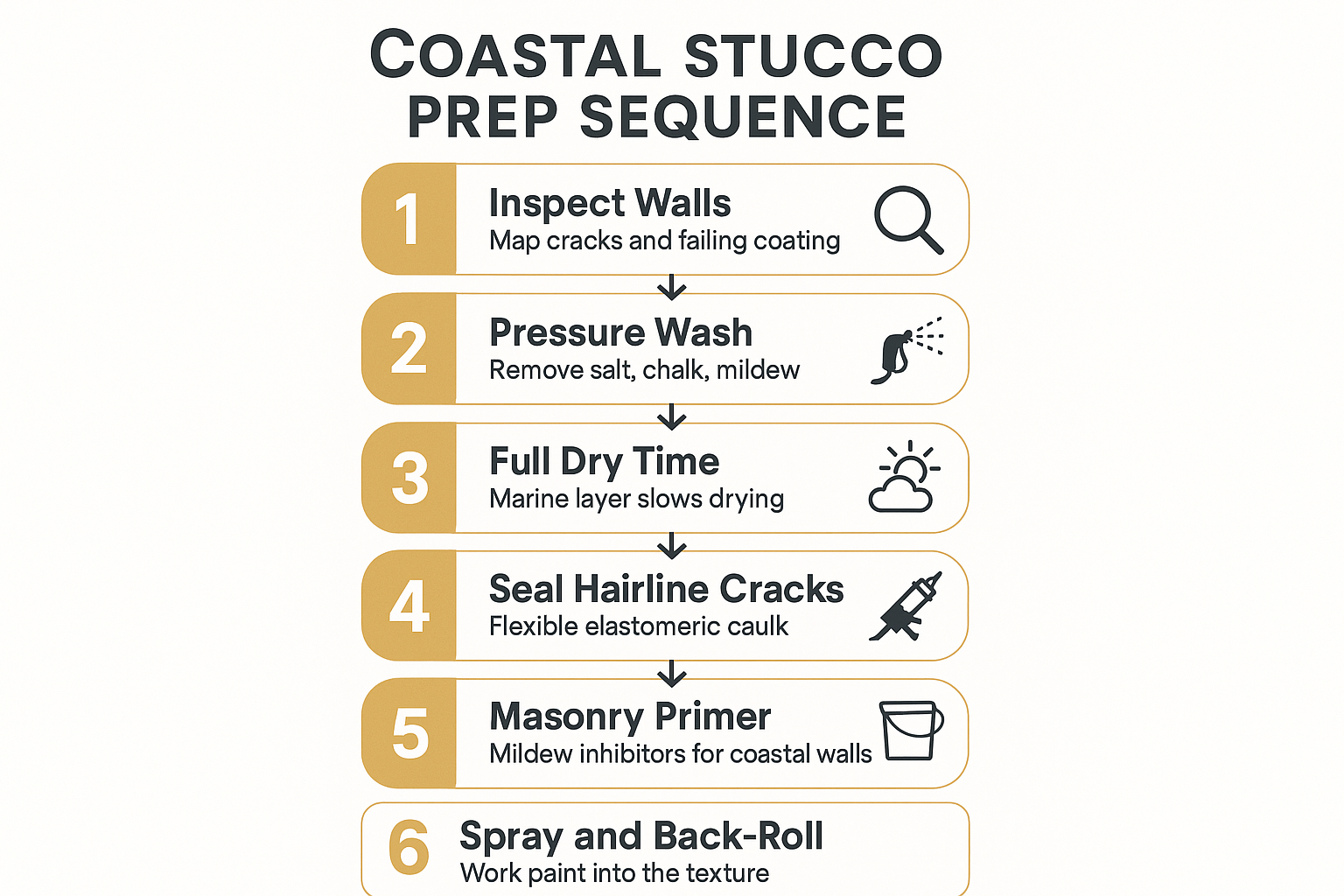
- Walk the walls first. Map every crack, patch, and area of failing coating before a hose comes out.
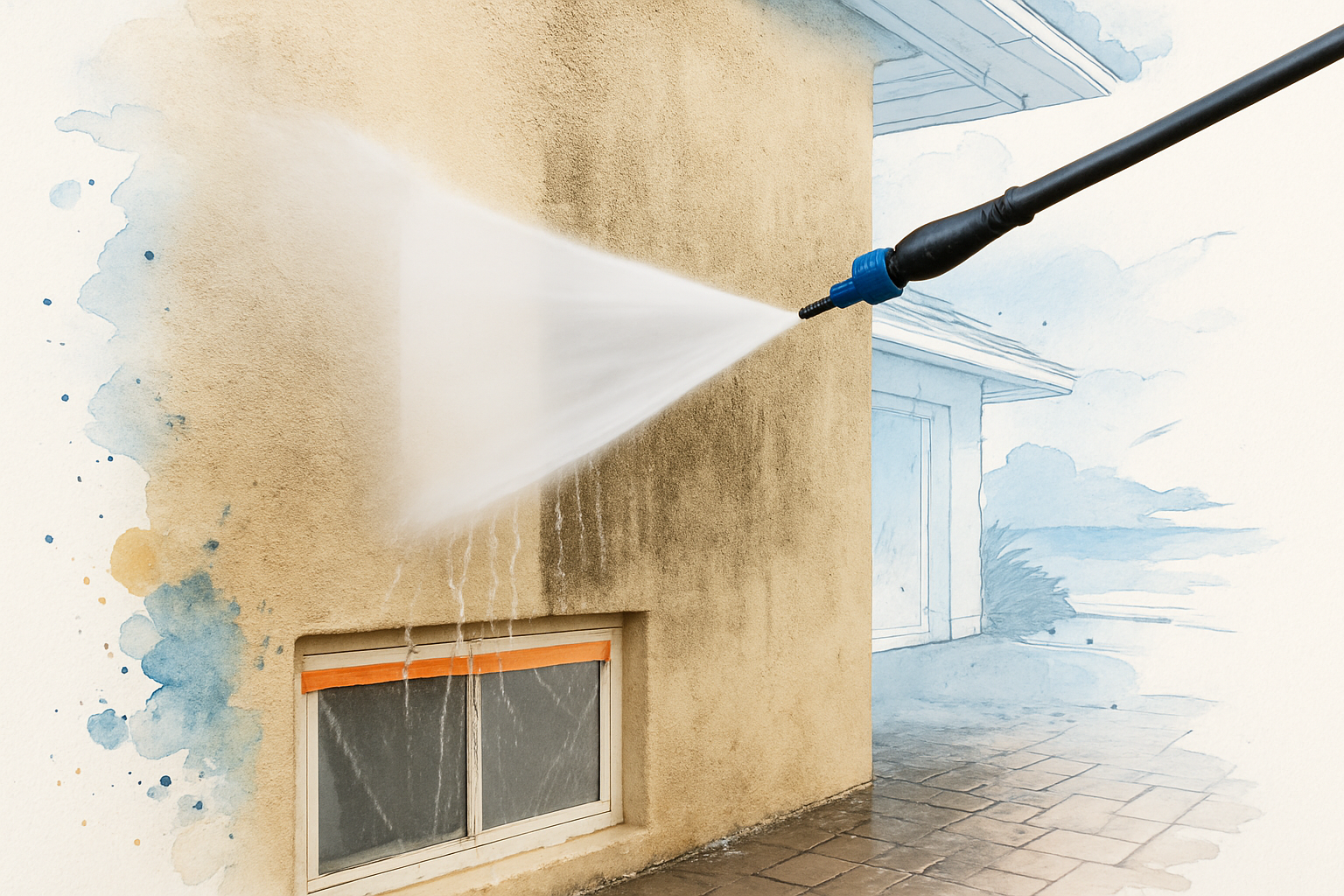
- Pressure wash. This removes salt, dirt, chalk, and biological growth living in the texture. Skipping this is the single most common shortcut I see.
- Let it dry. This is the step that gets rushed. A stucco wall that got washed in the fog does not dry in two hours.
- Fill hairline cracks with elastomeric caulk. Elastomeric just means it stays flexible. It moves with the wall instead of splitting again at the repair line.
- Patch larger cracks and damaged areas with a compatible stucco patch, then let those cure.
- Prime. More on that below.
I treat wash-to-paint dry time as a scheduling question, not a guess. In July, when the marine layer hangs around until noon in Seaside and Marina, a washed wall may need a full day or two before it is ready. In September, when we get warm dry afternoons, it moves faster.
Painting damp stucco is one of the fastest ways to buy yourself a peeling wall in three years. If you want the full picture of what goes into this phase, surface prep is most of the job breaks it down further.
What You See on Stucco and What It Actually Means
Before a bid ever gets written, these are the conditions I am looking for on a coastal stucco wall. Each one changes the prep plan.
| What you see | Likely cause | What has to happen before paint |
|---|---|---|
| White chalky powder near the base | Efflorescence from moisture moving through the wall | Find the moisture source, scrub the deposits, allow full dry time |
| Dark streaks on the shaded side | Mildew from fog and low sun exposure | Wash, treat the growth, prime with a mildew-resistant primer |
| Hairline cracks in a spiderweb pattern | Normal expansion and contraction from fog-to-sun cycles | Fill with flexible elastomeric caulk, then prime the repairs |
| Paint peeling in sheets | Coating applied over damp or dirty stucco | Scrape back to sound material, spot prime, feather the edges |
| Wide cracks you can fit a coin into | Possible movement or a stucco system issue | Inspect in person before committing to a paint scope |
The Coastal Stucco Prep Sequence
This is the order I follow on a Monterey County stucco repaint, and why each step exists.
Spray, Brush, or Both: How I Decide on a Stucco House
That homeowner who asked about the shared wall was right to raise it. Sprayers are the fastest way to cover stucco texture, but overspray does not care about property lines.
A sprayer atomizes paint into a fine mist. On a breezy afternoon in Monterey, that mist can travel farther than people expect, which is why the application method is a job-site decision, not a company policy.
Here is how I read a stucco house before deciding:
- Open walls with clearance: spray and back-roll. The sprayer lays the material down, the roller pushes it into the texture.
- Attached or shared walls: brush and roll only, or spray with heavy containment. On a wall the neighbor also owns, I would rather go slower than have a conversation about their car.
- Tight side yards and dense landscaping: roll the lower sections, mask and spray the upper.
- Two-story elevations: the staging plan drives the method as much as anything. Ladder work and lift access change what is realistic.
Back-rolling is the part people underestimate. Spraying alone can bridge over the texture and leave thin spots in the low points of the stucco, which is exactly where water finds its way in. Rolling behind the sprayer works the coating into those valleys and builds a real film.
Wind also decides the schedule. Afternoon breeze off the bay is a normal thing here, and it is a big reason the time of day you paint a house exterior on the Monterey coast affects the finish.
The Primer Question Worth Asking Every Bidder
Not all primers are made for masonry. A standard latex primer on bare or patched stucco is not the same product as a masonry primer built to handle alkalinity and moisture movement.
Fresh stucco and new patches are alkaline, and that alkalinity can attack a coating that was not made for it. On the coast, I also want mildew inhibitors in the primer on walls that stay shaded and damp.
So when you are comparing bids, ask three plain questions:
- What primer are you using, and is it made for masonry?
- Are you priming the whole wall or only the repairs?
- How many coats, and how are you handling the low spots in the texture?
You do not need a brand name answer. You need a contractor who can explain the reasoning without getting cagey. There is a longer list in what to ask an exterior painter before you book.
One more thing on older homes. If the house went up before 1978, trim, doors, and window frames may carry lead paint, and disturbing it triggers federal containment rules. The EPA’s Renovation, Repair and Painting rule sets those requirements, and they apply to plenty of houses in Pacific Grove and older Monterey neighborhoods.
What Drives the Price on a Stucco Repaint Here
Costs vary a lot, and anyone quoting you off square footage alone over the phone is guessing. On the Peninsula, the numbers move based on real conditions at the house.
The factors that shift a stucco bid most:
- Condition of the existing coating. Sound paint is a different job than widespread peeling.
- Crack volume. A wall with dozens of hairlines takes hours of caulking.
- Two-story access and staging on hillside lots in Carmel Valley or Pebble Beach.
- Salt and wind exposure, which pushes the prep and the coating spec.
- Pre-1978 construction and lead-safe work practices.
- Occupied versus vacant, since masking and daily setup take longer around a lived-in home.
Online calculators are useful for planning, but they cannot see your walls. What a house painting cost calculator can and cannot tell you explains where those tools stop being accurate. An on-site walkthrough of about thirty minutes usually settles it.
Frequently Asked Questions About Painting Stucco on the Coast
How long should stucco dry after pressure washing before painting?
It depends on the weather that week. On a warm dry stretch, 24 hours is often enough. During heavy marine layer mornings in June and July, I plan for longer and check the wall before committing. Rushing this step is the top cause of early failure on coastal stucco.
Can you paint stucco without a sprayer if my house is attached to my neighbor’s?
Yes. Brush and roll works fine on stucco, it just takes longer. On shared or close walls I use hand application near the boundary and switch to spray with back-roll on the open elevations. It is a normal request and a reasonable one.
How often does stucco need repainting on the Monterey Peninsula?
It varies with exposure. A protected inland wall in Salinas can go noticeably longer than an ocean-facing wall in Pacific Grove taking salt spray and wind. Prep quality has as much to do with it as the paint you choose.
What is elastomeric caulk and why does it matter on stucco?
It is a flexible sealant that stretches instead of hardening. Because stucco moves with temperature and humidity swings, a rigid filler cracks again in the same spot. Flexible caulk moves with the wall and keeps water out of the crack.
Do I need a full elastomeric coating on my stucco?
Not always, and it is not a default answer. Heavy elastomeric coatings can trap moisture in a wall that already has a water source behind it. That decision should come after someone looks at the wall in person, not off a checklist.
Planning a stucco repaint on the Peninsula?
If you are working through bids on a stucco home anywhere from Salinas to Carmel and want a second read on the prep plan, our team is around for walkthroughs most weeks. Legacy Painting and Renovating can be reached at (831) 917-0047 or through the contact form at legacypaintingrenovating.com. Either way, ask whoever you hire about their wash, dry time, and primer plan before you sign anything.