Direct Answer: Countertops come off first. Repair and refinish the cabinet boxes while the tops are off, then the new slab gets templated and installed, and finished doors go back on last.
A homeowner in Carmel Valley wrote in last summer with a scope I wish more people sent. He wanted to keep his cherry cabinets natural, fix some chipped veneer, swap the pulls, upgrade to soft-close slides, and replace the stone tops. His real question was whether there were timing efficiencies in doing the cabinet work while the countertops were off.
There are, and they are significant. But only if the work runs in a specific order, and the order is not the one most people guess.
Short version: the old tops come off first, box repairs happen while the boxes are exposed, the fabricator templates against the finished layout, and the doors go back on at the very end. Below I’ll walk through why, plus the two sequencing mistakes I see most often in Monterey County kitchens.
The order I run cabinet refinishing and a countertop swap
Every piece of this has a reason behind it, and most of the reasons come down to protecting work that is already done.
- Old countertops come out first. Slab demo is dirty, loud work, and prying stone off a cabinet run can chip edges or rack a box. You do not want that happening to a finish you just paid for.
- Box repair and re-leveling happen next, while the tops are off. This is the only clean window to pull a cabinet, re-shim a run, patch delaminating veneer on a panel edge, or reinforce a sink base.
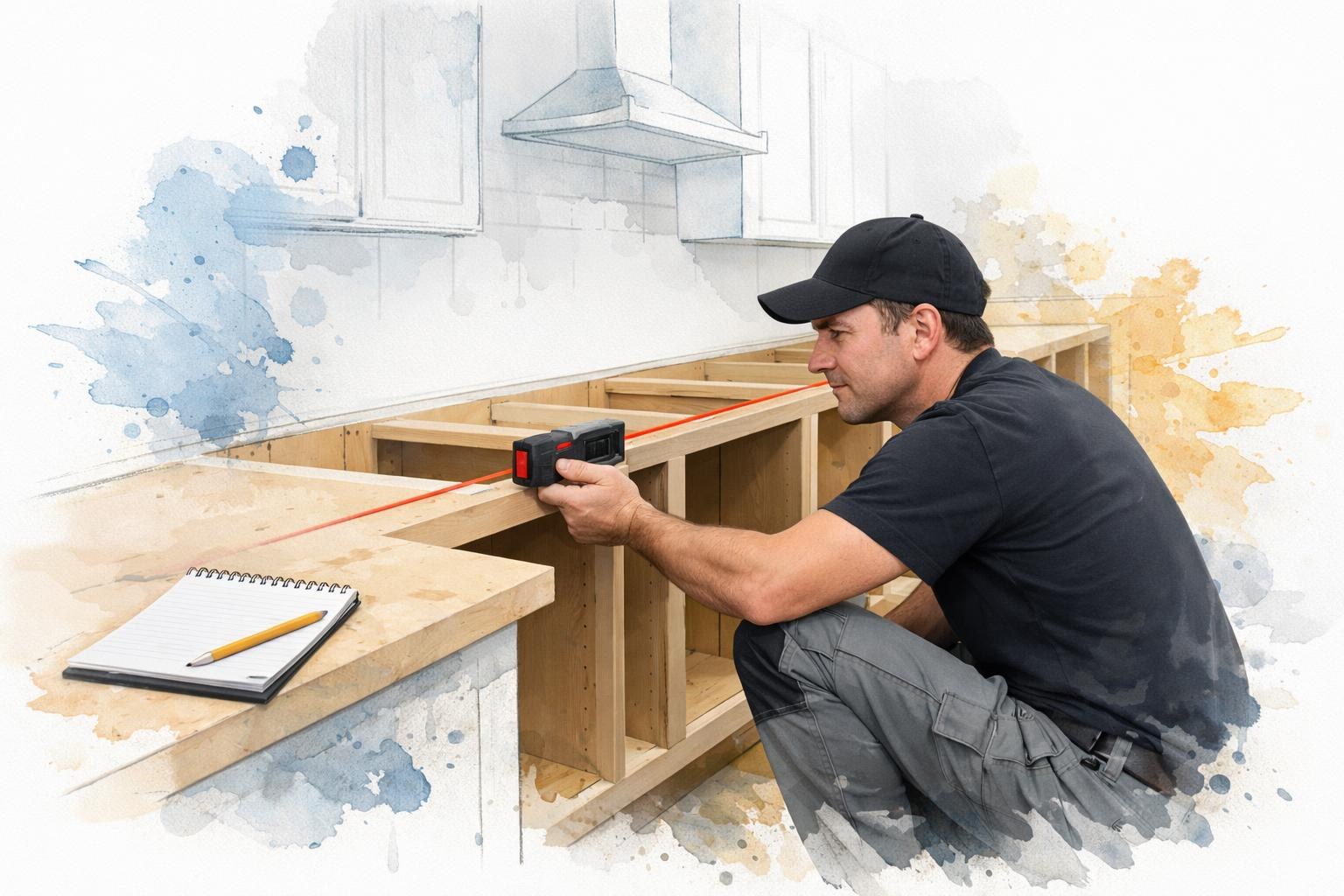
- The fabricator templates after the boxes are set. They measure the cabinets exactly as they sit, so the boxes need to be level, square, and screwed down before anyone shows up with a laser.
- Finish work on boxes and face frames fills the gap. Most fabricators need one to two weeks between template and install, which is dead time unless you use it.
- Doors and drawer fronts get finished off site and hung near the end, after the stone is in.
That last point is the one people push back on. The reason is simple: a stone crew hauling a 300 pound slab through a kitchen will touch the cabinets, and adhesive and silicone cleanup gets wiped across whatever is in the way. Fresh finish does not need that.
The two ways homeowners get the order wrong
Both mistakes come from trying to save money or time by shuffling the schedule. Both cost more than they save.
Mistake one: finish everything, then bring in the countertop crew. Now a slab install is happening over new lacquer or conversion varnish. Beyond the handling risk, a cured finish is much harder to touch up invisibly than one that is a few days old. A fresh coat blends. A hard, fully cured coat tends to show the repair under side light.
Mistake two: install the new tops before any cabinet repair is done. Once stone is set and plumbed in, the sink base is trapped. If that box turns out to be swollen at the bottom, out of level, or needs a panel replaced, you are either living with it or paying to disconnect and lift a slab you just bought.
I have walked into both situations. Neither is a disaster, but both are avoidable with a thirty minute walkthrough before anything gets ordered. That is honestly the whole argument for looking at the kitchen in person first.
What happens when, and when the kitchen works
Here is how a coordinated cabinet refinish and countertop swap generally sequences. Actual durations depend on the kitchen.
| Stage | What happens | Sink and range usable? |
|---|---|---|
| Tearout | Old slab removed, sink disconnected, doors and drawer fronts taken off site | No sink, range usually yes |
| Box work | Re-leveling, veneer repair, hardware hole fill, slide prep | No sink |
| Template | Fabricator measures the cabinets as installed | No sink |
| Fabrication gap | Boxes and face frames get sanded, sealed, and coated on site | No sink, limited counter space |
| Stone install | New tops set, sink and faucet reconnected | Sink back within a day or two |
| Final hang | Finished doors and drawer fronts returned, new pulls and slides installed | Full use |
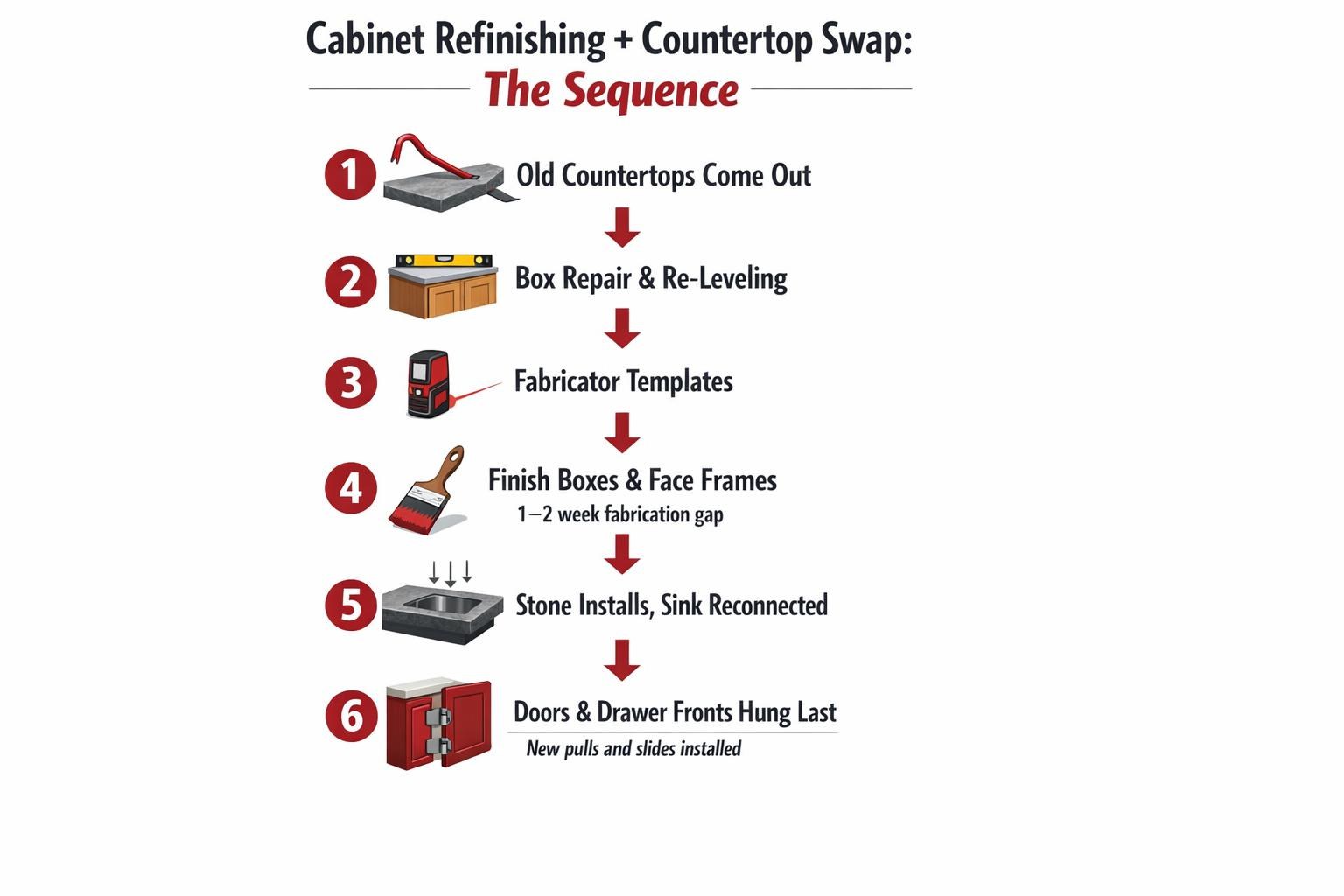
The sequence at a glance
This is the same order laid out as a straight line, which is how I explain it at the kitchen table.
Natural wood changes the hardware conversation
If you are painting cabinets, filling old pull holes is a non-issue. Fill, sand, prime, and the paint hides everything.
On a clear-coated cherry or oak kitchen, it is a different problem entirely. New pulls almost never land on the old drilled holes, and a filled hole under clear finish is still visible if you know where to look. Color-matched wood filler can get close on tone, but it has no grain, and in raking afternoon light through a west-facing window, grain is exactly what your eye picks up.
So on stained and clear-coated cabinets, homeowners generally pick one of three paths:
- Choose new hardware that spans or covers the old holes, which usually means matching or exceeding the existing center-to-center spacing
- Accept a visible fill, often by putting the patch on the inside face of the drawer front where it is rarely seen
- Replace the drawer fronts on the runs where the mismatch would bother you most
Decide this before sanding starts, not after. Once the doors are stripped and sanded, your options narrow fast.
One more thing about cherry specifically. It deepens in color as it ages, and it does that unevenly depending on sun exposure. A clear-coat refresh on a sun-faded door run will not always match a shaded run of uppers, so I like to flag that at the walkthrough rather than at delivery. If you want more on how a clear-coat refresh actually works, I went deeper on what it takes to refinish wood cabinets and keep the natural grain.
Will your drawer boxes take undermount soft-close slides?
This question comes up constantly, and most people genuinely do not know the answer about their own kitchen. That is fine, it is not obvious.
Undermount soft-close slides need a drawer box built for them. Specifically:
- A bottom panel set up into a routed groove, not tacked or stapled flat to the underside
- Enough box height and side clearance inside the cabinet opening, usually around 1/2 inch total
- A notched back so the locking clips can grab the bottom panel
Older boxes, especially stapled ones with a thin bottom nailed on from below, do not meet that. Rebuilding them is real money. In most of those kitchens, side-mount soft-close slides are the better call. They work well, they close softly, and they cost considerably less than new boxes.
Here is a two minute check you can do tonight. Pull a drawer all the way out, flip it over, and look at the bottom panel. If it sits down into a groove on all four sides, you are likely a candidate for undermount. If it is tacked underneath, plan on side-mount. Then measure the gap between the drawer box side and the cabinet opening on each side.
Planning around the calendar on the Peninsula
A coordinated refinish and countertop swap is not a weekend project, and the fabrication gap is the part people underestimate. The practical question is not how many days the crew is on site, it is when the sink and range come back.
The upside for Monterey County homeowners is that cabinet work does not care what the sky is doing. When the marine layer sits in all day or the rain settles in through January, exterior work stops and interior cabinet projects keep moving on schedule. That is why I see a lot of these jobs booked between November and March. I broke down the day-by-day reality in how long your kitchen is out of commission during a cabinet refinish.
On cost, I will not throw a number at you without seeing the kitchen. What moves the price is box condition, how much veneer repair is needed, hardware choices, and whether drawer boxes get replaced or re-slid. Two kitchens with the same door count can land thousands apart on those factors alone.
One note on older homes. If your cabinets are painted and the house was built before 1978, which covers a large share of Pacific Grove, Carmel, and older Monterey kitchens, sanding those surfaces falls under the EPA’s Renovation, Repair and Painting Rule. Containment and HEPA cleanup are part of doing the job correctly, not an add-on, and it is a fair question to ask anyone who plans to sand.
Why the coordination matters more than the craftsmanship here
On a job like this, the finish quality is table stakes. What decides whether it goes smoothly is whether the painting side and the stone fabricator are talking to each other and hitting dates.
A homeowner who spent eighteen years in the building industry wrote about a bath project with us and said, “They were always right on time and finished the project quicker than I expected.” Another described a job where the crew worked around an active bathroom remodel and a full door hardware changeout without an issue.
That is the skill the countertop coordination actually requires: showing up when you said you would, so the fabricator’s template date holds and nobody loses a week. I wrote more about how finishes hold up over time in painted cabinets a year later.
Frequently Asked Questions About Cabinet Refinishing and Countertop Timing
Can the cabinet refinishing and the countertop install happen the same week?
Rarely, and I would not plan on it. The fabricator needs to template against the finished cabinet layout, and most shops need one to two weeks between template and install. That gap is actually useful, since box and face frame finishing happens inside it.
Do I have to remove cabinets to replace countertops?
Usually not all of them. The sink base often comes out, and sometimes a cabinet that is out of level or sitting on a bad floor needs to be pulled and reset. That is exactly why the repair window belongs between tearout and template.
Is it cheaper to do cabinets and countertops at the same time?
Doing them together generally costs less than running them as two separate projects months apart, because you are paying for one setup, one masking, and one disruption instead of two. The savings depend on the kitchen, so it is worth getting it priced both ways.
What if my old pulls leave holes that show under a clear coat?
On stained wood, assume the fill will be somewhat visible in raking light. Most people solve it by picking new hardware that spans the existing holes. Decide before sanding begins, because it changes how the fronts get prepped.
Can I refinish cabinets during the rainy season in Monterey County?
Yes. Interior cabinet work runs year round here, which is part of why winter is a sensible time to book it. Exterior projects are the ones that wait for a dry window.
Thinking through the order on your own kitchen?
Sequencing questions like this get settled fastest standing in the kitchen, looking at the boxes and the drawer construction together. If you are planning a cabinet refresh and a countertop swap somewhere in Monterey County, Legacy Painting and Renovating does free on-site walkthroughs to sort out scope and order before anything gets ordered. You can reach us at (831) 917-0047 or through legacypaintingrenovating.com.