Direct Answer: On a California home improvement contract, the down payment is capped at $1,000 or 10 percent of the contract price, whichever is less. Everything after that is paid as work gets finished.
The hardest moment in any home project is not picking the color. It is writing the first check to someone you met two weeks ago.
I hear a version of the same question from Monterey County homeowners all the time: how do I know you won’t take my deposit and disappear? Usually it comes from someone in their forties or fifties who already lived through a bad one, with a half-finished house and a contractor who stopped answering the phone.
So here is the plain answer, and then the part almost nobody tells you. California caps the down payment on a home improvement contract at $1,000 or 10 percent of the contract price, whichever is less. But the deposit is not really what protects you. The payment schedule is.
The California Deposit Cap Most Homeowners Have Never Been Told
A lot of people believe a 30 to 50 percent deposit is just how contracting works. On a home improvement contract in California, that is not how it works.
The law sets a hard ceiling on the down payment. It is $1,000 or 10 percent of the contract price, whichever is less. On a $14,000 exterior repaint in Pacific Grove, that means the most that can be collected before work starts is $1,000, not $1,400 and definitely not $4,500.
There is one real exception worth knowing. When a job involves special order materials that are made or bought specifically for your home, a contractor can ask for additional money up front to cover those goods. That comes up more on kitchen and bath work with custom cabinetry or ordered tile than it does on a standard repaint.
So what do you do when a bid comes back asking for a third up front?
- Ask why, before you assume anything bad
- Ask whether the extra is tied to specific special order materials
- Ask to see that broken out in writing on the contract
- If the answer is vague or the number stays the same, keep shopping
Some contractors genuinely do not know the rule. Some do. Either way, the question tells you a lot about how the rest of the project will go.
Why the Payment Schedule Protects You More Than the Deposit Does
A small deposit feels safe. But a small deposit on a project with no written payment stages still leaves you exposed, because the real risk is not month one. It is the crew that gets paid ahead of the work and slows down.
The fix is simple. Money should trail completed work by one step, never lead it. Progress payments should be tied to finished stages you can walk out and look at, not to calendar dates.
On a typical Peninsula repaint, those stages usually look like this:
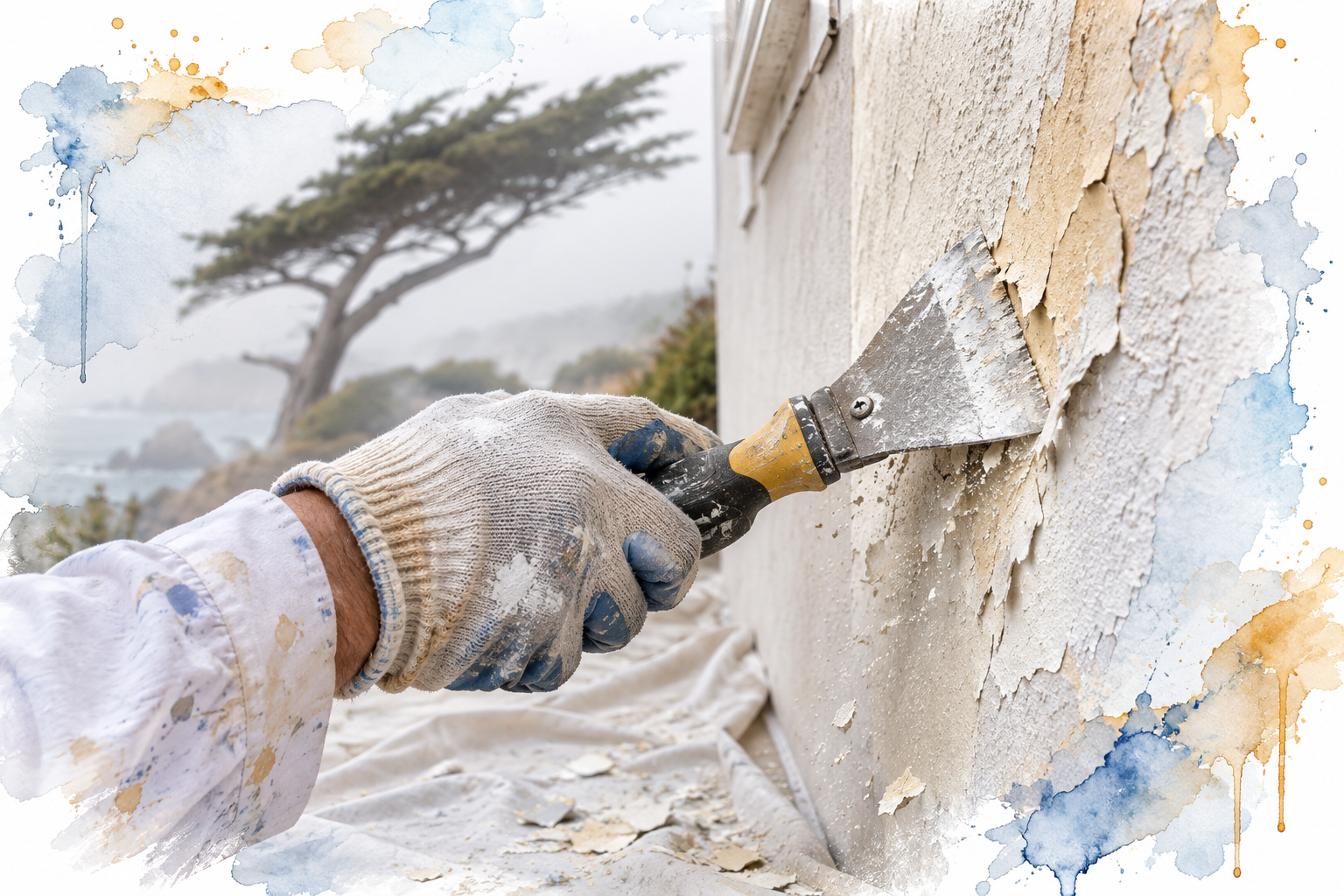
- Prep and repairs complete – pressure washing, scraping, sanding, caulking, drywall or siding repairs done and visible
- Primer applied – bare and patched areas sealed
- First coat complete – full coverage on the body
- Final walkthrough – second coat, trim, touch-ups, and site cleanup signed off by you
When payments are written this way, you are never the person calling a crew back to the house after they already have all the money. You hold the last payment until you have walked the job with them.
One of our reviewers is a retired general contractor who spent a career hiring specialty trades. His summary of the job was that the crew “made carpentry repairs as expected and needed, and finished on time.” That is the whole goal of a staged schedule. It keeps everyone honest without turning the project into a standoff.
What a Stage-Based Payment Schedule Looks Like
Here is an illustration of how progress payments can be structured on an exterior repaint. The exact split varies by scope and by contractor, so treat this as a shape rather than a formula.
| Stage | What has to be finished first | Illustrative share |
|---|---|---|
| Down payment | Contract signed, nothing started | $1,000 or 10%, whichever is less |
| Progress payment 1 | Wash, scrape, sand, caulk, repairs complete | Often the largest single progress draw |
| Progress payment 2 | Primer and first finish coat applied | A middle draw |
| Final payment | Second coat, trim, cleanup, walkthrough approved | Held until you sign off |
Why Most of Your Money Buys Work You Can Barely See
Here is what makes a payment schedule feel lopsided to people. By the time a finish coat goes on, a big share of the budget is already spent.
On a typical Monterey Peninsula repaint, surface preparation and labor run roughly three quarters of the total cost, while the paint itself is the smaller piece. Homeowners comparing bids often assume they are mostly buying buckets of paint. They are mostly buying hours.
On the coast, that prep is not optional busywork:
- Salt air and marine layer moisture open up caulk joints that have to be cut out and redone
- Stucco in Pacific Grove and Carmel chalks under UV and has to be washed and scraped back to something sound
- Wood siding and shingle homes hold fog moisture, so timing matters as much as technique
- Two story work means staging, which adds labor before a brush ever moves
So when a progress payment is tied to prep completion, you are paying for the part of the job that decides whether the finish lasts five years or twelve.
This is also why two houses of the same square footage can come back thousands apart. Condition, siding type, exposure, and whether the home is occupied all move the number. Any figure you see online is a planning range, and a real one comes from a walkthrough of about thirty minutes.
Three Things to Verify Before the First Payment
Each of these takes about five minutes and tells you more than any sales conversation will.

The Mid-Project Money Question Nobody Warns You About
Most deposit fear is really fear of the open ended invoice. The crew opens up a wall or pulls a trim board, finds something nobody could see from the ground, and suddenly the number moves.
On older Peninsula homes, this is common, not rare. Monterey County’s median home dates to the mid 1970s, and roughly 12 percent of the county’s housing stock predates 1950, with heavier concentrations in Pacific Grove and Carmel.
The usual surprises are:
- Soft wood and dry rot hiding behind peeling exterior paint
- Failed siding or trim boards that will not hold a finish
- Pre-1978 lead paint, which triggers EPA lead-safe work practices like contained work areas, HEPA cleanup, and controlled disposal
One homeowner who reached out to us described heavy cracking and peeling outside and said they suspected lead paint. That is exactly the right instinct, and exactly the kind of thing that should be settled before a brush touches the house.
Ask two questions at the estimate: how do surprises get priced, and how do they get approved? The honest answer is that scope changes go in writing and get your sign-off before the work continues.
And if a contractor tells you dry rot and carpentry repairs are quoted separately after they see the actual condition, that is accuracy, not evasion. Nobody can price rot they have not uncovered yet.
Protections That Exist Whether Your Contractor Is Nice or Not
This article is about where the money sits in the project timeline. The paperwork side has its own rules, and those have changed recently.
A few you can check quickly:
- You have three business days to cancel a home improvement contract, extended to five days if you are 65 or older and seven days for disaster repairs
- As of January 1, 2026, contractors must list an email address on the contract and accept cancellation notices by email, per the CSLB’s 2026 new laws bulletin
- You can look up any license number on the CSLB site and confirm it is active and insured
If you want the full picture of what has to be in writing now, we covered it in this breakdown of California homeowner contract rights. The penalties for working unlicensed also got significantly steeper this year, and starting in 2027, unpaid state sales tax can suspend a license, which is one more reason to check status rather than assume it.
Ask these questions out loud at the estimate. A contractor who welcomes them is handing you the answer you were looking for.
Frequently Asked Questions About Contractor Deposits in California
Is a 30 percent deposit ever legal on a home improvement job?
Not as a straight down payment. The cap is $1,000 or 10 percent of the contract price, whichever is less. The one common exception is money collected for special order materials made or purchased specifically for your home, and that should be itemized in the contract rather than folded into a vague percentage.
What if the contractor asks for cash or payment outside the contract?
Treat it as a stop sign. Payments should match the written schedule, go to the business, and leave a record. A paper trail is what gives you standing later if something goes wrong.
Should I ever pay the full amount before the final walkthrough?
No. Hold the final payment until you have walked the job with the crew, checked the touch-ups, and confirmed the site is clean. That last payment is the only leverage you have left, and a good contractor expects you to use it.
How do progress payments work if my project runs long because of fog or rain?
Payments should be tied to completed stages, not calendar dates, which is why weather delays on the Peninsula are less painful than people expect. If prep is finished, that payment is earned even if coating has to wait for a dry window. Marine layer mornings regularly push coating start times later in the day here, and a schedule built on stages absorbs that without anyone arguing.
What should the written scope actually include before I pay anything?
Enough detail that you could hold it next to a second bid and compare apples to apples. That means prep steps spelled out, number of coats, product lines being used, what is included versus excluded, how change orders get approved, and the payment stages themselves.
Planning a Project and Want the Numbers Explained First?
Legacy Painting and Renovating is a licensed and insured family business, CSLB #1066829, started by two brothers with more than twenty years of combined experience on the Central Coast. Our reviews come from people who know construction, including a retired general contractor and a homeowner who ran a 5,000 square foot stucco remodel with multiple trades on site. Free on-site estimates are available across Salinas, Monterey, Pacific Grove, and Carmel at (831) 917-0047 or through the contact form at legacypaintingrenovating.com.