Direct Answer: Yes, most households can stay put during an interior repaint. It works when the crew paints room by room, seals off work areas, and leaves you a place to sleep, cook, and work each night.
Almost nobody asks me this question straight out, but I can hear it underneath a lot of walkthroughs. Can my family keep living here normally while your crew is inside the house?
People in Monterey County do not have a spare week to go stay somewhere. One homeowner asked us flat out whether we work Sundays and how long the job would take, which read to me less like a scheduling question and more like someone trying to fit a paint job around their actual life.
My position after years of interior work on the Peninsula: most households should stay put. Whether that goes well has almost nothing to do with the paint and almost everything to do with how the job is sequenced, how prep dust gets contained, and who agreed to move the furniture. That is what this article covers.
Living in Your Home During Interior Painting Comes Down to Sequencing
A repaint does not happen to the whole house at once. A good crew works it in blocks so you always have somewhere to sleep, cook, and take a call.
Here is the order I usually push for in an occupied home:
- Guest rooms and spare rooms first. They are the easiest to empty and they buy everyone a fallback bedroom.
- Kids’ rooms and the primary bedroom next, early in the day so they air out before bedtime.
- Living room and dining room while the household is at work or school.
- Kitchen last or split, because it is the hardest room to live without.
- Hallways and stairwells at the very end of a block, often on a day you can be out for a few hours.
Stairwells are the real pinch point. We painted a three-story Monterey townhome one color throughout, both stairwells included, and those stairwells were the only path between floors. That kind of area gets scheduled for a window when nobody needs to go up and down, then it is cleared.
At your walkthrough, ask one question that settles most of this: which rooms are off limits on which days? That is a different question from how many days the whole job takes, which I covered in one wall or a whole townhome.

The Dust Is From Prep, Not Paint
Paint itself is a tidy step. The mess comes before it, and that is where an occupied house either stays livable or turns into a dust bowl for three weeks.
Prep on a real interior job here includes sanding, drywall patching, caulk removal, and sometimes wallpaper removal. Every one of those throws fine grit into the air before a can is opened.
Dust control is simple work that either gets done or does not:
- Plastic hung at doorways, taped top to bottom, usually with a zipper or overlap you can pass through
- HVAC returns and supply vents taped off in the active room so grit does not ride through the ducts into the rest of the house
- Floors covered with canvas or paper, not just a sheet thrown down near the wall
- A cutting and sanding station set up outside the living space when weather allows, so the worst of it never comes indoors
- Daily vacuuming with a HEPA filter, not a push broom that lifts dust back into the air
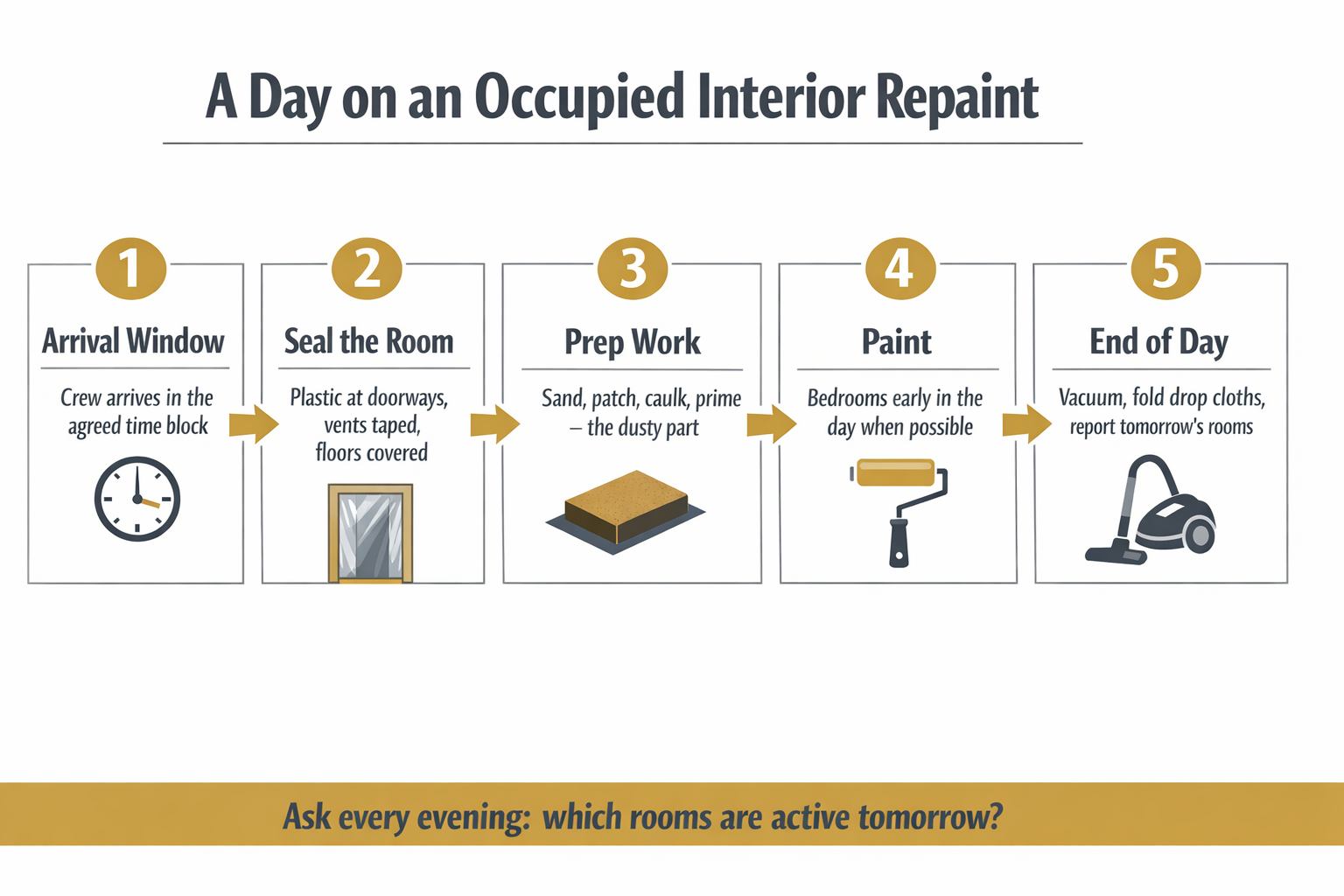
Here is the test I would apply. Walk the house at 4pm on a Tuesday. Drop cloths should be folded and stacked, tools gathered, floors vacuumed, and the plastic still sealed where the work continues tomorrow. Drop cloths left spread across the floor overnight are a tell.
There is a local wrinkle. A lot of Pacific Grove, Carmel, and older Monterey housing stock was built before 1978, which triggers federal lead-safe work practices: contained work areas, no open sanding, and controlled cleanup. I wrote more about that in older homes on the Peninsula and the lead paint question. If your home predates 1978, ask how containment and disposal are handled before anyone touches a sander.
What a Controlled Job Site Looks Like Day to Day
This is the daily rhythm I would expect on an occupied interior repaint, from morning setup through the end-of-day walk.
Fumes, Ventilation, and the Problem With Monterey Winters
The standard advice is open the windows and run a fan. That advice assumes a dry day, and it stops being practical when a storm sits over the Peninsula for three days straight.
Monterey normally collects most of its 15 to 18 inches of annual rain between December and February, with the wettest months landing somewhere in the 2.4 to 4 inch range. Forecasters have pointed to a strong El Nino raising the odds of above-normal precipitation across much of California in those months. Odds are not a forecast for your address, but it is worth planning around.
This matters because the EPA notes that indoor VOC levels typically run 2 to 5 times higher than outdoors, spike sharply during and shortly after coating work, and come down fastest with more ventilation, not less.
So on a wet week, ventilation gets deliberate:
- Paint bedrooms and nurseries early in the day so the room has the longest possible airing window before bedtime
- Crack windows in the active room only during breaks in the rain, and run a box fan pointed out rather than in
- Keep the door to the rest of the house sealed so odor does not migrate into rooms you are still using
- Choose low-VOC and CARB-compliant products, which California already pushes hard on. I broke down what those labels actually mean in what low-VOC really means
Tell the crew up front if anyone in the house has asthma or scent sensitivity, and ask two specific questions: which product is going on the walls, and what the manufacturer lists as the re-entry window. I will not promise a dry or cure time, because it moves with humidity and that is exactly what the marine layer plays with.
Pets are simpler than people think. Put them in a closed, unpainted room with food, water, and their bed, tell the crew that door stays shut, and hang a note on it. Dogs and open paint cans are a bad combination, and a cat that bolts through a sealed doorway undoes a morning of dust control.
Who Moves What: Settle This Before Day One
Most arguments about an occupied repaint trace back to furniture. Put this in writing at the estimate stage so nobody is guessing on the morning of day one.
| Item | Usually the crew | Usually the homeowner |
|---|---|---|
| Sofas, dressers, dining tables | Moved to room center and covered | Nothing, but clear the surfaces first |
| Beds | Often moved or wrapped in place | Strip bedding before the crew arrives |
| Small decor, lamps, books, photos | Not handled | Boxed and out of the room |
| Closet contents | Not handled | Emptied if closet interiors are being painted |
| Wall-mounted TVs and brackets | Varies, agree in writing | Often homeowner or an AV tech |
| Curtains, rods, blinds | Often removed and reinstalled | Confirm it is in the scope |
| Art, mirrors, anything fragile or valuable | Not handled | Removed and stored by the owner |
Why an Occupied House Reasonably Costs More
A vacant house is an open shell. A crew walks in, works wall to wall, and walks out.
An occupied house gets masked, moved, and reset every single day. Furniture goes to the center, comes back, goes out again tomorrow. Paths stay walkable. Floors get cleaned nightly instead of once at the end.
That is real labor, and occupied versus vacant is one of the standard factors that moves an interior number up. Costs vary quite a bit by home, so treat any figure you see online as a planning range and get an on-site walkthrough for anything firm.
The same goes for prep. On a typical repaint, surface prep and labor make up roughly three quarters of the cost while paint is the smaller share, which is why two homes of the same square footage can land thousands apart. I went deeper on that in surface prep is most of the job.
The Daily Communication That Makes or Breaks It
From what homeowners tell me, the real fear is not a bad paint job. It is a contractor who goes quiet, shifts the schedule without saying anything, or leaves the project half finished.
Lock these down before work starts:
- The daily arrival window, so you are not waiting around all morning
- How access works – key, lockbox, or someone home
- Which rooms are active each day, confirmed the evening before
- What end-of-day cleanup includes, specifically floors, drop cloths, and tool storage
- Who to text with a question, by name and number
This matters even more when other trades are in the house at the same time, which is common on Peninsula remodels. One repeat client of ours had interior painting and door hardware swaps happening while her primary bathroom remodel was underway and described it this way: “All completed without a ‘hitch.” That outcome comes from scheduling conversations, not luck.
If you are weighing whether winter is even a workable season for the inside of your house, that is a separate question I answered in painting indoors during a wet Monterey winter.
Frequently Asked Questions About Living in Your Home During Interior Painting
Can we sleep in a room the same night it was painted?
Often yes with a low-VOC product painted early in the day and good airflow, but I will not promise it for every room or every product. Ask what is going on the walls and what the manufacturer lists for re-entry, then plan a backup room for the first night if anyone in the house is sensitive to odor.
What should I do with my dog while the crew is here?
Pick one room that is not scheduled for work, put food, water, and a bed in it, and keep the door closed with the crew told clearly to leave it shut. Open paint, wet trim, and a curious dog is the combination I see go wrong most.
How much dust should I actually expect?
Some is unavoidable because sanding and patching are part of the job. What you should not accept is dust in rooms that are not being worked on. Taped vents, sealed doorways, and daily HEPA vacuuming are what keep it contained to the active area.
Does my pre-1978 Pacific Grove home change anything?
Yes. Federal lead-safe rules kick in, which means contained work areas, no open sanding, HEPA cleanup, and controlled disposal. It adds time and cost to prep, and any bid that comes in far below the others may simply be skipping it.
Will the crew move my furniture or do I have to?
It depends on what you agree to in writing. Crews commonly move the large pieces to the center of the room and cover them, while homeowners clear small decor, closet contents, art, and anything fragile. Wall-mounted TVs and curtain hardware should be named specifically in the scope so nobody assumes.
Planning an Interior Repaint You Will Be Living Through
We are two brothers with over 20 years of combined experience on the Central Coast, licensed under CSLB #1066829, and the thing homeowners mention most in our reviews is not the finish. It is the clean job site, the daily tidiness, and knowing what was happening each morning. Legacy Painting and Renovating takes interior work across Monterey, Pacific Grove, Carmel, Carmel Valley, and Salinas, and an on-site walkthrough runs about thirty minutes if you would like one at (831) 917-0047 or through the contact form at legacypaintingrenovating.com.