Direct Answer: Salt air, daily fog cycles, and UV exposure cause outdoor wood stain on the Monterey Coast to fail faster than inland — usually within two seasons if surface prep and product selection aren’t right.
I’ve seen it more times than I can count on the Monterey Peninsula — a homeowner who had their deck or outdoor pillars stained a couple of years ago, and already the finish is graying, cracking, and in some spots peeling away from the wood. It doesn’t look like a project that just happened. It looks like one that failed. And most of the time, the problem started before the first brush hit the wood.
We work with a lot of homeowners across Pacific Grove, Carmel, and the Monterey waterfront who are dealing with exactly this. One recent inquiry that stuck with me was from a local homeowner requesting a quote for wood staining and maintenance of outdoor wooden pillars — a very common situation here. Pillars, railings, pergolas, decks: any structural wood element on a coastal home is living in one of the harshest finishing environments in California.
This article is about why outdoor wood staining on the Monterey Coast is different from what you’d do in Fresno or Sacramento — and what actually separates a stain job that holds up for five or six years from one that’s peeling by year two.
What the Coastal Climate Is Actually Doing to Your Wood
The Monterey Peninsula’s climate sounds pleasant — and for living, it is. But for exterior wood finishes, it’s genuinely punishing in ways that aren’t always obvious.
Salt air is the first factor. Salt doesn’t just sit on the surface of wood — it carries moisture into the grain, and that trapped moisture does real damage. On a surface that wasn’t properly cleaned and dried before staining, salt residue acts as a barrier between the wood and the finish. The stain can look fine for a season, then start lifting and bubbling from underneath as that moisture works its way through.
Marine layer fog is the second factor, and it’s one most homeowners don’t think about. Every morning along the coast — especially in Pacific Grove, Pebble Beach, and the western edge of Carmel — wood surfaces absorb surface moisture from overnight fog. Even when that wood feels dry to the touch by mid-morning, it may still carry enough moisture in the outer grain to cause adhesion problems if you apply stain too early.
UV exposure is the third factor. The fog burns off, and then the sun comes out hard. That daily cycle of moisture followed by intense UV light is what causes wood to check, crack at the end grain, and gray out faster than you’d expect. It’s not any single condition doing the damage — it’s all three working together, every day.
If you want to understand more about what this climate does to exterior surfaces in general, What Monterey’s Coastal Climate Does to Exterior Paint Over Time covers the broader picture well.
Why Timing and Surface Prep Determine Everything
Here’s where I see most DIY stain jobs — and honestly, some contractor jobs too — go wrong. The prep work gets rushed, and the timing gets ignored.
Surface moisture is the biggest variable on the coast. Unlike inland California where summer mornings are typically dry and you can start early, a home in Pacific Grove or along Scenic Road in Carmel may have wood that’s still holding surface moisture at 9am even on a sunny day. The marine layer doesn’t always lift until 10 or later. Applying stain over wood that hasn’t fully dried out produces adhesion failure that often doesn’t show up until the following season — by then, most people assume it was a bad product.
Before staining, every surface needs to be:
– Pressure washed to remove salt deposits, mildew, algae, and any chalking from old finish
– Allowed to dry fully — in coastal conditions, that typically means waiting a full day after washing, minimum, and checking again in the morning before starting
– Sanded to open the grain and remove any residual old finish that would prevent penetration
– Inspected at the end grain — this is where checking and cracking start first, and where moisture infiltration is worst
One practical check I always use: hold your hand flat an inch above the wood surface. If you feel any coolness or dampness, it’s not ready. On a coastal home, that test will save you from a stain job that fails from the inside out.
For a broader look at how preparation standards affect long-term results on any exterior surface, What to Ask an Exterior Painter Before You Book Anyone gives homeowners a solid framework for evaluating any contractor they’re considering.
Stain Types for Outdoor Wood: What Works Where on the Coast
Not all stains behave the same way in a marine environment. Here’s how the main categories compare for coastal applications.
| Stain Type | How It Works | Best For on the Coast |
|---|---|---|
| Penetrating oil-based | Soaks into the wood grain rather than forming a surface film | Decks, structural pillars, railings — anywhere wood needs to flex with humidity changes |
| Semi-transparent | Adds color while still showing wood grain; some penetration, some surface film | Pergolas and wood features where appearance matters but full grain visibility is preferred |
| Solid-color (opaque) | Forms a surface layer that fully covers grain — closer to paint behavior | Older or weathered wood where grain appearance is already compromised; higher maintenance on coastal surfaces |
| Water-based (acrylic) | Easier cleanup, faster dry time, but less flexible on coastal wood | Better for protected areas; can struggle with expansion and contraction from fog-to-sun cycling |
Penetrating Stains vs. Film-Forming Stains: The Coastal Difference
Most of the stain failures I see on Monterey Peninsula homes involve film-forming products — solid-color stains or thick opaque coatings applied to surfaces that weren’t ready for them. When wood expands and contracts through the daily fog-to-sun cycle, a surface film cracks. Water gets in behind the film, and now you have a failure that’s actually harder to fix than if the wood had never been stained at all.
Penetrating oil-based stains behave differently. Instead of sitting on top of the wood, they absorb into the grain and become part of the wood structure itself. When the wood swells with moisture and then dries out, the stain moves with it. There’s no surface layer to crack.
This is why penetrating stains tend to outperform solid-color products on exposed coastal wood — decks, pillars, railings, pergola beams. The U.S. Forest Products Laboratory has documented extensively that penetrating finishes generally outperform film-forming finishes on exterior wood in high-humidity and high-UV environments, which describes the Monterey Coast accurately.
Semi-transparent stains are a reasonable middle ground. They add some UV protection and color while still allowing enough penetration to minimize cracking. For wood that’s in decent shape and not fully exposed to direct ocean air, they’re a solid choice.
Solid-color stains have their place — particularly on older or heavily weathered wood where the grain has already degraded. But on a home in Carmel or along the Monterey Bay, the maintenance cycle on a solid-color product will be shorter, not longer, than on a penetrating finish applied correctly.
How Long Should Outdoor Wood Stain Last on the Monterey Coast?
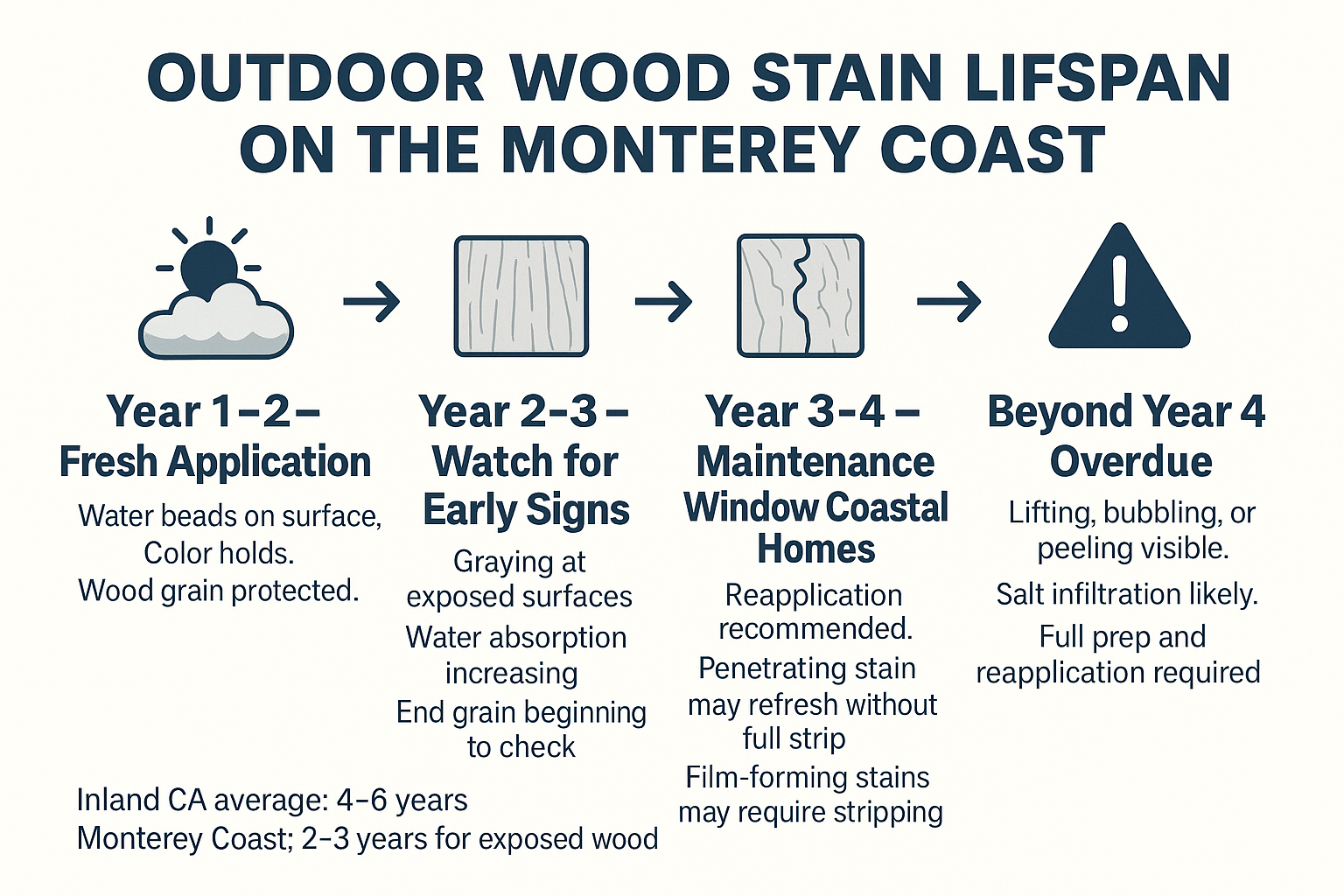
This breakdown shows realistic maintenance intervals and the warning signs that tell you a reapplication is overdue — specific to coastal Central Coast conditions.
How Often Does Outdoor Wood on the Coast Actually Need Maintenance?
Most product labels suggest a four-to-six-year reapplication cycle. That timeline is not realistic for exposed wood on the Monterey Peninsula.
For a deck or set of outdoor pillars on a home in Carmel, Pacific Grove, or along the Monterey waterfront, a two-to-three-year maintenance interval is more accurate. That’s not a reason to avoid staining — it’s just the honest math of what this climate does.
The good news is that catching a maintenance application at the right time is far cheaper and easier than waiting until the finish has failed completely. A light prep and recoat at year two or three is a fraction of the work and cost of stripping weathered, gray wood and starting over.
Here’s what to watch for as indicators that maintenance is overdue:
– Graying of the wood surface — UV is breaking down the finish and the wood beneath it
– Water no longer beading on horizontal surfaces like decks or rail caps
– Cracking or checking at end grain — this is where moisture infiltration starts
– Soft or spongy spots in any structural element, which may indicate deeper moisture damage
If you’re seeing the first two signs, you’re in good shape for a maintenance coat. If you’re seeing cracking at the end grain, you’re at the edge of the window. If you’re seeing soft spots, the conversation shifts from finishing to potential repair — which is a different project entirely.
This same principle applies to any outdoor renovation work on your home. When a Small Project Turns Into Something Bigger — and How to Plan for It walks through exactly what to expect when early maintenance gets delayed and the scope expands.
Frequently Asked Questions About Outdoor Wood Staining on the Monterey Coast
Can I apply new stain over old stain without stripping the surface first?
It depends on the condition of the existing finish. If the old stain is still mostly intact and a penetrating product was used, a light sanding and cleaning may be enough to prep for a maintenance coat. But if the finish is peeling, bubbling, or flaking — which is common on coastal homes where prep wasn’t done right the first time — stripping is the only way to get a new coat to adhere properly. Applying over a failing surface just locks in the failure.
What time of year is best for staining outdoor wood on the Monterey Peninsula?
Late spring through early fall generally works best — roughly May through September. But even in summer, morning fog means you shouldn’t start applying stain until midday when the wood has had time to dry out. Days with overnight lows above 50°F and no rain in the forecast for at least 48 hours after application are what you’re looking for. Avoid starting a project the same week a marine layer is forecast to stick around.
Why does my deck stain keep peeling when I use a good product?
Product quality rarely causes peeling on its own — surface condition almost always does. The most common causes on coastal homes are applying stain over wood that still holds moisture from fog, skipping the pressure wash so salt residue stays in the grain, or applying a second coat before the first has fully cured. In a marine environment, any of those shortcuts produces adhesion failure. The product gets blamed, but the prep is usually where things went wrong.
Is there a stain that works better in salt air environments?
Penetrating oil-based stains generally hold up better than film-forming products in marine climates. They absorb into the wood grain rather than forming a surface layer, which means they flex with the wood instead of cracking when humidity changes. I wouldn’t point to a specific brand without seeing your wood and its current condition, but the product category matters more than the brand name in most cases.
How much does it cost to have outdoor wood stained professionally in Monterey County?
Costs vary quite a bit depending on the size of the project, the condition of the wood, what prep work is needed, and how accessible the surfaces are. Many Monterey County homeowners see estimates that factor in prep, product, and labor together rather than a simple per-square-foot rate. The best way to get an accurate number is to have someone look at the actual wood and give you a written estimate — what looks like a simple staining job sometimes involves more prep work once you’re on-site.
Do wooden pillars and pergolas need the same maintenance as a deck?
Yes — and in some ways vertical elements like pillars and pergolas can be easier to maintain than decks because they don’t take the same foot traffic wear. But they’re just as exposed to salt air and UV, and end grain on any beam or post cap is especially vulnerable. Keep the same watch for graying, loss of water repellency, and cracking at joints and end cuts.
Ready to Get an Honest Assessment of Your Outdoor Wood?
If you have a deck, pillars, railings, or any other outdoor wood on a Monterey County home that’s showing signs of wear, Legacy Painting and Renovating is happy to take a look and give you a straight answer on what it actually needs. Reach out at (831) 917-0047 or through the contact form at legacypaintingrenovating.com — we’ll tell you what we see, what prep is required, and what a realistic maintenance plan looks like for your specific situation.