Direct Answer: If paint is failing in one concentrated spot, the wood underneath is usually wet or already soft. That means carpentry repair first, priced separately from painting, then paint.
A homeowner in Monterey County reached out a while back describing paint that was cracking and peeling badly, but only in a few isolated spots on the house. Everything else looked fine. They asked whether we even did repair work, and mentioned the house was old enough that lead paint might be in the mix.
That call is a good example of something I see constantly on the Peninsula. When paint fails across a whole wall, that is usually a coating or prep issue. When it fails hard in one small area, low trim, a sill, a fascia board, the wood underneath is usually wet.
This article is about what happens when that wood has already gone soft. Not why coatings peel in general, but how dry rot changes the scope, the bid, and the timing of an exterior repaint.
Concentrated Peeling Is a Wet Wood Signal, Not a Paint Problem
Paint is a film. It does not hold water out forever, and once water gets behind it, the film loses its grip from the back side. That is why rot damage shows up as cracking, curling, and lifting in one tight area while the paint ten feet away is still stuck down.
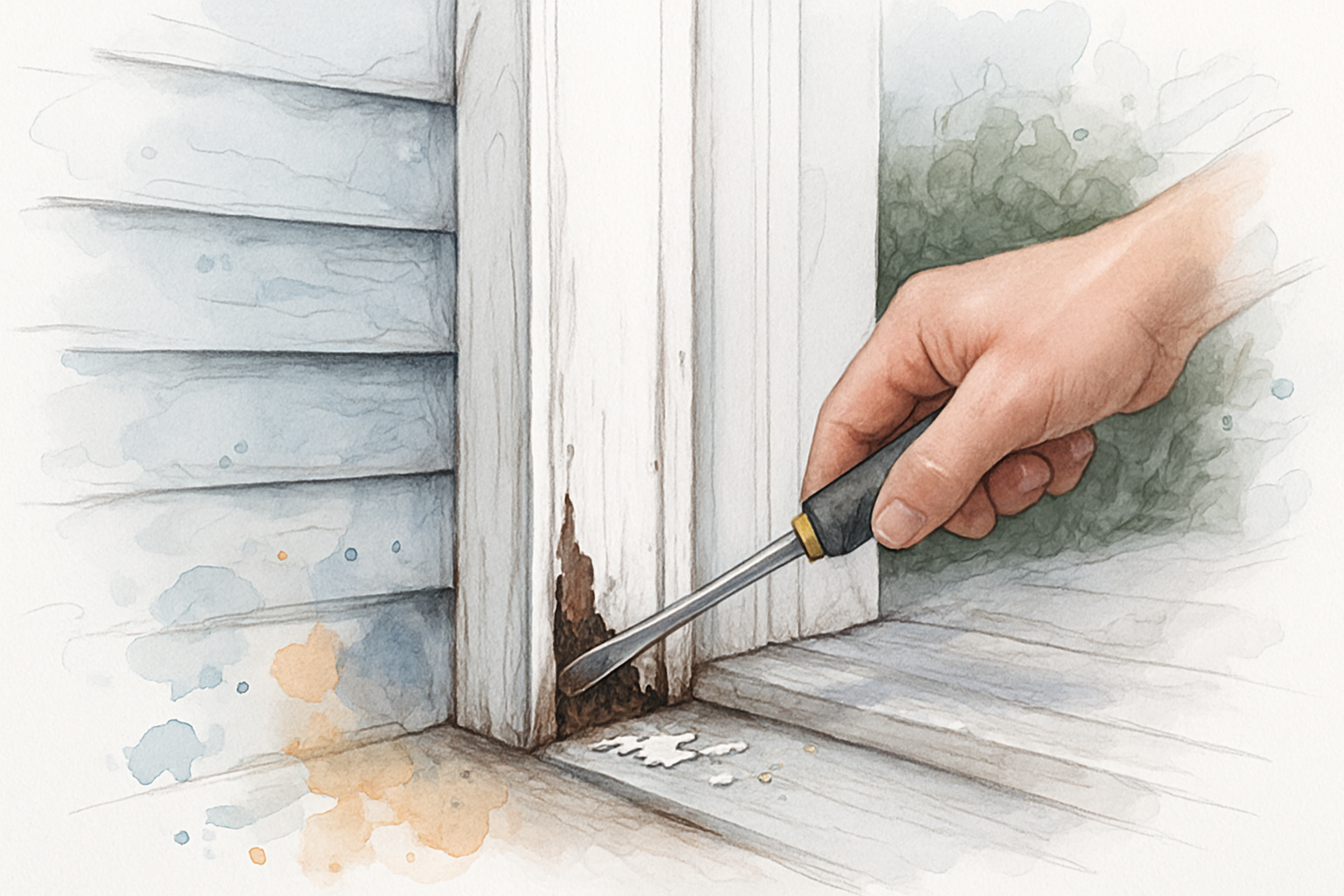
You do not need a contractor to check this. A blunt screwdriver or an awl tells you more in ten seconds than staring at it for ten minutes.
Press the tip firmly into the suspect wood. Sound wood resists and barely marks. Decayed wood sinks in and crumbles. If the tip goes in a quarter inch with light pressure, you have rot, not a paint issue.
The spots that fail first on Monterey Peninsula homes are pretty predictable:
- Bottom rail of window and door trim, where water sits on the horizontal edge
- Fascia and rake boards, especially under a gutter that overflows
- Deck post bases where the post meets concrete or soil
- Stair stringers, at the notch cuts
- Siding butt joints where two boards meet end to end
- Anywhere a sprinkler head throws water on a wall, which is more common than people think
In Pacific Grove, Carmel, and the west facing streets of Monterey, check the north and west elevations first. Those are the walls that sit in fog drip until late morning.
Why Wood Rot Repair in Monterey Happens on a Coast That Barely Rains
This is the part that surprises people. Monterey sees roughly 15 to 18 inches of rain in an average year. Homeowners hear that number and assume rot is a Pacific Northwest problem.
But decay fungi do not care how much rain falls. They care how long the wood stays wet. A marine layer that keeps north facing siding damp until noon, day after day, does more damage than one hard January storm that dries off by afternoon.
Salt air makes it worse in a quiet way. Salt deposits on a surface hold humidity against the wood instead of letting it release. That is the same mechanism behind what Monterey’s coastal climate does to exterior paint over time.
The good news in all of this is that the process has a clear off switch. USDA Forest Products Laboratory research shows that wood kept air dry, generally at a moisture content not above 20 percent, will not decay, and existing decay stops progressing once the wood dries out.
So the goal of any real repair is not just replacing bad boards. It is fixing whatever kept that spot wet in the first place.
Where to Look First on a Peninsula Home
These are the areas I check before anything else on an exterior walkthrough in Monterey, Pacific Grove, or Carmel.
| Location | Why it stays wet | What you will find |
|---|---|---|
| Bottom rail of window trim | Horizontal surface holds fog drip and condensation | Paint curling upward, soft corners, open miter joint |
| Fascia and rake boards | Gutter overflow and slow drying under the eave line | Dark staining, spongy edge, nail heads backing out |
| Deck post bases | Wicking from concrete or soil contact | Crumbling fibers at the bottom two inches |
| Siding butt joints | Exposed end grain absorbs water fast | Swelling, split ends, caulk pulled loose |
| Walls near sprinkler heads | Daily irrigation spray on painted wood | Chalky blistered paint in a fan-shaped pattern |
| North and west elevations | Fog drip that does not burn off until midday | Mildew growth plus soft spots at any joint |
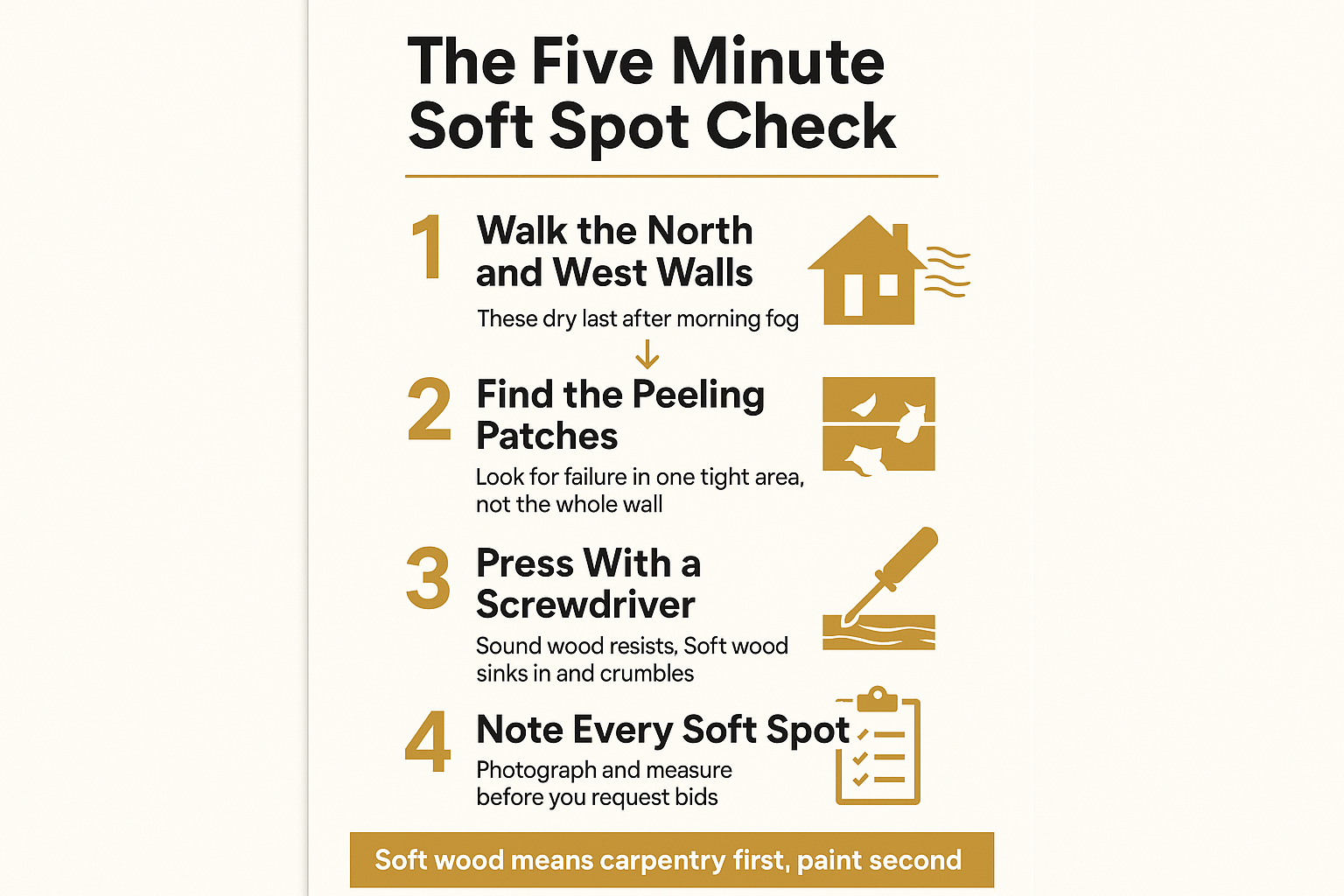
The Five Minute Soft Spot Check
Here is the same walkthrough I do, simplified so you can run it yourself before anyone comes out to look.
Why Rot Repair Is Priced Separately From the Paint
Nobody can see how far rot travels from the outside. The visible soft spot on a window sill might stop there, or the trim comes off and the sheathing behind it is damp too.
That is why carpentry and rot repair is normally quoted separately from the painting and confirmed after an on site look, sometimes after demolition starts. Anyone who gives you a firm rot number from a photo is guessing.
This is also the single biggest reason two bids on the same house land thousands apart. One contractor carried a repair allowance and wrote down what they found. The other planned to caulk the crack, fill the soft area, and paint over it.
The second bid looks better on paper and fails in about a season. When you compare bids, ask for these in writing:
- How rot is identified on the job, and whether anyone probes the wood or just looks
- Whether repair is time and materials or a set price, and what the hourly or unit basis is
- Who confirms the extent of the damage before repair work starts, and whether you get photos
- What happens if more damage is found once trim is removed
- Whether the paint warranty still applies over repaired areas
If your home was built before 1978, that changes things too. Disturbing old paint during carpentry work triggers EPA lead-safe practices, which means containment and controlled cleanup. I wrote more about that in older homes on the Peninsula and the lead paint question. Ask any bidder how they handle it before you sign.
For how the rest of the numbers should be laid out, what a painting estimate should actually tell you covers the line items worth arguing about.
The Timing Question Homeowners Are Facing This Fall
There is a real fork in the road right now if you have found soft wood.
NOAA has El Nino at advisory status heading into the 2026-27 winter, with very strong intensity the most likely outcome. The Climate Prediction Center’s August 2026 outlook puts the heaviest rain signal over coastal California, with the peak landing January through March 2027.
I would treat that as raised odds, not a promise. The 2015-16 event was strong and underdelivered rain to the state, so anyone telling you this winter is guaranteed to be soaking is overselling it.
Still, the decision in front of you is simple. Repair and seal the failing wood now, even if the full repaint waits for spring, or leave open joints and bare wood to drink water for four months.
Bare end grain is the fastest way to turn a two board problem into a six board problem. If a full repaint is not in the budget this year, sealing the exterior before winter rain is the middle path, and paint now or wait for spring walks through the tradeoff in more detail.
What Separates a Real Repair From a Cover Up
Filler smeared over soft wood buys you one season. It looks fine at the final walkthrough and comes apart by the following winter, usually after the painter is long gone.
A repair that actually holds looks like this:
- Rotted material is cut out back to sound wood, not feathered into it
- Replacement stock is primed on all six sides before it goes up
- End grain gets primed, because that is where water enters fastest
- Joints are sealed with a flexible sealant rated for exterior movement
- The water source is addressed, whether that is a sprinkler aimed at the wall or a gutter that overflows
Good prep is where most of the labor in a repaint lives anyway. If you want the full picture of what that includes, surface prep is most of the job breaks it down step by step.
This shows up in our reviews more than anything else. A retired general contractor who hired us for a full exterior repaint put it plainly: “made carpentry repairs as expected and needed, and finished on time” – John S.
That is the bar. Find the bad wood, replace it, tell the homeowner what you found, and then paint.
Frequently Asked Questions About Dry Rot and Exterior Repaints
Can you just paint over rotted wood?
You can, and it will look fine for a few months. But paint does not stop decay, and it does not add back structural strength. Soft wood has to be cut out and replaced or the same spot fails again, usually right after the first wet winter.
Why does my house have rot when Monterey barely gets rain?
Because decay depends on how long wood stays wet, not how much rain falls. Our marine layer keeps north and west facing surfaces damp until midday for much of the year, and salt air holds that humidity against the surface. Time under moisture is the problem, not rainfall totals.
How do I know if it is dry rot or just peeling paint?
Press a screwdriver into the wood under the failing paint. If it resists, you have a coating problem. If it sinks in and the fibers crumble, you have decay. Also look at the pattern: paint failing in one small concentrated area almost always means wet wood underneath.
Why won’t a contractor give me a firm price for rot repair over the phone?
Because nobody can see how far the damage runs until the trim comes off and the wall behind it is exposed. A visible soft corner on a sill might be the whole story, or the sheathing behind it might be wet too. Honest rot pricing is confirmed after an on site look and often adjusted once demo starts.
Should I fix the rot now or wait until spring to do everything at once?
If the wood is already soft and joints are open, waiting means four months of water getting in. A reasonable middle path is to repair and seal the failing areas now and schedule the full repaint for spring when conditions are better for coatings.
Does rot repair require a permit in Monterey County?
Straightforward trim, siding, and fascia replacement is usually treated as maintenance and does not need one. Once repairs move into structural framing, that changes. Your building department is the right first call, since requirements differ between the county, Monterey, Pacific Grove, and Carmel.
Found a Soft Spot on Your Trim?
If you have pressed a screwdriver into a sill or a fascia board and it sank in, the next step is an on site look so someone can tell you how far it goes. Legacy Painting and Renovating works throughout Monterey County, from Pacific Grove and Carmel to Seaside, Marina, and Salinas, and walkthroughs are free with no obligation. You can reach us at (831) 917-0047 or through the contact form at legacypaintingrenovating.com when you are ready.