Direct Answer: Monterey’s marine layer, salt air, and narrow dry season directly affect when paint can be applied, which coatings hold up, and how much prep work a job actually requires.
Most homeowners think of house painting as a straightforward project: pick a color, hire a crew, done. But if you live on the Monterey Peninsula, the climate adds a layer of complexity that most people don’t see coming, and that separates a paint job that lasts eight years from one that starts failing in three.
I’ve worked on homes throughout Monterey County, from older neighborhoods in Pacific Grove and Salinas to newer construction in Carmel Valley and Marina. The single most common thread across the jobs that go wrong, whether it’s blistering, peeling, or early adhesion failure, is that someone skipped the part where the environment gets factored into the plan.
This article focuses on the two things that matter most for exterior and interior house painting in Monterey: how fog and salt air change what a painter can and can’t do, and why the prep work under the paint determines almost everything about how long it lasts.
What the Marine Layer Does to a Painting Schedule
The morning fog on the Monterey Peninsula is not just scenery, it’s a real variable that affects when a painter can safely put brush to surface. During summer months, surface moisture from the marine layer can linger on siding, stucco, and trim well into late morning, sometimes past 10 or 11 a.m. depending on how thick the layer is and how much direct sun the wall gets.
Paint manufacturers are clear on this: the surface temperature must be at least 5 degrees Fahrenheit above the dew point before application begins. Apply paint to a damp or cold surface and it won’t bond correctly. The film cures wrong, and the failure shows up weeks or months later as blistering or peeling, long after the crew is gone.
In practice, this means a professional crew on the Central Coast builds morning moisture checks into the daily routine before a single can gets opened. We use surface thermometers and dew point readings to confirm conditions are right. It shortens the usable window some days, but it’s the difference between work that holds and work that doesn’t.
When you’re comparing bids for a house painting project in Monterey, ask each contractor how they handle morning moisture. A good answer is specific. A vague one tells you something important about how they approach quality.
Salt Air Is the Reason Coastal Paint Jobs Fail Faster
Here’s something most homeowners don’t think about until they’re already dealing with a failing paint job: salt particles from the ocean air settle on every painted surface, and they break down the paint film from the outside in.
This is most aggressive on trim, fascia boards, railings, and entry doors, surfaces with less square footage that get the same salt exposure as everything else, but don’t have the same volume of coating protecting them. Homes near Cannery Row, the beaches in Pacific Grove, or the coastline along Carmel face this more aggressively than properties further inland toward Salinas or Carmel Valley.
For this reason, choosing coatings formulated for high-moisture, high-salt environments is not optional on the Monterey coast, it’s the starting point. Standard interior-grade or even mid-shelf exterior paints that perform fine in Sacramento or Fresno simply don’t hold up the same way here. You need products built for coastal exposure, and your painter should be able to tell you exactly which ones they’re using and why.
For wood surfaces specifically, salt air accelerates the cycle of expansion, contraction, and moisture intrusion that causes stain and sealant to break down. I wrote about this in more detail in a separate piece on why outdoor wood stain fails faster on the Monterey coast, the same principles apply to painted wood siding and trim.
The Monterey Exterior Painting Window: What the Seasons Actually Look Like
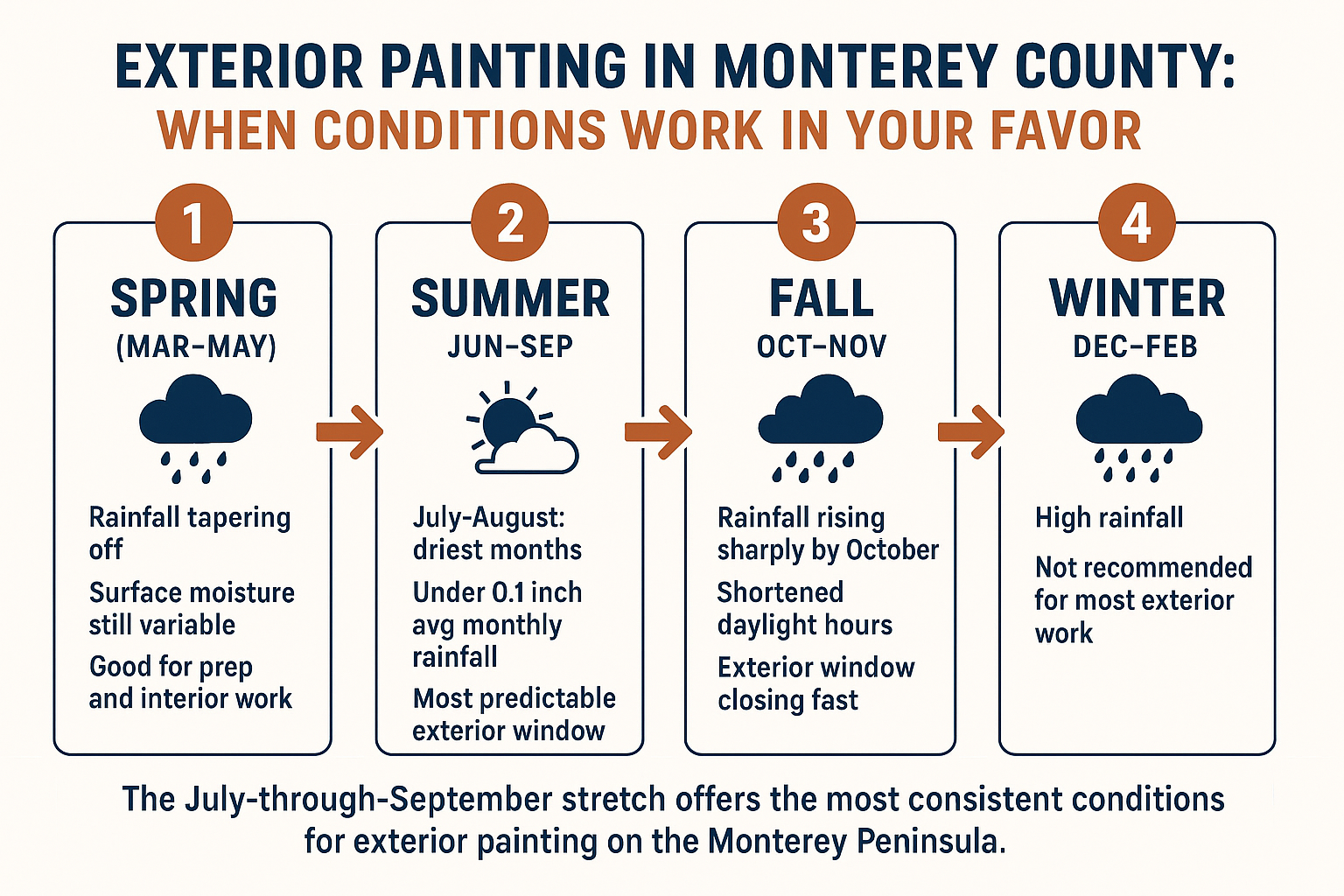
This infographic shows why timing matters for exterior painting in Monterey County, and where the reliable work window actually falls.
 House Painting Project” />
Why the July-to-September Window Matters More Than Most People Realize
Every year, homeowners in Monterey County delay booking exterior painting because summer feels far away or the schedule fills up fast. By late August, the crews with strong reputations are already committed through September, and by October the equation changes.
Historical precipitation data for Monterey County shows that July and August average well under a tenth of an inch of rainfall per month. By October, rainfall climbs meaningfully. By November, it climbs further and daylight hours shrink, compressing the usable workday on both ends.
If exterior work is on your list this year, the July through September stretch is not just convenient, it’s when conditions are most predictable. Fog is still present in the mornings, but afternoon windows are reliable and dry. Pushing into October is a gamble that often ends with the job either rushing to finish before rain or getting pushed to the following spring.
If you’re unsure how to sequence exterior and interior work, this piece on which to tackle first walks through the logic in more detail.
The Prep Work Gap: Why Bids on the Same House Can Vary by Thousands
One question I hear constantly from homeowners shopping for exterior painting in Salinas, Monterey, and Pacific Grove: “I got three quotes and they’re all completely different, what’s actually in there?”
The answer, almost every time, is preparation. Surface prep is where the real time and cost difference between bids lives. A contractor who spends a full day on prep before opening a can of paint is not padding the job, that prep is what determines how long the work holds up.
A proper prep sequence for an exterior paint job on the Monterey Peninsula typically includes:
- Pressure washing to remove salt residue, dirt, and chalky old coating
- Scraping and sanding any areas where the existing paint is loose or failing
- Caulking around windows, doors, trim joints, and any gaps where moisture can enter
- Priming bare wood, repaired spots, and any surfaces that need a bonding base
- Spot repairs for minor stucco cracks, wood rot, or damaged fascia
A lower bid almost always means a shorter prep list. The homeowner often can’t see this on paper, but the difference shows up clearly two or three years later when one house still looks sharp and another is already peeling at the trim.
For a deeper look at what to ask before you book anyone, this guide on interviewing an exterior painter covers the specific questions worth asking.
Also worth knowing: for homes built before 1978, which describes a large share of the housing stock in historic Pacific Grove, older Monterey neighborhoods, and parts of Salinas, lead paint is a real possibility. California contractors performing renovation, repair, and painting work on pre-1978 homes are subject to EPA Renovation, Repair, and Painting rules, which require specific containment and cleanup practices. Ask any painter directly whether they are RRP-certified and how they handle lead-safe prep. For more on what this means in a local context, painting a historic Pacific Grove home covers the topic in detail.
Stucco, Lot Size, and Why Application Method Isn’t Always the Painter’s Choice
One situation that comes up more than most homeowners expect on the Monterey Peninsula is that a sprayer can’t always be used on every side of a house. Lot sizes in neighborhoods like parts of Seaside, older blocks in Salinas, and areas like Pasadera in Monterey mean homes are sometimes close enough to neighboring properties that overspray becomes a real problem.
When that’s the case, brush and roller application on stucco is the right call, not a shortcut or a compromise. It takes longer, because stucco’s texture requires more deliberate coverage to get paint into every recess without leaving dry spots or holidays in the film. But it protects the neighbor’s property and produces a clean, controlled result.
If you’re getting bids on a stucco home, ask each contractor how they plan to handle any sides that are close to fences, neighboring walls, or shared structures. The answer tells you whether they’ve actually looked at your property or are giving you a boilerplate estimate.
How Monterey’s Climate Affects Common Exterior Surfaces
Different exterior surfaces respond differently to salt air, fog cycles, and UV exposure on the Central Coast. Here’s a quick reference for what to watch for on each one.
| Surface | Main Climate Risk | What Prep Addresses It |
|---|---|---|
| Stucco | Salt residue buildup, hairline cracks from thermal cycling | Pressure wash, crack repair, masonry primer |
| Wood siding and trim | Salt air moisture intrusion, paint film breakdown | Scraping, sanding, spot prime, quality exterior topcoat |
| Fascia and soffits | Concentrated salt exposure, peeling at edges | Full scrape to bare wood if needed, bonding primer |
| Railings and metal trim | Rust bleed-through, salt corrosion under paint film | Rust treatment, metal primer, topcoat rated for coastal use |
| Decking and exterior wood | Accelerated stain and sealant breakdown | Full cleaning, sanding, re-stain with moisture-resistant product |
What a Good Job Looks Like From Day One
A lot of homeowners have had at least one contractor experience that left them frustrated, job site left a mess, crew showing up late or not at all, no communication about what was happening. These are not minor annoyances. On a multi-day exterior project, they compound quickly.
One reviewer who described himself as a retired general contractor put it this way after an exterior repaint: the crew “arrived and pursued the job very professionally, kept everything protected and clean, moved exterior furniture and replaced it, made carpentry repairs as expected and needed, and finished on time.” That kind of specific operational detail is worth paying attention to, because it describes exactly what a well-run job site looks like.
From the first day on a project, a few things should be visible:
- Drop cloths and surface protection in place before any work starts
- A clear explanation of what the crew will be doing that day and when they’ll arrive
- Any unexpected findings, rot, cracks, old lead paint, communicated immediately before work continues
- The job site left clean and organized at the end of each day
If those things aren’t happening on day one, they’re unlikely to improve as the project continues. The homeowner experience during the job matters just as much as the finished result.
For anyone planning a larger project that might run across multiple weeks, this piece on living in your home during a renovation covers what to expect practically day to day.
Frequently Asked Questions About House Painting in Monterey
Can exterior painting really be done in the summer with all the morning fog?
Yes, and summer is actually the best time for it. The key is that a professional crew accounts for morning moisture conditions before starting each day. Once surfaces dry out and temperatures rise above the dew point threshold, usually by mid-morning on most summer days, the window opens up reliably. July and August are the driest months in Monterey County by a significant margin, which makes them the most predictable for exterior work.
How do I know if my home has lead paint and what does that mean for a painting project?
If your home was built before 1978, there’s a real chance some of the existing paint contains lead. This is especially common in historic Pacific Grove, older Monterey neighborhoods, and parts of Salinas. Before any scraping or sanding begins on exterior surfaces, ask your painter directly whether they are RRP-certified under EPA guidelines. Contractors who are certified follow specific containment and cleanup procedures that protect your family and your property. If a painter doesn’t know what RRP certification is, that’s a red flag.
Why are the bids I’m getting for exterior painting so different from each other?
The gap almost always comes down to preparation. A bid that looks low usually reflects a shorter prep list, less pressure washing, less scraping, less caulking, fewer spot repairs. Those steps take real time and labor, and they’re what separates a paint job that holds up for eight-plus years from one that starts peeling in three. Ask each contractor to walk you through exactly what prep steps are included. If they can’t explain it specifically, the price difference starts making more sense.
Do I need to use a special paint on the coast, or does any exterior paint work?
Standard exterior paints designed for inland California climates don’t perform the same way on the Monterey Peninsula. Salt air accelerates paint film breakdown, especially on trim, doors, and railings close to the ocean. Coatings formulated for high-moisture, high-salt environments are the right baseline here. Your painter should be able to name specific products they’re using for coastal applications and explain why they chose them.
What if the painter can’t use a sprayer on one side of my house because it’s close to a neighbor?
This is more common on the Peninsula than most people expect. Brush and roller application on stucco takes longer, but it’s the correct approach when overspray would damage a neighboring property. A good painter accounts for this in the estimate rather than finding out on the day of the job. When you describe your property during the bidding process, mention any proximity issues so they’re priced into the scope upfront.
When is the worst time of year to paint the exterior of a home in Monterey County?
November through February is the period with the most risk. Rainfall increases significantly by late October and continues through winter. Shorter daylight hours further compress the usable workday. Paint applied in wet or cold conditions doesn’t cure properly and can fail quickly. If exterior work gets pushed out of the summer window, most experienced painters in Monterey County will recommend waiting for spring rather than pushing through fall.
Ready to Plan Your Exterior Painting Project?
If you’re a homeowner in Monterey County thinking through an exterior paint job for this season, Legacy Painting and Renovating is available to come out, look at the property, and walk you through exactly what the scope involves. You can reach us by phone at (831) 917-0047 or through the contact form at legacypaintingrenovating.com to request a free estimate.