Direct Answer: If your Monterey County home was built before 1978, any paid painting work that disturbs more than 6 square feet inside or 20 square feet outside requires an EPA RRP certified contractor using lead-safe practices.
A homeowner in Monterey sent us a note last year about extensive cracking and peeling on parts of their exterior. Then came the line I hear more often than people would guess: I believe it may be lead paint.
That is a fair thing to wonder about here. A large share of the housing on the Peninsula went up before 1978, which is the year lead-based paint was banned for residential use in the United States.
So before anyone climbs a ladder with a scraper, it helps to know what that pre-1978 build date actually changes. I want to walk through the rule that applies, what lead-safe work looks like in real life, and the questions worth asking any contractor before you sign anything.
Why the lead paint question comes up so often on the Monterey Peninsula
Walk through Pacific Grove and you are looking at block after block of homes from the Victorian and early cottage era, many with historic designation. Carmel has its own stock of small older houses, and older Salinas neighborhoods near Oldtown have plenty of homes from the 1920s through the 1960s.
Age alone does not mean lead is present. But it does mean lead is possible, and that changes how the prep work has to be handled.
Our climate makes this show up faster than it would inland. Marine layer moisture, salt air, and the fog-to-sun swing all work on old coatings until they crack, curl, and let go. That is the same pattern of coastal paint failure I see on siding, trim, and window sashes across the Peninsula.
Here is the part that matters. When old paint fails, homeowners reach for the fix, and the fix almost always means disturbing the surface:
- Scraping loose and flaking paint
- Sanding to feather rough edges smooth
- Power washing before repaint
- Cutting out and replacing rotted trim or siding
- Removing old window or door casing
Every one of those creates dust or chips. If lead is in those layers, that dust is the actual hazard, not the paint sitting quietly on the wall.
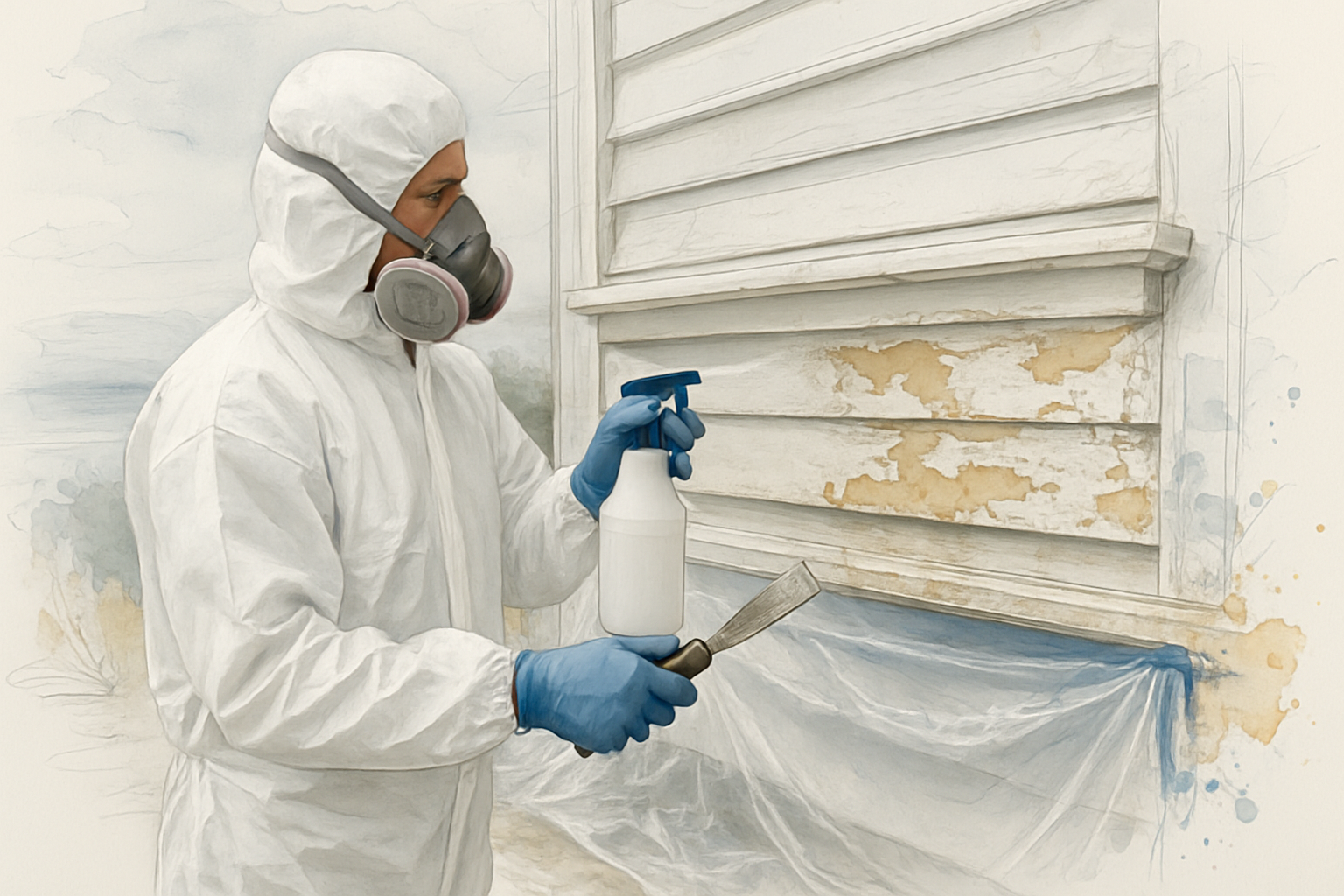
What the EPA RRP lead paint rule requires on pre-1978 homes
The federal rule people are talking about is the Renovation, Repair and Painting Rule, usually shortened to the RRP Rule. It applies to paid work that disturbs painted surfaces in housing built before 1978.
It kicks in once the job crosses a size threshold:
- More than 6 square feet of interior painted surface in a single room
- More than 20 square feet of exterior painted surface
- Any window replacement or demolition of painted surfaces
Those numbers are small. Twenty square feet of exterior is a stretch of siding roughly 2 feet by 10 feet. Most repaint projects blow past that on day one.
When the rule applies, the firm doing the work has to be EPA RRP certified, has to have a certified renovator on the job, has to use lead-safe work practices, and has to keep records of it. You can read the program details straight from the source at the EPA’s Lead Renovation, Repair and Painting Program.
One more thing worth knowing for 2026: EPA’s stated enforcement priorities call out painting contractors, landlords, and property managers working on pre-1978 housing. Civil penalties under this rule can run into tens of thousands of dollars per violation, per day.
Does the RRP rule apply to your project?
A quick way to think through common Monterey County projects. This is general guidance, not a legal determination for your specific home.
| Project | Surface disturbed | Likely status |
|---|---|---|
| Full exterior repaint on a 1940s Pacific Grove home | Well over 20 sq ft | Rule applies |
| Scraping and repainting one badly peeling exterior wall | Usually over 20 sq ft | Rule applies |
| Repainting a pre-1978 bedroom after light sanding | Over 6 sq ft in the room | Rule applies |
| Small drywall patch in one interior spot | Under 6 sq ft in that room | May fall under the threshold |
| Any window replacement in pre-1978 housing | Any amount | Rule applies |
| Painting a home built in 1995 | Any amount | Rule does not apply |
In California, your painter is not allowed to test the paint
This trips people up. In California, only a state-certified Lead Inspector or Risk Assessor may test for lead-based paint. A painting contractor cannot swab your siding, call it clean, and move on.
So you have two honest paths on a pre-1978 home:
- Hire a certified inspector or risk assessor to test, and work from the results
- Assume lead is present and have the work done using lead-safe practices from the start
Both are legitimate. Testing costs vary quite a bit depending on the size of the home and how many surfaces are sampled, so it is worth calling a couple of certified inspectors for current numbers. On a large or complex home, testing sometimes saves money by narrowing which areas need the full protocol.
On a smaller project, assuming lead and working safely is often simpler and faster than waiting on lab results. What is not acceptable is a contractor telling you it is probably fine. Nobody on a paint crew is qualified to make that call in this state.
What lead-safe work looks like on the job site
Here is the sequence a certified crew follows on a pre-1978 home, start to finish.
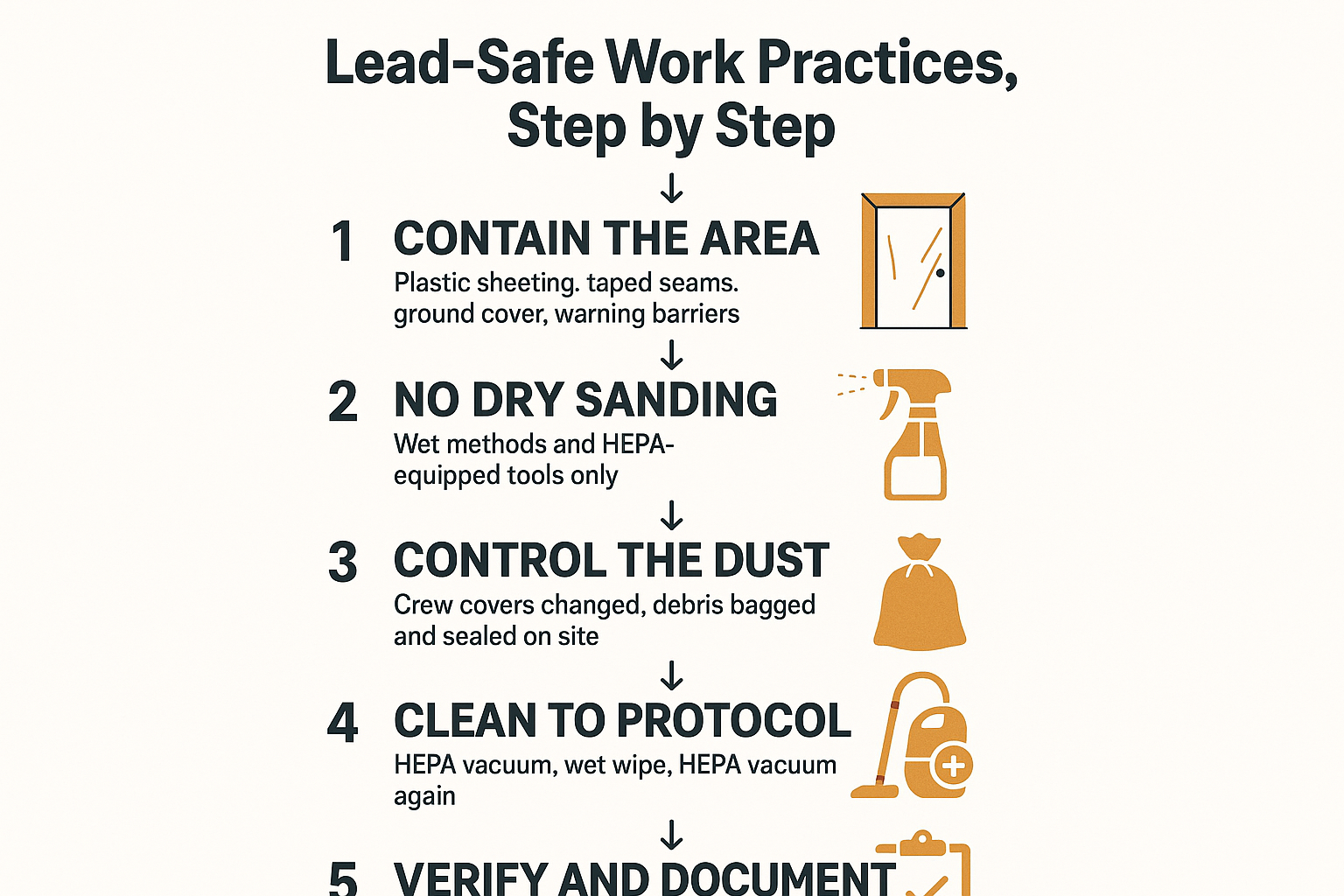
The practical version: containment, wet methods, cleanup, verification
Rules on paper are one thing. Here is what it actually looks like when a crew shows up at your Pacific Grove or Carmel house and does this right.
Containment comes first. Interior work gets plastic sheeting sealed over doorways and floors so dust does not migrate into the rest of the house. Exterior work gets ground cover extending out from the wall, weighted and taped, with the work area marked off.
Dry sanding is out. Surfaces get misted before scraping, and sanders run with HEPA vacuum attachments. Open-flame burning and high-heat guns are off the table entirely on these surfaces.
Cleanup is a protocol, not a habit. HEPA vacuum, wet wipe, HEPA vacuum again, with debris bagged and sealed before it leaves the site. Then the certified renovator performs cleaning verification and keeps the records.
This is a slower way to work, and it should be reflected honestly in the estimate. It is also the reason surface prep is the bulk of the labor on any older Peninsula home. On a historic property, where you are already dealing with original wood, layered coatings, and design review considerations, the process differs from a standard repaint in ways worth understanding before you get bids.
Four questions to ask before you sign a contract
If your home predates 1978, ask these before money changes hands. The answers tell you a lot.
- Are you EPA RRP certified, and what is your firm certification number? Ask for it in writing. A certified firm will hand it over without hesitation.
- Will you test, or assume lead is present? The honest answer is that they cannot test, so either you hire a certified inspector or the crew works as if lead is there.
- What containment will you set up, specifically? You want to hear about sheeting, sealed seams, ground cover, and where debris goes.
- How will cleanup be verified and documented? Cleaning verification and written records should be part of the job, not an afterthought.
One more angle homeowners miss. If an uncertified contractor gets caught doing this work on your property, that becomes a problem attached to your project and your home, not just theirs. Landlords and property managers handling rental turnovers on older Salinas and Seaside units carry that exposure too.
California also tightened what a contractor owes you in writing, which is worth reading up on before you sign any renovation or painting contract in 2026.
Frequently Asked Questions About Lead Paint in Older Peninsula Homes
My house was built in 1965. Does that mean it definitely has lead paint?
No. It means lead is possible, not certain. Plenty of pre-1978 homes have been stripped and repainted several times over. But since the paint cannot be tested by your contractor in California, the safe assumption for any pre-1978 home is that lead may be in one of those layers until a certified inspector says otherwise.
Can I scrape and repaint my own house without following these rules?
The RRP Rule applies to paid work, so a homeowner doing their own house is not covered by it. That said, the dust is exactly as hazardous either way, especially with kids or pets in the home. If you are going the DIY route on an older home, the containment and wet-method practices are still the smart way to work.
Does lead-safe work cost more?
Generally yes, because containment setup, wet methods, and the cleanup protocol all take additional labor and materials. How much more depends on the size of the home, how much surface actually needs disturbing, and whether it is interior or exterior. Any contractor bidding an older home should be able to explain that line item clearly rather than burying it.
What if only one section of my exterior is peeling? Does the rule still apply?
If that section is more than 20 square feet of painted exterior surface, yes. That is a smaller area than most people picture, roughly a 2 foot by 10 foot patch of siding.
Who is qualified to test for lead paint in Monterey County?
In California, testing has to be done by a state-certified Lead Inspector or Risk Assessor. They are a separate trade from painting contractors, and hiring one keeps the testing independent from whoever is bidding the paint work.
Planning work on an older Peninsula home?
If your home in Monterey, Pacific Grove, Carmel, or Salinas was built before 1978 and the paint is starting to fail, it is worth talking through the prep approach before you commit to anything. Legacy Painting and Renovating is available for free estimates across Monterey County at (831) 917-0047 or through legacypaintingrenovating.com. Even if you end up going a different direction, you will at least know the right questions to ask.