Direct Answer: Usually, yes. Lifted veneer can often be re-bonded and clamped flat, and missing chips can be patched with matching stock. Only widespread bubbling or swollen core material forces replacing a door.
You open a cabinet door, run your thumb down the edge, and feel a thin strip of wood lifting away from the panel. Maybe a corner is missing a chip the size of a dime. And right then the math in your head jumps straight to new cabinets, which for a Monterey Peninsula kitchen is a big, ugly number.
I get this question a lot, and I want to say it plainly: chipped veneer is a condition question, not an automatic death sentence for your cabinets. Most of the edge damage I look at in Carmel, Pacific Grove, and Monterey kitchens is localized and repairable.
What follows is how I actually decide. What your doors are made of, why the edges give out first in a coastal kitchen, which repairs are worth doing, and the one question that tells you more about a bid than the price does.
First Figure Out What Your Doors Are Actually Made Of
Before anybody talks about repair, you need to know whether you have solid wood, a real wood veneer over a plywood or particleboard core, or a plastic style laminate printed to look like wood. The three sand completely differently, and the whole prep plan hangs on it.
You can sort this out yourself in about ten minutes:
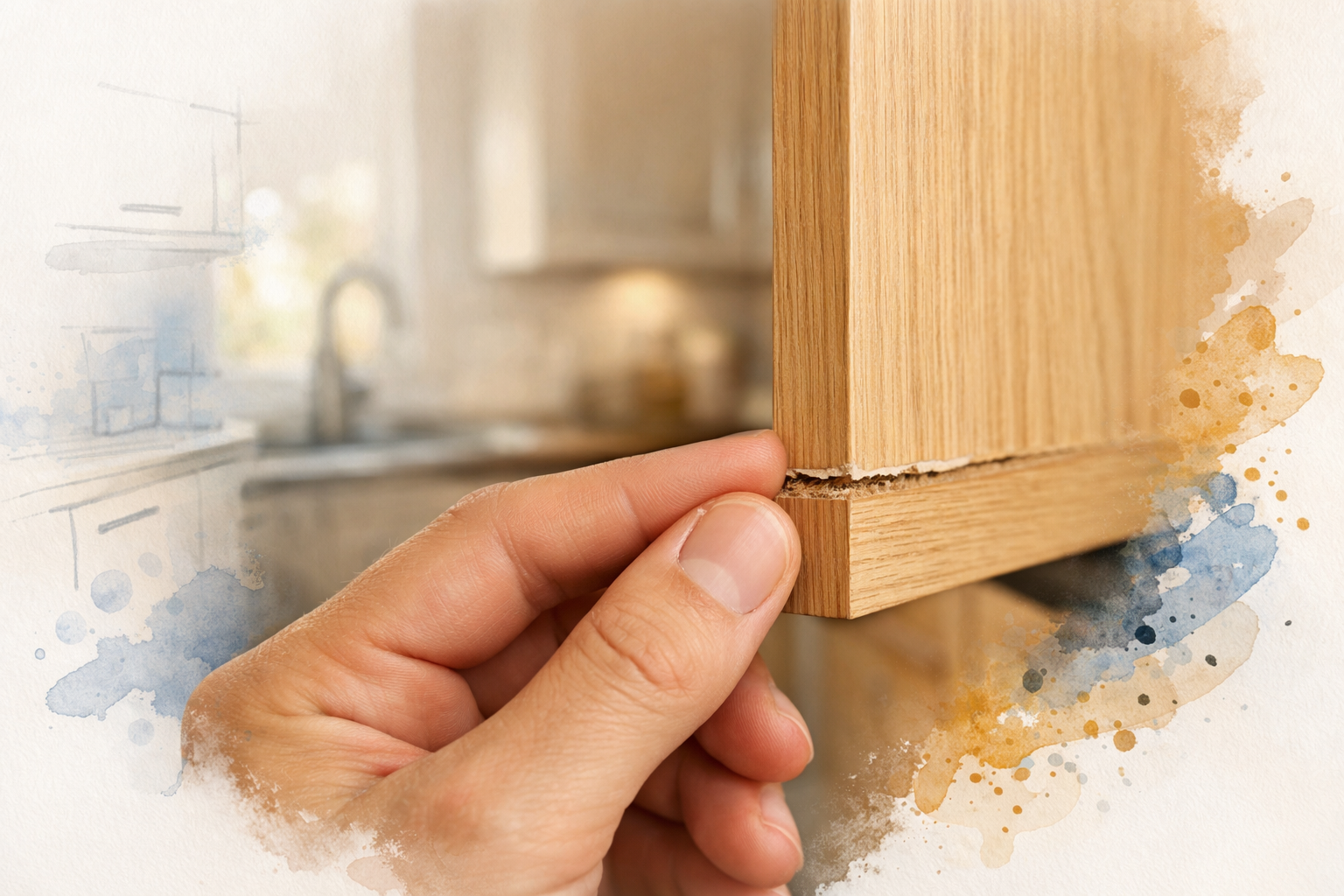
- Open a door and look straight at the edge. Solid wood shows the same grain running off the face and around the edge. Veneer shows a hairline seam where a thin face layer stops and a core begins.
- Check the inside face of the door. On solid wood, the grain pattern continues and makes sense front to back. On a veneered panel, the inside is often a plainer, cheaper face or a different species entirely.
- Compare a drawer front to the cabinet box. Lots of kitchens pair solid wood or veneered fronts with a laminate covered box. If the box feels slick and plastic under your nail, that is laminate, and it gets handled differently.
Here is why it matters so much. A typical cabinet veneer is thinner than a credit card, sometimes well under a millimeter. Sanding too hard, or with the wrong grit, burns right through the face layer and exposes the core, and that is the single most common way a cabinet refinish goes wrong.
Why the Edges Always Fail First on the Monterey Peninsula
The face of a veneered panel is glued to a flat, stable surface. The edge is where that face layer wraps over the raw cross section of the plywood or particleboard, and that bond is the weakest point on the whole door.
Manufacturer field guidance on veneer delamination points at the same culprits I see in the field: the edge where veneer meets the core is where bonding fails first, and temperature extremes plus sudden swings in the surrounding air are a primary cause.
That describes a Peninsula kitchen almost perfectly. Cool damp marine layer in the morning, dry warm afternoon, and most homes around here have no air conditioning to flatten the swing. Add steam and heat in the same spots every day and the glue line gives up.
When I walk a kitchen, I check the usual suspects first:
- The door next to the dishwasher, which takes a steam bath every time it finishes a cycle
- The sink base doors, especially the bottom edges that catch splash and drips
- The panel beside the range, where heat cycles the surface daily
- Toe kicks and the lowest edge of any door, where mopping water sits
County housing data puts the median Monterey County build year in the mid 1970s, and roughly one in eight homes here predates 1950, a share that climbs in Pacific Grove and Carmel. A lot of these kitchens still have their original cabinetry. Decades of fog mornings and dry afternoons will do this to a glue line. It is normal wear, not something you did wrong.
The Four Conditions I Sort Veneer Damage Into
Almost every chipped or lifted door I look at falls into one of these four buckets. The bucket decides the plan.
| Condition | What you see and feel | Typical approach | Honest outcome |
|---|---|---|---|
| Lifted but intact | A strip of veneer pulls away but is still attached and still flexible | Glue worked under the lift, then clamped flat with a caul and left to cure | Usually disappears completely once finished |
| Small missing chip | A gap at a corner or edge with bare core showing | Grain matched patch cut from similar stock, or a tinted fill under an opaque finish | Very good under paint, subtle but visible under a clear coat |
| Bubbled across the face | Soft raised areas in the middle of a panel, not just the edge | Limited success. Often a sign the whole glue line is letting go | Repair is a gamble, replacement of that door is often smarter |
| Swollen or crumbling core | Particleboard edge is puffed up, soft, or breaks apart under a fingernail | No reliable repair exists for failed core material | Replace that door or drawer front |
The Repair Itself, and Where It Gets Hard
Re-bonding lifted veneer is patient work, not complicated work. You clean out the old failed glue, work fresh adhesive into the gap, then clamp the piece flat with a block so it dries in the right plane. Rush the clamp time and it lifts again in a year.
A missing chip is harder. The right fix is a patch cut from stock that matches the species and grain direction, feathered in so the seam reads as part of the grain. That takes real bench time, which is why it gets quoted separately rather than lumped into a square foot number.
Now the part nobody likes hearing. A clear finish hides nothing. Last summer a homeowner in Carmel Valley asked us about cherry cabinets with veneer chipping on a few panel edges, and the stated goal was to refresh and protect, not to repaint or change color. That is the hardest version of this problem.
Under paint, a well executed fill vanishes. Under a clear coat over natural cherry, filler telegraphs. The color is never quite right, and it will not take stain the way the surrounding wood does. So on a stained kitchen, a visible chip on a prominent door usually forces a choice between three things:
- Live with a subtle, honest looking repair
- Replace that one door with new stock and work to match the color
- Move the whole kitchen to a painted or opaque finish
There is no fourth option where a patch under clear coat becomes invisible. Anyone who tells you otherwise has not done enough of them. If keeping the natural grain is the priority, it is worth reading up on what it takes to refinish wood cabinets without painting before you commit.
How I Walk Through a Veneer Decision
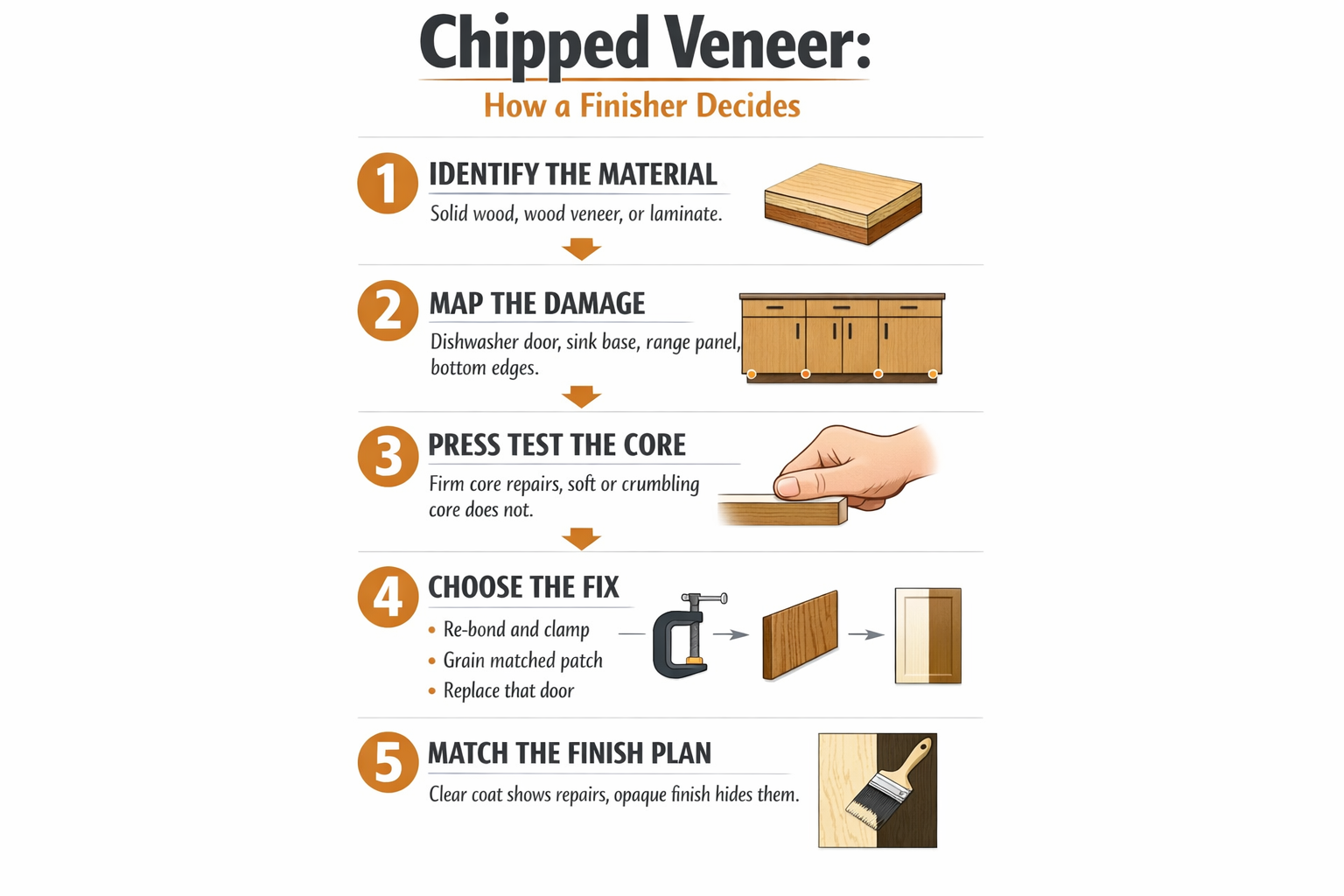
This is the order I work through on a walkthrough, from identifying the material to landing on a plan for each damaged door.
Why Two Refinishing Bids for the Same Kitchen Look Nothing Alike
When veneer damage is in play, two bids on an identical kitchen can be thousands apart, and it usually is not greed on one side or a bargain on the other.
One bid prices a straight scuff, prime, and coat. The other prices repair hours, patch stock, clamp and cure time, and the real risk that more loose veneer shows up once the doors come off and get laid out flat under good light. Doors always look worse on the bench than they do on the wall.
On a full repaint, preparation and labor run roughly three quarters of the total while the coating itself is the smaller share. On cabinets, prep dominates even harder.
So ask every bidder the same question: what happens, and what does it cost, if you find more loose veneer once the doors are off?
- A good answer explains how extra repair gets documented and priced before the work happens
- A good answer treats carpentry and veneer repair as a separate line quoted after inspection, not a guess from a photo
- A vague answer, or a flat “we will take care of it,” usually means that cost is coming back to you later, or the repair is getting skipped
The answer tells you more about the contractor than the bottom line does. For anything beyond that, the only honest number comes after someone opens the doors and looks at them in person. Timing matters too, since this kind of work interacts with your countertops and your kitchen being out of commission for a stretch.
Frequently Asked Questions About Chipped Cabinet Veneer
Can you just fill a veneer chip with wood filler and sand it smooth?
Under an opaque painted finish, yes, and it holds up well. Under a clear coat over natural wood, filler shows. It will not accept stain the way the surrounding grain does, so the patch reads as a patch under certain light.
How do I know if my cabinets are veneer or solid wood?
Open a door and look at the cut edge. Solid wood carries the same grain around the edge. Veneer shows a thin face layer with a visible seam where it meets the core underneath. Comparing the inside face of the door to the outside is the other quick tell.
Does the marine layer here really cause veneer to lift?
It contributes. The bigger driver is repeated swings between damp and dry, plus steam and heat in specific spots. Most Peninsula homes have no air conditioning, so a kitchen cycles through cool damp mornings and warm dry afternoons every day of the year.
If one door is too far gone, do I have to replace the whole set?
No. Replacing a single door or drawer front is normal. The challenge is color matching new stock to decades old wood under a clear finish, which is much easier if the kitchen is moving to a painted finish instead.
Should I handle the veneer repair before or after new countertops go in?
Sequence matters more than people expect, especially if cabinets need to come out temporarily for the stone. It is worth reading about whether refinishing or countertops should go first before you book either trade.
How long should a repaired and refinished cabinet actually last?
With a sound core, proper re-bonding, and a correctly cured finish, you should get years of normal use out of it. What fails early is almost always rushed prep, not the coating. Here is what holds up and what doesn’t a year later.
Wondering Which Category Your Cabinets Fall Into?
Chipped veneer is one of those things that has to be seen and touched before anyone can tell you honestly whether it saves or not. One homeowner summed up what we aim for in a review: “With his knowledge and expertise can recommend suggestions and are honest if expectations cannot be met.” We are a family run, licensed and insured operation here on the Peninsula, CSLB #1066829, and cabinet refinishing is regular work for us rather than an add on. If you want someone to look at your doors and tell you straight, Legacy Painting and Renovating offers free estimates across Monterey County at (831) 917-0047 or through legacypaintingrenovating.com.