Direct Answer: Painters price turnover painting by the condition of the unit, not by bedroom count. Faded walls and small nail holes are usually owner maintenance. Large holes and heavy marks are documented damage.
The keys just came back. The unit needs to be rent ready in days, not weeks, and the first question is always the same: does the whole place get repainted, or just the rough spots?
I get this call constantly from owners and managers in Seaside, Marina, Salinas, and Monterey. One property manager at a local apartment community put it about as plainly as it gets: “We are looking for pricing as soon as possible for 1 bed, 2 bed & 3 bed units upon turnovers.”
That is exactly how owners think, and I understand why. But turnover painting does not price that way, and California’s new deposit documentation rules changed what has to happen before a painter ever walks in. Here is how I’d think it through.
Why Turnover Painting Has No Per-Bedroom Price
A 2 bedroom that had a careful tenant for four years and a 2 bedroom that had a family with three kids and a dog are not the same job. Same square footage, completely different labor.
Painters price by condition, not bedroom count. What a walk-through actually changes:
- How many holes need patching, and whether any are big enough to need drywall repair rather than spackle
- Whether the existing finish is a wipeable sheen or a cheap flat that has to be fully recoated
- Whether there are stains that need spot priming so they don’t bleed through
- Whether a tenant painted a bedroom a deep color that needs extra coats to cover
- Whether the unit is empty and open, or still holding appliances and window coverings
- Whether the building predates 1978, which brings EPA lead-safe work practices into play
Owners with multiple identical floor plans can absolutely get a working budget number per plan type once a painter has seen a few of them. That’s normal and useful for forecasting. But the honest answer on any single unit comes from the walk-through, and a proposal that skips the walk-through is a guess dressed up as a bid. If you want to know what a real one should spell out, I’d read what a painting estimate should actually tell you.
Take the Photos Before Anyone Touches the Walls
This is the part most landlord content gets wrong, and it matters for painting specifically.
AB 2801 amended California Civil Code Section 1950.5 to require timestamped photos at set points in a tenancy. Move-out and post-repair photos became required starting April 1, 2025, and move-in photos on new tenancies starting July 1, 2025. Those photos go to the tenant along with the itemized statement inside the standard 21 day deposit return window.
Here’s the wrinkle for painting. The move-out photos have to be taken before any repairs or cleaning begin. That means the documentation has to happen in the narrow gap between key return and the first vendor walking through the door.
So the sequence looks like this:
- Keys returned
- Move-out photos taken, before cleaning, before patching, before any prep
- Painter walks the unit and writes the scope
- Work performed
- Post-repair photos taken
- Itemized statement plus photos sent inside the 21 day window
I’ve had owners call to book prep work the same afternoon the keys came back. Sometimes the right answer is to slow down by two hours and get the photos done first. And to be clear, I paint houses for a living, I don’t practice law. Confirm the specifics of your own situation with your attorney or property manager rather than treating a blog post as legal advice.

Reading the Wear and Tear Line on a Painting Proposal
California practice commonly treats interior paint as having a useful life in the range of roughly 2 to 3 years. That’s the framework most owners and managers I work with are using when they sort a unit into buckets.
After a long tenancy, faded walls, light scuffs, and a handful of picture nail holes are generally the owner’s maintenance cost. That’s the paint doing what paint does over time.
Large holes, unauthorized paint colors, and heavy marker or crayon work sit in a different category. Those aren’t aging, they’re damage, and they usually take extra labor: cutting in a drywall patch, stain blocking, or two extra coats over a dark accent wall.
The useful part of this is procedural, not philosophical. Ask your painter to itemize documented damage repair separately from the general refresh so the paperwork lines up with whatever deduction you’re documenting.
One more thing worth saying out loud: a charge tied to one damaged bedroom wall does not justify billing a full unit repaint. If the proposal lumps everything into a single line, ask for it to be broken out. A painter who can’t separate those two things is making your documentation harder than it needs to be.
Sorting a Unit Before You Call for Pricing
This is roughly how I mentally sort what I see on a turnover walk-through. It’s a planning tool, not a legal opinion.
| What I see in the unit | Usually treated as | What it changes in the painting scope |
|---|---|---|
| Faded walls after a multi-year tenancy | Normal wear, owner maintenance | General refresh coat, standard prep |
| A dozen picture nail holes | Normal wear | Spackle and sand, minimal added labor |
| Light scuffs along a hallway | Normal wear | Wash and spot prime, may not need full repaint if sheen allows |
| Fist-sized or larger holes | Damage, documented separately | Drywall patch, tape, texture match, prime, then paint |
| Tenant-applied deep accent color | Damage or unauthorized alteration | Stain-blocking primer plus extra coats to cover |
| Heavy marker or crayon on walls | Damage, documented separately | Cleaning, stain blocking primer, sometimes multiple coats |
| Mildew in bath or closet after vacancy | Condition issue, not tenant damage | Wash, full dry time, spot prime before any topcoat |
The Coastal Problem a Generic Turnover Checklist Misses
A turnover checklist written for Sacramento or Phoenix falls apart on the Peninsula, and the reason is humidity.
Rentals in Seaside, Marina, and Monterey sit under the marine layer most of the summer. A vacant unit with the heat off and the windows closed for a week grows mildew in bathrooms, closets, and along cool north-facing walls faster than an inland property ever would.
Painting over that surface locks the problem under the new coat. It will come back through, usually within a few months, and then you’re paying for the same wall twice.
What that means in practice:
- Wash first, don’t just wipe. Mildewed surfaces need cleaning, not a dry rag pass
- Let it dry all the way. Damp drywall under fresh paint is a future callback
- Spot prime stained areas with a product meant to block, not just cover
- Plan for longer dry times. Fog-to-sun cycles stretch cure times even on interior work when windows are open for ventilation
That last one surprises people. A summer morning in Marina can sit at high humidity until noon, and the coat you rolled at 9 a.m. is not ready for a second pass at 10:30 just because the label says two hours. The same coastal conditions that chew through exterior paint affect interior schedules more than most owners expect.
The Turnover Sequence That Prevents a Repeat Repaint
The order matters more than the speed. Here’s the sequence a vacant unit realistically moves through.
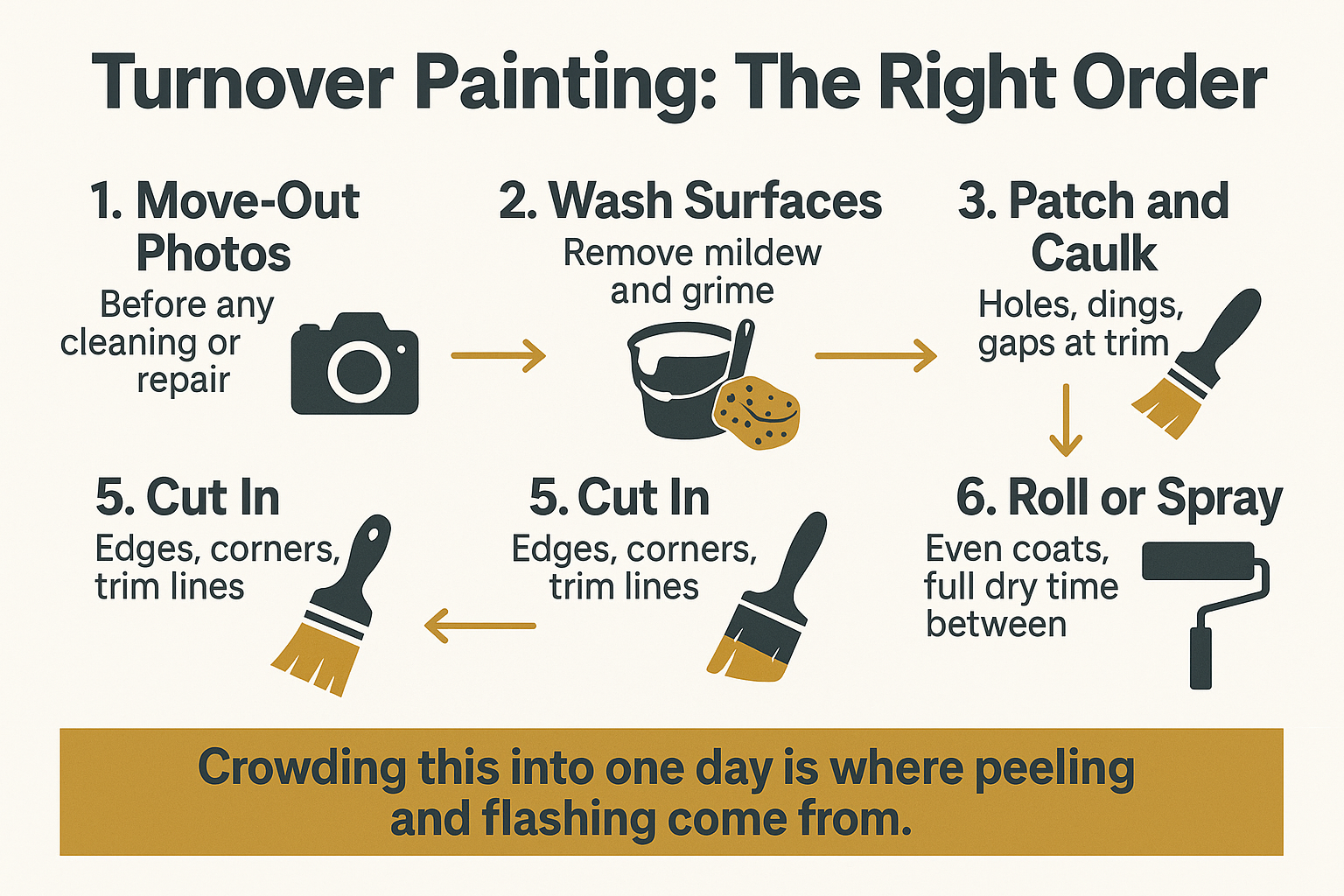
The Math That Decides Cost Is Vacancy Days, Not Paint Gallons
Owners ask about paint. Paint is the smaller share of the cost. Surface preparation and labor are the majority of a typical repaint, and on a turnover the real currency is days the unit sits empty.
So the temptation is to compress everything into one day: patch, prime, and coat before the sun goes down. That compression is where the failures come from. Fresh spackle that hasn’t dried, primer topcoated too early, second coats over a first coat that’s still soft. You get flashing, where patched spots read as dull shadows under the finish, and you get paint that lifts at the next turnover.
A homeowner in the area contacted me after buying a place where the previous owner had painted without prepping. Paint was already coming off in sections. That is the exact same failure I see in rentals painted in a hurry between tenants, just on a longer delay.
The honest way to frame it: you pay once for prep, or you pay again at the next turnover. If you want the full picture of what real prep involves, I broke it down in what surface prep actually includes.
Pick Products for the Next Five Turnovers, Not This One
Most product advice is written for homeowners choosing a look. Owners and managers need a different lens: what makes the next turnover cheaper?
The biggest lever is sheen in high-touch zones. Flat paint in hallways and stairwells can’t be wiped without burnishing, which leaves a shiny smudge worse than the mark. Units finished in the cheapest flat coating often need a full repaint every single turnover.
A washable finish in hallways, kitchens, and bathrooms changes the math. Now the next turnover can be a clean and patch instead of a repaint. Over three or four tenancies, that difference is real money. Same logic applies to why high-traffic rooms get painted twice as often as bedrooms.
The other practical point is odor. Low-VOC and CARB-compliant coatings matter when a new tenant needs to move in fast, because low odor products shorten the airing-out window. In a foggy coastal unit where you can’t just throw the windows open and count on dry air, that helps. Worth understanding what low-VOC actually means in California before a vendor uses it as a selling point.
And if a bid comes in far below the others, look at what’s missing. Usually it’s prep, lead-safe practices on pre-1978 buildings, or dry time.
What Actually Matters When You Hire for Turnovers
For an owner-occupied home, the conversation is about color and finish quality. For a rental turnover, it’s about schedule and site discipline. A unit that finishes two days late is two days of lost rent.
That means the questions worth asking are boring ones:
- Will the crew show up on the day they committed to?
- Will the unit be left clean enough to hand off to a cleaner or a new tenant?
- Will someone tell me when something changes, instead of after?
- Is the work licensed and insured?
Our reviews tend to land on those same things rather than artistry. One client, a retired general contractor who has hired plenty of specialty trades, noted simply that “their schedule was in alignment with my needs” and that the crew arrived professionally, kept everything protected and clean, and finished on time. For turnover work, that’s the whole ballgame.
Frequently Asked Questions About Turnover Painting in Monterey County
Can I get a flat per-unit price for 1, 2, and 3 bedroom turnovers?
You can get a reliable planning range per floor plan once a painter has walked a few of your units and knows the construction, the existing sheen, and the typical condition at move-out. What you can’t get honestly is a fixed number sight unseen, because two identical 2 bedrooms can differ by a lot depending on holes, stains, and whether a tenant painted.
Do I have to repaint the whole unit if only one wall is damaged?
Not usually. If the existing finish is a washable sheen and the color is still available and matched, a wall or two can be repainted cleanly. Full-unit repaints get necessary when the original finish was a cheap flat, when the color can’t be matched, or when the paint is past the point where a spot repair blends.
How long should I plan for a vacant unit to be down for painting?
It depends on the unit, and I won’t quote a fixed number without seeing it. What I will say is that prep, primer, and topcoat each need real dry time, and Monterey County’s marine layer stretches those windows in summer. Build a little cushion into your rent-ready date instead of assuming a one-day paint.
The bathroom has mildew after the unit sat empty. Can it just be painted over?
No. Paint over mildew and it comes back through the new coat. The surface needs washing, full drying, and a stain-blocking spot prime first. Skipping that step is one of the most common reasons a coastal rental gets repainted twice in a year.
Does the pre-1978 lead rule apply to rental turnovers?
Buildings built before 1978 bring EPA lead-safe renovation requirements into play when work disturbs painted surfaces, which includes sanding and scraping during prep. That means certified containment, HEPA cleanup, and controlled disposal. Much of Pacific Grove, Carmel, and older Monterey and Salinas housing stock falls in that range, so it comes up often.
Planning turnover painting on a Monterey County rental?
If you own or manage rentals in Salinas, Seaside, Marina, Monterey, or anywhere else on the Peninsula and want a walk-through that separates documented damage from a general refresh, Legacy Painting and Renovating is licensed and insured under CSLB #1066829 and does free estimates. You’re welcome to call (831) 917-0047 or use the contact form at legacypaintingrenovating.com when the timing works for you. Happy to look at one unit or a whole floor plan type.