Direct Answer: Most coastal homes get both. Large stucco or siding walls are sprayed and back-rolled, while trim, eaves, railings, and walls near neighbors are brushed and rolled by hand.
A homeowner reached out to us last year while she was still comparing prices on a full exterior repaint. Her house was two stories, stucco, about 1,240 square feet, and one wall sat directly against the neighbor’s house. She asked, if possible, that we not use a sprayer on that side.
Her instinct was right. And it points to something a lot of Monterey County homeowners never get told: application method is not one setting a crew picks on day one. It gets decided wall by wall.
So here is how I actually think through spray vs brush and roll exterior painting on a coastal home, why stucco changes the math, and what the wind coming off the bay every afternoon has to do with any of it.
Spray vs brush and roll is a wall by wall call, not a house-wide one
When someone asks me “do you spray or brush?”, the honest answer is both, on almost every house.
A sprayer moves material fast and gets into texture that a roller cannot fully reach. A brush gives control in tight spots and puts the coating exactly where I want it and nowhere else. On a real house, I need both of those things on different surfaces on the same day.
Here is what usually pushes a wall one direction or the other:
- Shared walls and property lines. Zero-lot-line and close-set homes in Seaside, Marina, and the newer Salinas subdivisions often sit a few feet from the neighbor. Hand work is the safer choice.
- Surface size and texture. A big, open stucco elevation is a natural spray candidate. A porch railing is not.
- What is nearby. Parked cars at the curb, a neighbor’s roses, an open window, a swimming pool.
- Wind exposure that day. More on that below, because on the Peninsula it changes hour to hour.
That is why I walk every elevation before quoting. Two sides of the same house can get handled two different ways.
What spraying does and does not do on stucco
Stucco covers a huge share of homes in Monterey, Seaside, Marina, and the newer tracts out in Salinas. It is also the surface where spray gets misunderstood most often.
Stucco is porous. It has peaks and valleys, hairline cracks, and thousands of tiny open pores. A sprayed coat lands on the high points beautifully and can look perfect the day it goes on.
But if nothing works that material down into the pores, the film ends up uneven in thickness. Thin spots weather faster. Three or four years later you get blotchy fade, chalking in patches, and color that looks tired on one wall while the next wall still looks fine.
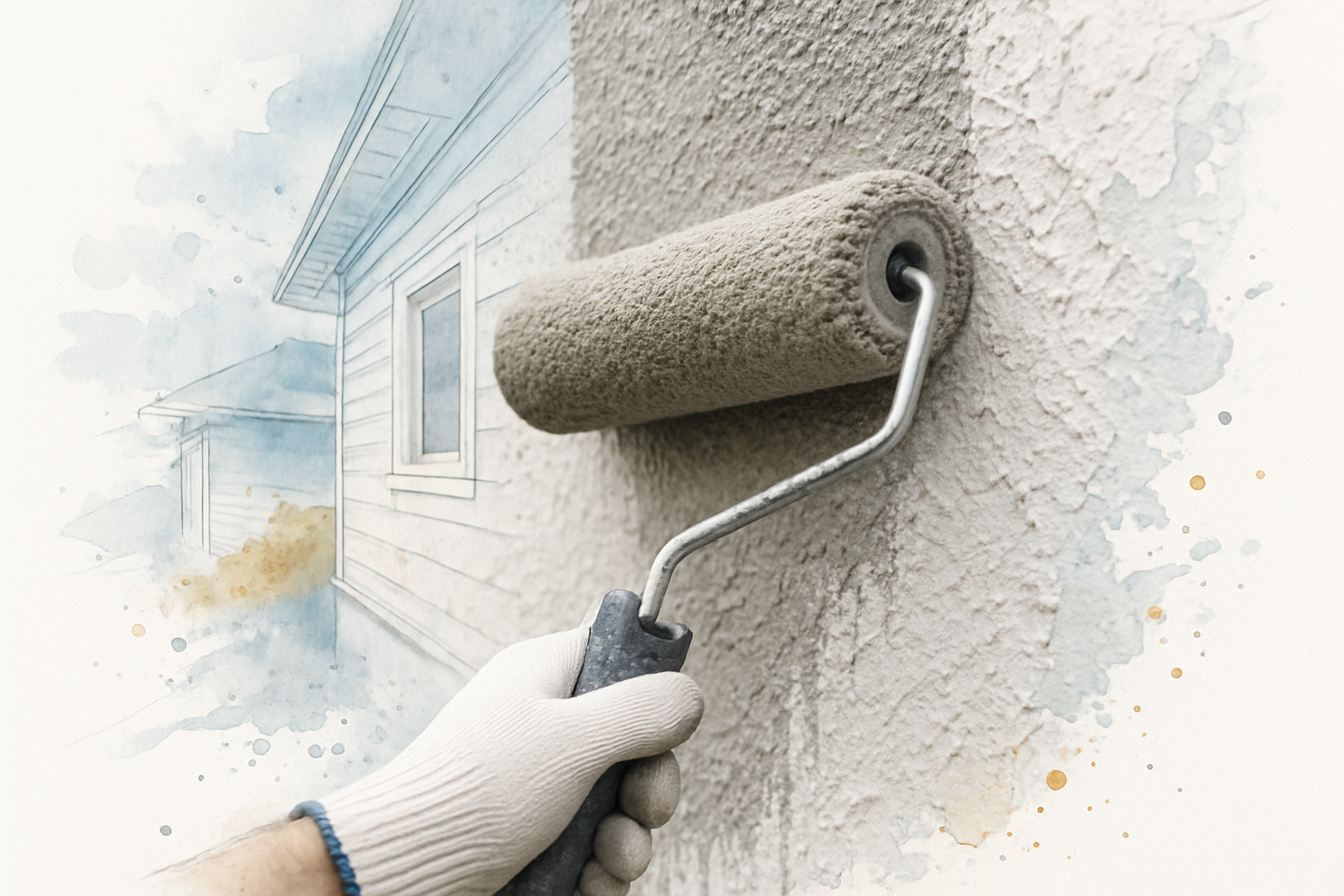
The fix is back-rolling. Someone follows right behind the sprayer with a roller and works the wet coating into the texture, so the film sits even across the whole wall. It is not optional on a coastal stucco house in my opinion, and it is a big part of what makes painting a stucco exterior different on the coast.
So ask every bidder one question: does the stucco get back-rolled? Two proposals that both say “spray applied” can mean completely different work. One is a fast pass. The other is two people working together on the same wall.
Where brush and roll still wins on the Peninsula
Plenty of surfaces get painted by hand simply because masking them properly would take longer than painting them.
On most homes here, that list looks like:
- Window casings and sills
- Door frames, doors, and thresholds
- Eaves, fascia, and rafter tails
- Porch railings, posts, and stair stringers
- Detailed trim and decorative woodwork on older homes
The older housing stock in Pacific Grove and Carmel is where this really shows. One homeowner contacted us about a historic Pacific Grove home they had been renting out and were about to move into. It needed interior and exterior repainting plus help choosing colors.
That kind of house has layered trim profiles, wood shingle, and joints that have moved over a century. Hand work carries the finish there, and there are other differences worth knowing about painting a historic Pacific Grove home.
Trim also fails first on the coast because it takes the most direct sun and moisture cycling. Brushing lets us build a heavier, more even film on those edges, which matters when you understand why trim paint fails faster in coastal homes.
Which Method Fits Which Surface
This is roughly how I sort surfaces on a typical Monterey Peninsula exterior. Every house has exceptions, which is what the walkthrough is for.
| Surface | Usual Method | Why |
|---|---|---|
| Large stucco walls | Spray plus back-roll | Speed with even film thickness in the pores |
| Wood siding or shingle | Spray plus back-brush, or brush and roll | Coating needs to be worked into laps and edges |
| Wall facing a neighbor’s house | Brush and roll | No drift risk onto the adjoining property |
| Trim, casings, and fascia | Brush | Control at edges and a heavier film where sun hits hardest |
| Railings, posts, spindles | Brush | Too many angles to mask; brushing is faster and cleaner |
| Doors and garage doors | Spray if removable or well contained, otherwise brush and roll | Smooth finish matters, but containment decides it |
| Eaves and soffits | Spray with heavy masking, or brush | Overhead spray drifts more than people expect |
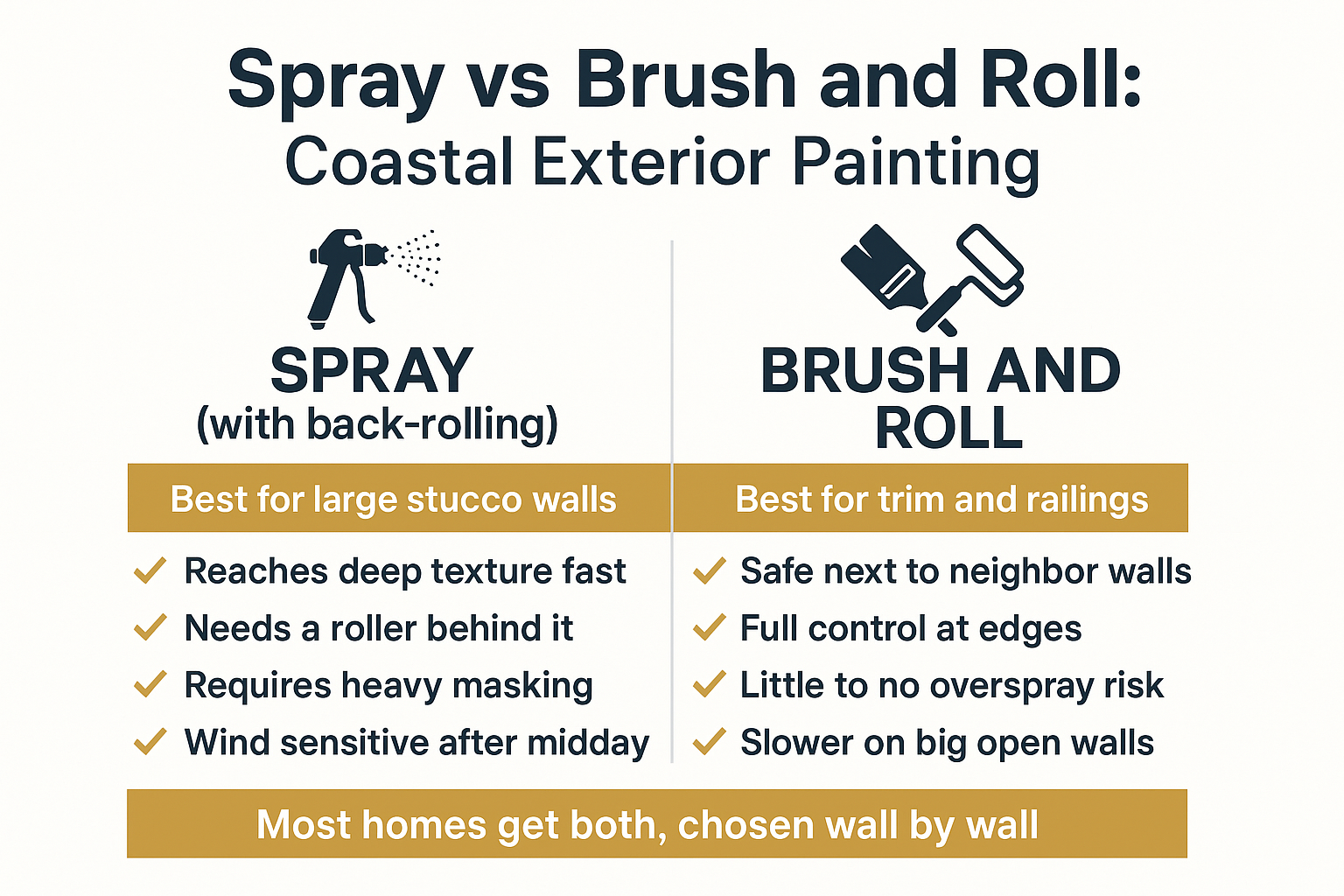
How the Two Methods Compare on a Coastal Home
A quick side by side look at what each method gives you and where each one falls short on a Monterey County exterior.
Monterey’s daily weather rhythm decides the sequence
This is where local knowledge separates a real answer from a generic one.
Onshore wind off the bay tends to be calm in the morning and builds through the afternoon. Anyone who has watched a flag in Pacific Grove at 8 a.m. and then at 3 p.m. knows the difference.
Airborne spray travels farther than most homeowners picture. A light breeze that barely moves a drop cloth can carry fine mist a couple of houses down. So a sensible plan often looks like this:
- Spray the protected or downwind elevation early, while the air is still
- Back-roll immediately behind the spray pass
- Move to hand work on the exposed elevation as the wind picks up
- Save trim, railings, and detail work for the windier part of the day
The marine layer matters just as much. A north or west wall that held fog moisture overnight will not take a sprayed coat any better than a brushed one, so scheduling and method get planned together, not separately. I go deeper on that in this piece on the right time of day to paint a house exterior on the Monterey coast.
If a bidder can walk you through their sequence by elevation and time of day, that tells you something useful about how they work.
The real story behind the method is masking and containment
Here is what surprises people: spraying is not actually faster once you count the setup.
Plastic on the windows. Paper on the concrete. Tape lines at every edge. Plants covered. Patio furniture moved. Light fixtures wrapped. On a two-story house, staging and masking can eat more time than the painting itself.
And containment is not just a courtesy. California’s own standards for painting state facilities call for care with spray equipment to prevent overspray and runoff reaching people, plants, waterways, and storm drains, which you can read in the state’s painting requirements in the State Administrative Manual. On the Peninsula, where storm drains empty toward the bay, that is not an abstract concern.
Homeowners judge a crew on this part more than any other. One customer, a retired general contractor, wrote that our crew “kept everything protected and clean, moved exterior furniture and replaced it.” That is the standard, and it applies whether we spray or brush.
Questions worth asking any bidder:
- What exactly gets covered, and for how long?
- How are neighbor vehicles and shared fences handled?
- Where does pressure washing runoff go?
- Who puts furniture and planters back at the end of each day?
- Who is on site if a wind shift means changing the plan mid-morning?
A proposal that answers those is a proposal you can compare. If you want a fuller checklist, see what to ask an exterior painter before you book anyone.
The finish comes from the standard, not the tool
Sprayer, brush, roller. They are all just ways to move coating onto a surface.
What actually decides how a coastal repaint looks in year five is the prep underneath it and whether someone thought carefully about each elevation. Washing, scraping, caulking, priming bare spots, and repairing damaged wood all matter more than which tool touched the wall.
We are a licensed and insured contractor, CSLB #1066829, run by two brothers with more than 20 years of combined Central Coast experience. Our approach leans on high-quality preparation and clear communication about how each side of a house will be handled before anyone opens a bucket.
Frequently Asked Questions About Spray vs Brush and Roll Exterior Painting
Is a sprayed finish better looking than a brushed one?
On smooth surfaces like doors and cabinet faces, spray gives a glassier finish with no brush marks. On stucco, the texture hides brush and roller marks anyway, so the visual difference is small. What you notice years later is film thickness, not tool marks.
Can you paint my house without using a sprayer at all?
Yes. Brush and roll on the whole exterior is completely doable, and it is the right answer for some houses, especially where a wall is attached to a neighbor or the lot is very tight. It takes longer on large open walls, and that shows up in labor time, so mention it during the walkthrough so it is priced into the plan from the start.
Will overspray get on my neighbor’s car or house?
Not if containment is handled properly and the crew watches the wind. On close-set lots we usually hand-apply the shared elevation instead of relying on masking alone. Ask specifically how neighbor vehicles are protected before you sign anything.
Does spraying use more paint than brushing?
It can, depending on equipment and technique, and some of that material goes into the air rather than the wall. But on a coastal repaint, preparation and labor make up the large majority of the cost and paint is the smaller share, so material use is rarely what separates two bids.
How do I compare two bids that both say spray applied?
Look past the word “spray.” Ask whether stucco gets back-rolled, how many coats, what prep is included, which surfaces get hand work, and how masking is handled. Costs vary a lot in Monterey County based on those answers, so an on-site walkthrough is the only way to get an accurate number for your house.
Thinking through an exterior repaint on your own house?
If you are mapping out an exterior project in Salinas, Monterey, Pacific Grove, or Carmel and want a straight answer on how each side of your house would be handled, we are glad to walk it with you. Legacy Painting and Renovating takes estimate requests by phone at (831) 917-0047 or through the contact form at legacypaintingrenovating.com.