Direct Answer: Low-VOC paint contains fewer airborne chemicals than standard paint, but the label isn’t fully regulated, California’s CARB rules set the baseline every paint sold here must meet, and there’s a real spectrum above that.
A homeowner in Monterey recently submitted a question through our contact form asking about ‘non-toxic paint’ for a home she was moving back into after a rental period. She’s not alone, we hear some version of this question regularly, and the answers people get online tend to be either too vague or too alarming to be useful.
The honest answer is that ‘low-VOC’ is a real category, not a marketing invention, but the label means different things depending on which product you’re holding and which room you’re painting. California has some of the most specific regulations in the country on this, which actually helps narrow things down.
This article breaks down what VOCs actually are, what the California regulatory baseline means for you as a homeowner, and when it’s worth going beyond the minimum. I’ll also cover the outdoor side, because the reasons to care about low-VOC exterior coatings on the Monterey Peninsula are a little different than most people expect.
What VOCs Are, and Why the Label Isn’t Binary
VOC stands for volatile organic compound. These are chemicals in paint that evaporate into the air as the product dries, a process called off-gassing. In high enough concentrations, they contribute to indoor air quality problems, and outdoors they play a role in ground-level ozone formation.
The key thing most homeowners don’t realize: ‘low-VOC’ and ‘zero-VOC’ are not the same thing, and neither label means no emissions at all. Low-VOC products contain fewer of these compounds than conventional paint, but they still off-gas while drying. Zero-VOC formulas have trace amounts, typically under 5 grams per liter, but the colorants added at the paint store can push that number up depending on the shade you choose.
So the spectrum looks something like this:
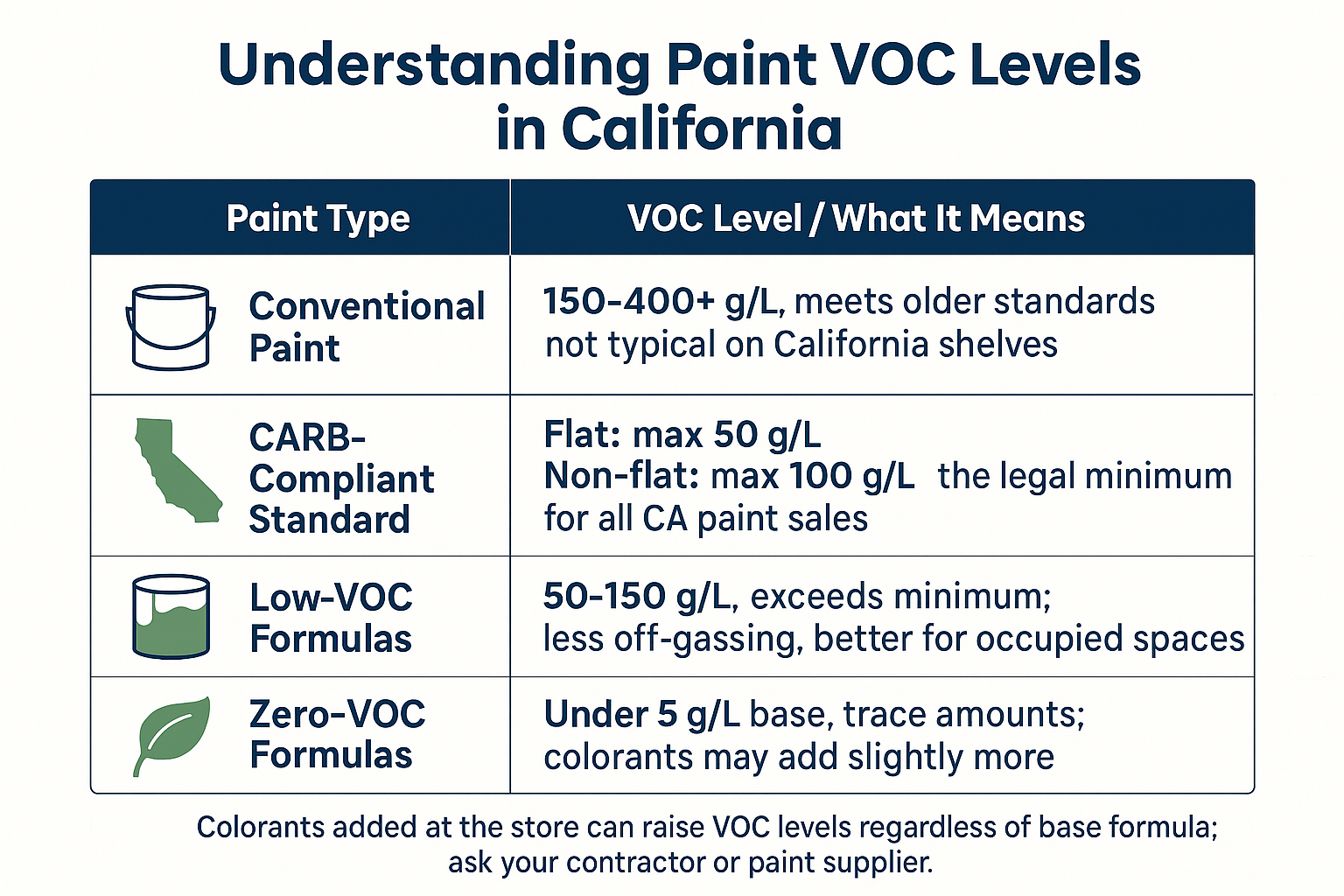
- Conventional paint: Can contain 150-400+ grams of VOCs per liter depending on the product type
- Low-VOC paint: Generally falls in the 50-150 g/L range, though this varies by product category
- Zero-VOC paint: Typically under 5 g/L in the base formula, but colorant can add more
None of these numbers are fixed by the label alone. That’s why understanding California’s CARB regulations matters more than reading the front of the can.
How California’s CARB Rules Actually Affect What’s on the Shelf
The California Air Resources Board (CARB) sets maximum VOC limits for architectural coatings, the paints used on homes. These aren’t voluntary guidelines. Every paint sold in California must meet these standards, which means the baseline here is already stricter than in most other states.
CARB breaks coatings into categories and sets limits for each:
- Interior flat paint: Maximum 50 g/L
- Interior non-flat paint: Maximum 100 g/L
- Primers and sealers: Their own set of limits, often 100-200 g/L depending on type
- Specialty coatings like floor paints or waterproofing formulas have separate categories
What this means practically: if you walk into a paint store in Salinas or Monterey today, everything on the shelf already meets a regulated minimum. You’re not choosing between a compliant and a non-compliant product, you’re choosing between the minimum standard and something formulated specifically to go further.
That distinction matters more than most people think. A paint that hits exactly the CARB floor is very different from one engineered with low-emission performance as a design goal. And the good news for homeowners who’ve held off on eco-friendly formulas because they heard the old generation of low-VOC paints performed poorly, that’s largely changed over the past decade. Today’s high-end low-VOC and zero-VOC paints hold up well in terms of hide, washability, and durability. The performance gap has closed considerably.

When Low-VOC Paint Matters Most Indoors
For most exterior work, VOC content is mostly about regulatory compliance and product engineering. But for interior painting, it has a direct impact on the people inside the house, and that’s where I’d encourage homeowners to pay the most attention.
The rooms where it matters most:
- Nurseries and children’s bedrooms, children breathe more air relative to body weight and spend long hours in these rooms
- Bedrooms where someone has a respiratory condition, asthma, allergies, and chemical sensitivities are all real factors
- Poorly ventilated spaces, small bathrooms, interior hallways, and rooms that don’t get much airflow hold off-gassed compounds longer
- Homes moving from rental back to owner-occupancy, when walls haven’t been freshly painted in years, a full repaint means more product, more off-gassing, and a longer air-clearing period
A homeowner who reaches out about repainting a rented property before moving back in has every reason to ask about low-VOC options. When we’re working in these situations, we often recommend opening windows and running fans for at least 48-72 hours after the final coat, not because the paint is dangerous, but because good ventilation accelerates the off-gassing process significantly and gets you back to normal air quality faster.
Re-occupancy timing is one of the most commonly asked questions on interior jobs. A zero-VOC or high-quality low-VOC product in a well-ventilated space can reach comfortable re-occupancy within 24 hours for most adults. For a nursery or a space with limited airflow, I’d recommend giving it a full 48-72 hours if you can. The paint manufacturer’s technical data sheet will have specific guidance, and that’s worth reading before you or your contractor commits to a product.
For more on how we think about interior painting in the context of occupied homes, our guide on living in your home during a full renovation covers a lot of the practical scheduling questions.
The VOC Spectrum: From Conventional to Zero-Emission
This breakdown shows where common paint types fall on the VOC scale and what each level means for indoor air quality and California compliance.
Low-VOC Paint at a Glance: Indoor vs. Outdoor Priorities
The reasons to choose a low-VOC or CARB-optimized coating indoors are different from the reasons to care about it on exterior surfaces. Here’s a quick side-by-side.
| Factor | Interior Application | Exterior Application |
|---|---|---|
| Primary concern | Indoor air quality and re-occupancy | Environmental compliance and durability |
| Who it affects most | Children, pets, respiratory conditions | Ozone/air quality regulations; coastal performance |
| California baseline | CARB limits apply to all interior coatings | CARB limits apply to all exterior coatings |
| Ventilation role | Critical, speeds off-gassing after painting | Less relevant, open air disperses quickly |
| Product performance | High-end low-VOC = comparable to conventional | CARB-compliant formulas often engineered for climate durability |
| When to go beyond minimum | Nurseries, sensitive occupants, poor ventilation | Coastal exposure, wood substrates, long recoat intervals |
Why It Also Matters for Exterior Painting on the Monterey Coast
The outdoor angle on low-VOC paint gets less attention, but it’s worth understanding, especially here on the Peninsula.
For exterior coatings, the main reason CARB compliance matters is environmental, not respiratory. Off-gassed VOCs from exterior surfaces contribute to ground-level ozone, and California regulates this carefully. Every licensed contractor working in Monterey County is required to use CARB-compliant exterior products. That’s not a choice, it’s the law.
But there’s something beyond compliance worth knowing. Manufacturers formulating specifically for the California market have had to engineer products that perform within tighter VOC limits. Many of the top-performing exterior coatings available in Salinas or Monterey today are low-VOC by design, and they’ve been developed to handle the conditions that coastal climates throw at them.
Marine layer humidity, salt air, and the fog-to-sun cycles that run through most of Monterey’s spring and summer are hard on paint. What Monterey’s coastal climate does to exterior paint over time is its own topic, but the short version is that substrate prep and coating selection are both shaped by these conditions. A contractor who knows which CARB-compliant products perform best in coastal environments is doing more than following the rules. They’re making a choice that affects how long the paint lasts.
On stucco exteriors especially, which are common throughout Monterey and Pacific Grove, a properly formulated, flexible low-VOC coating handles thermal movement better than an older high-VOC formula would. That flexibility matters when the temperature swings between a cold morning fog and a warm afternoon in the same day.
How to Actually Use This When You’re Choosing Paint
A few practical takeaways for homeowners going into a painting project:
For interior painting:
– Ask your contractor which product they plan to use and what the VOC content is, they should know
– If you have a nursery, a family member with respiratory sensitivities, or a space with limited ventilation, request a zero-VOC or specifically low-emission formula
– Plan for at least 48-72 hours of ventilation after the final coat in sensitive spaces
– Keep in mind that colorants added at the mixing counter can push VOC levels up, ask about this if you’re choosing a deep or saturated color
For exterior painting:
– CARB compliance is already the floor, you’re not getting a non-compliant product from a licensed contractor
– Ask about which exterior formulas hold up best in coastal conditions, this is where product knowledge and local experience actually matter
– If your exterior has a wood substrate, why outdoor wood stain fails faster on the Monterey coast is a good read before your estimate
For historic homes in Pacific Grove or Carmel, there’s an additional layer, older paint layers, lead paint concerns, and surface prep requirements all affect which modern coatings are appropriate. Painting a historic Pacific Grove home covers that process in more detail.
And if you’re not sure what questions to ask before you book anyone, what to ask an exterior painter before you book is a good starting point.
Frequently Asked Questions About Low-VOC Paint
Is ‘non-toxic paint’ the same as low-VOC or zero-VOC paint?
Not exactly. ‘Non-toxic’ isn’t a regulated term, any manufacturer can put it on a label. Low-VOC and zero-VOC refer to measured compound levels and have more meaning in practice. In California, all paints must meet CARB limits, so the baseline is already regulated. If you’re concerned about air quality for a specific room or occupant, asking for the VOC content in grams per liter is more useful than looking for a ‘non-toxic’ claim.
How long do I need to stay out of a room after painting with low-VOC paint?
For most healthy adults, a freshly painted room with a high-quality low-VOC formula is comfortable after 24 hours with good ventilation. For a nursery, a space where someone has asthma or chemical sensitivities, or a room with limited airflow, I’d give it 48-72 hours and run fans to pull fresh air through. Zero-VOC products typically off-gas faster, but ventilation matters more than the product choice alone.
Do zero-VOC paints perform as well as conventional paint?
Yes, for most residential applications. The earlier generation of low-emission paints, from roughly 10-15 years ago, did sometimes sacrifice washability and hide. That’s mostly no longer true with quality products from major manufacturers. High-end zero-VOC interior paints now hold up well in kitchens, bathrooms, and high-traffic hallways. The key is choosing a reputable product, not just a label.
Does adding colorant to a zero-VOC base change the VOC level?
Yes, it can. The colorant pastes used at the mixing counter often contain their own VOC compounds. A zero-VOC base with a deep or custom color added may end up in the low-VOC range after tinting. If this matters for your project, ask the paint supplier or your contractor specifically about low-VOC colorant systems, some manufacturers offer them.
Are all California exterior paints already CARB-compliant?
Yes, if a product is sold legally in California, it meets CARB’s VOC limits for its coating category. Every licensed contractor in Monterey County is using CARB-compliant products by default. The relevant question for exterior work isn’t compliance, it’s which compliant products are best suited to coastal conditions like salt air, marine layer humidity, and sun exposure.
What’s the difference between a paint that meets the CARB minimum and a specifically low-emission formula?
The CARB minimum is a floor, not a standard of excellence. A product formulated specifically for low emissions is engineered with that goal across the entire formula, not just reduced to pass a threshold. For most standard rooms, the difference in air quality is modest. For a nursery, a rental home you’re moving back into, or a space with poor ventilation, choosing a product that goes beyond the minimum is worth the conversation with your contractor.
Have Questions About Paint Selection for Your Monterey Home?
If you’re planning an interior or exterior paint project and want to talk through coating options, VOC levels, or what actually holds up in the Monterey County climate, Legacy Painting and Renovating is happy to walk through the specifics during an estimate. You can reach us at (831) 917-0047 or through the contact form at legacypaintingrenovating.com.