Direct Answer: Test large painted sample boards on every side of your house, checking them in morning fog, midday sun, and late afternoon. Fog light mutes warm tones, so colors read cooler and flatter than they will by noon.
You have three swatches taped up near the front door and you have been circling them for a week. You keep walking outside, squinting, and changing your mind. That is not indecision on your part.
On the Monterey Peninsula, the light genuinely changes twice a day. A color that looks perfect at 8 a.m. under the marine layer can read like a completely different paint at 2 p.m. once the fog burns off.
I have watched homeowners fall in love with a soft greige in the morning and then stand in their driveway in June wondering why the house looks blue. Below is how fog light works, a weekend test that shows you the full range before the sprayer comes out, and why color choice on this coast is also a durability decision.
Why Fog Light Changes the Color You Picked
Fog light is flat and cool. There is no direct sun angle, no warm cast, and very little contrast between a lit surface and a shaded one. That does three predictable things to exterior color.
- Warm undertones disappear. A greige with a tan base goes cold and gray.
- Grays pick up blue. Any gray with a cool base leans noticeably bluer than the chip suggested.
- Soft whites look chalky. Without sun to warm them, creamy whites flatten out and read dusty.
Then the marine layer lifts, often somewhere around late morning, and the same wall can swing several shades warmer and lighter. Deep colors look less deep. Light colors can go bright enough to bounce glare off a west wall.
This is why choosing a color indoors under a showroom light is the single worst way to do it. Store lighting is warm and steady, and nothing about your house is. Our coastal weather shapes more of a paint project than most people expect, which I get into further in how Monterey’s climate actually shapes a house painting project.
So the goal is not to find a color that looks good once. It is to find one you can live with across both versions of the day.
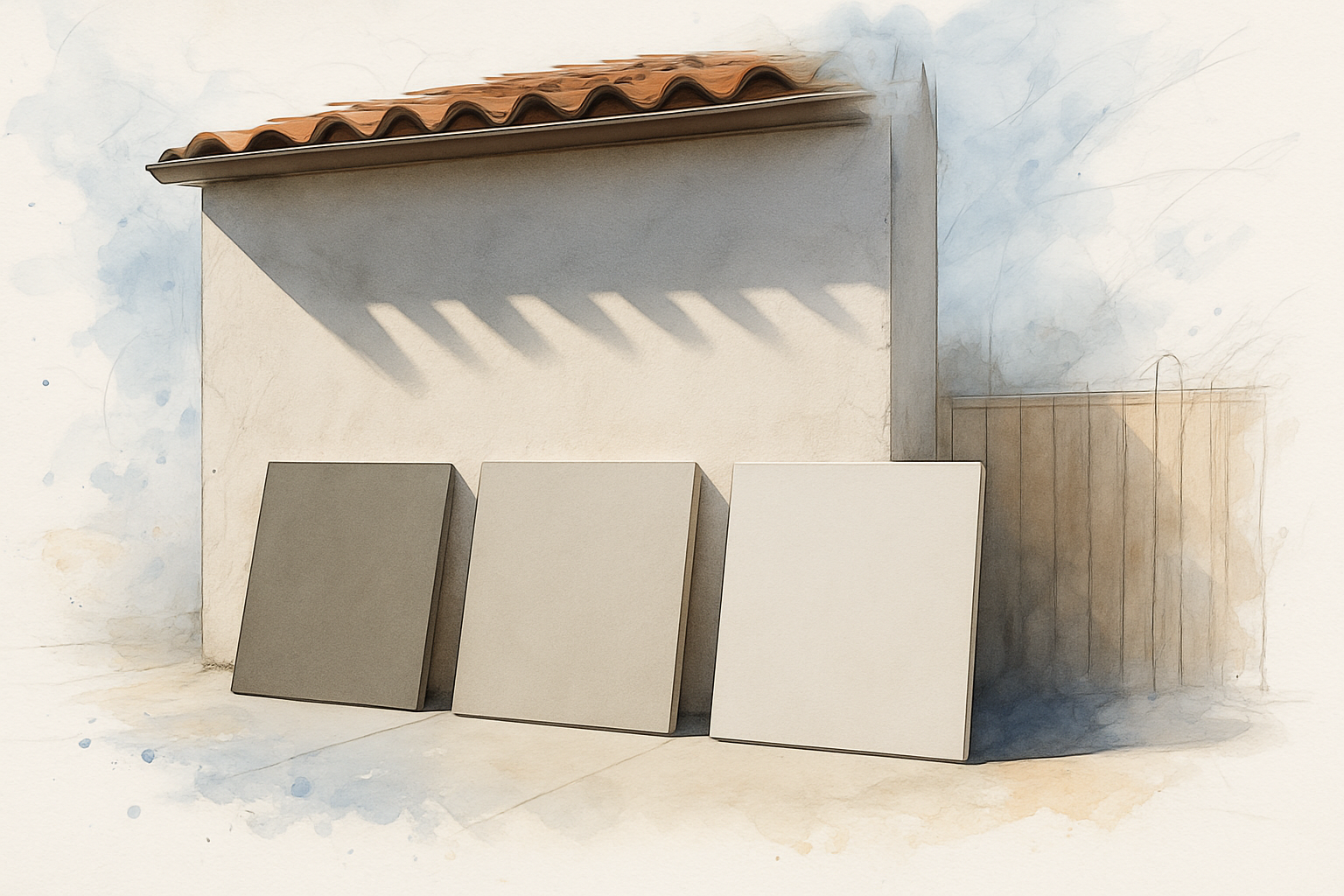
The Sample Board Test: One Weekend, No Regret
Taping a two inch paper chip to your siding tells you almost nothing. The surrounding color swallows it, and the chip is too small to show how the color behaves over a full wall.
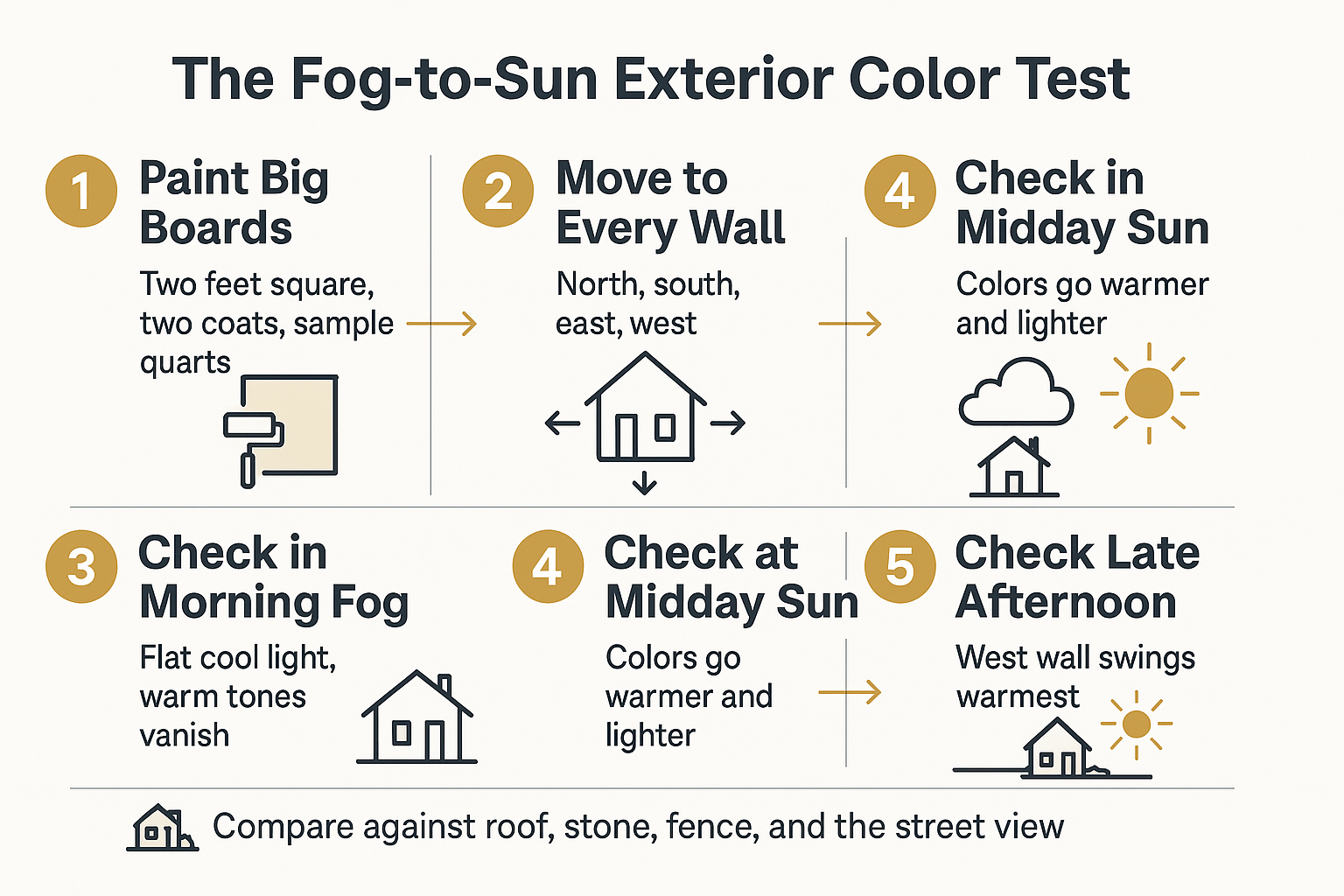
Here is what I tell homeowners to do instead. Buy sample quarts of your top two or three colors and paint large boards, at least two feet square. Primed hardboard or a scrap of the same siding material works. Two coats, let them cure.
Then move them around:
- Lean one against each elevation of the house, north, south, east, and west.
- Check them three times: early in the fog, around midday with sun on the wall, and late afternoon.
- Hold them next to the things that are not changing, meaning the roof, the stone, the fence, the window frames, and yes, the neighbor’s house.
- Step back to the sidewalk. Most people only ever judge color from three feet away.
The north wall and the ocean-facing wall will almost never match. North elevations stay in cool indirect light most of the day, so they hold the fog version of the color. A west wall facing the water gets hammered with warm afternoon light and will look like a different paint by 4 p.m.
Sample quarts and a few boards are a small spend, often well under a hundred dollars for three colors depending on the product. Against a full exterior repaint, it is the cheapest insurance in the project.
The Fog-to-Sun Color Test, Step by Step
Here is the whole test in five steps, the way I walk homeowners through it before a bid.
On This Coast, Color Is Also a Durability Decision
Almost nobody talks about this part locally, and it matters more here than inland. Color affects how long your paint job looks like the color you picked.
UV radiation breaks down pigment over time, and some pigment families give up faster than others. A major coatings manufacturer lays this out plainly in its guidance on fading exterior paint color, noting that bright blues, reds, and yellows are the most vulnerable and that darker colors and coastal conditions speed the process up.
Now add what the bay sends at your house. Salt carried in on the wind, moisture from the marine layer most mornings, then direct sun in the afternoon. That cycle of wet and dry with salt sitting on the surface accelerates chalking, the powdery film that shows up on south and west elevations first.
I am not telling you to play it safe. I am telling you where bold is a good bet and where it will cost you.
- Good bets for saturated color: a front door under a covered porch, shutters, trim tucked under a deep eave, a north-facing accent wall.
- Expensive bets: a deep body color on a two story west wall facing the water, or a dark red on a fully exposed south elevation.
Trim takes the worst of it either way, which is why it tends to fail first. I covered that pattern in detail in why trim paint fails faster in coastal homes.
Fade Risk by Color Family on a Peninsula Exterior
This is a general guide, not a rule. Quality of the coating and the exposure of the wall both move these outcomes.
| Color family | Fade risk in coastal sun | Where it holds up best |
|---|---|---|
| Bright reds and oranges | High | Shaded entry doors, covered porch accents |
| Strong blues | High | Shutters, north elevations, protected trim |
| Saturated yellows | High | Small accent areas under eaves |
| Deep charcoals and near-blacks | Moderate to high | North and east walls, single story homes |
| Mid-tone grays and greiges | Moderate | Most elevations, including west walls |
| Soft whites and warm neutrals | Low | Full body color anywhere, including two story exposures |
Pacific Grove Light Is Not Carmel Valley Light
People say “the coast” like it is one climate. A few miles changes the whole equation.
- Pacific Grove and Seaside sit under fog most mornings through the summer. Colors here spend a big share of their life in cool flat light, so warm undertones are worth keeping in the mix.
- Carmel Valley gets long hours of direct sun and real heat. Deep colors fade faster there than they would two ridges over.
- Salinas is driven by inland heat rather than marine layer. Surface temperature, not fog, is the thing that shapes both color behavior and when the crew can safely apply paint.
- Marina and newer neighborhoods have a different streetscape entirely than a block of 1920s cottages.
That last one matters more than people expect. A good share of the housing in Pacific Grove and Carmel predates 1950, and a color that sits right on a historic cottage street will look off on a newer home a few miles north.
If your home sits in a historic district, there may be a review step before you commit to a palette. I would call your city planning department and ask directly rather than assume. For what else changes on those houses, see painting a historic Pacific Grove home.
One more local note. Homes built before 1978 trigger EPA lead-safe work practices during prep, which affects scope and schedule more than color does.
Write the Formula Down Before the Crew Packs Up
This is the step almost everyone skips, and it is the one that bites later. You will patch a wall, replace a door, or get drywall work done, and you will need that exact color again.
Color matching off a dried exterior wall years later is never perfect. The surface has already weathered, chalked slightly, and shifted. A scanner reads the weathered version, not the original.
Take five minutes at the end of the job and record:
- Brand and product line of the paint
- Color name and code
- Base and the full tint formula from the can label
- Sheen for body, trim, and doors separately
- Which color went where, written out room by room or wall by wall
- Store and date of purchase
Photograph the can labels, email the photos to yourself, and tape a printed copy inside a utility closet door. One homeowner wrote to us asking about retouching paint to match their original interior color, and that is a much easier conversation when the formula still exists.
It also helps to know how the paint went on in the first place, since sheen and application method change how a touch-up blends. That is the subject of spray, brush, or both on a coastal home.
Frequently Asked Questions About Exterior Color on the Monterey Coast
How long should I leave sample boards up before deciding?
At least a full weekend, and ideally longer if the weather is doing something unusual. You want to see the color on a foggy morning and on a clear sunny afternoon. During a solid stretch of marine layer in June, give it a week so you catch at least one bright day.
Will a lighter color really last longer than a dark one here?
Generally yes. Lighter colors use less pigment load and reflect more UV, so they hold their appearance longer on exposed walls. Dark and saturated colors are not off limits, they just tend to show fade sooner on south and west elevations that catch the afternoon sun off the bay.
Does my stucco or shingle siding change which colors work?
It changes how the color reads more than which colors work. Texture creates tiny shadows, so a color on rough stucco looks slightly deeper and more muted than the same color on smooth fiber cement. Always test on a board that matches your surface if you can.
Can I just match my neighbor’s color since I like it?
You can get the formula, but expect it to look different on your house. Orientation, siding texture, roof color, and how much tree cover you have all shift the result. Paint a board and set it against your own walls before committing.
Do I need approval from the city for an exterior color?
It depends on where you are and whether the property sits in a historic district. Some Peninsula neighborhoods have a review process and others do not. Call your city planning department before you order paint rather than after.
Thinking Through an Exterior Color for Your Monterey County Home?
Color help is part of how we work rather than something left entirely on the homeowner, and we keep a record of what went on the wall. One Monterey County customer put it this way in a review: “Not only did they give me the name of the paint color, they also called it in to the paint store.” If you want to talk through a palette or walk the house with someone who has watched these colors shift from fog to sun for years, Legacy Painting and Renovating offers free on site estimates at (831) 917-0047 or through the contact form at legacypaintingrenovating.com.